10 Supreme Court Judgments Every UPSC Aspirant Must Know: UPSC Prep Essentials
Introduction
The Supreme Court of India is not merely an interpreter of the Constitution; it is a constitutional guardian, social reformer, and policy shaper. Over the decades, landmark judgments delivered by the apex court have expanded fundamental rights, strengthened federalism, upheld democratic values, and ensured social justice.
For UPSC aspirants, Supreme Court judgments are high-yield areas for:
- Prelims factual questions
- GS-II polity & governance answers
- Essay enrichment
- Ethics case studies (GS-IV)
This article explains 10 must-know Supreme Court judgments in a clear, exam-oriented, and analytical manner.
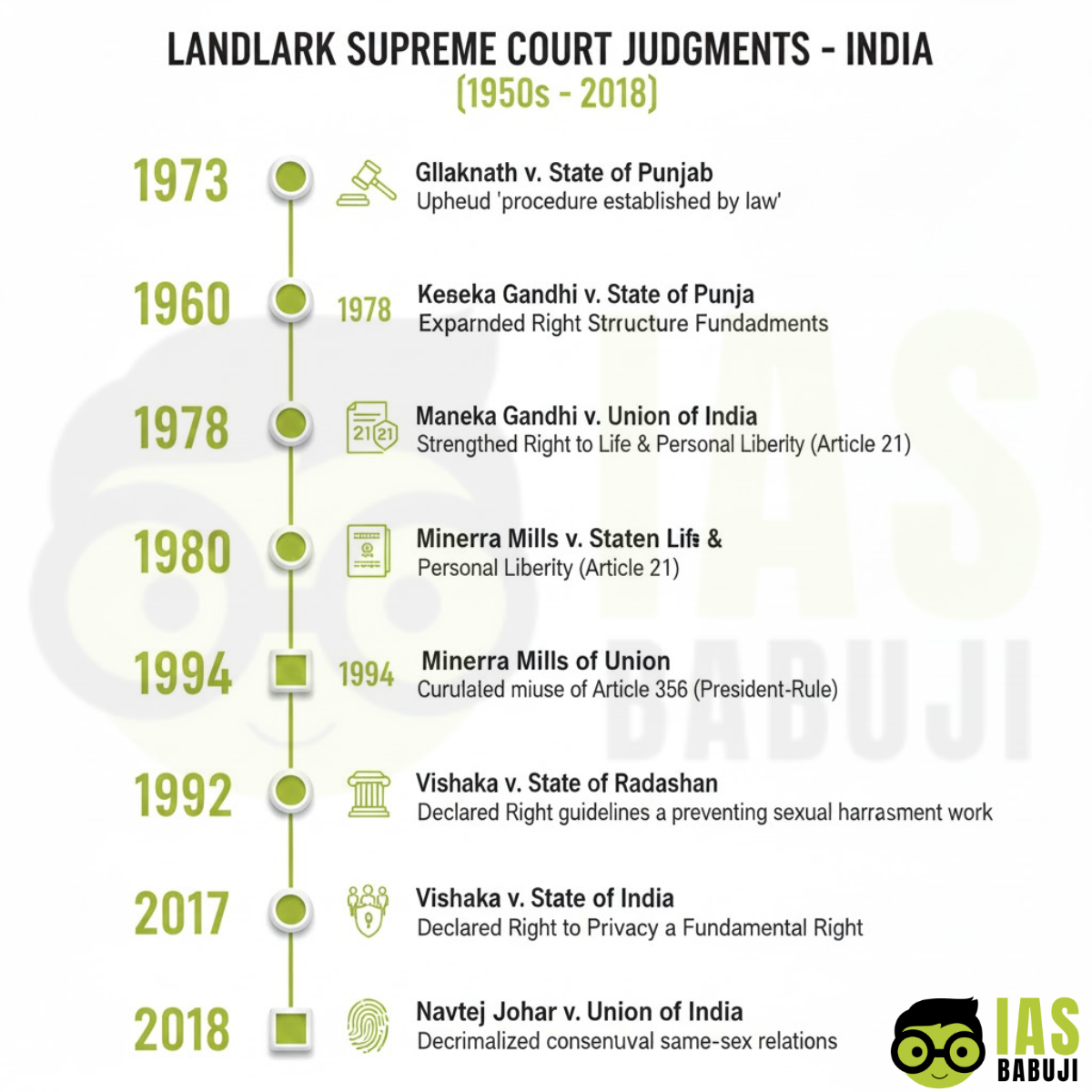
Kesavananda Bharati Case (1973) – Basic Structure Doctrine
Background
Kesavananda Bharati Case (1973) arose from a conflict between Parliament’s amending power under Article 368 and the citizens’ fundamental rights.
Supreme Court Verdict
- Parliament can amend the Constitution
- BUT cannot alter its “Basic Structure.”
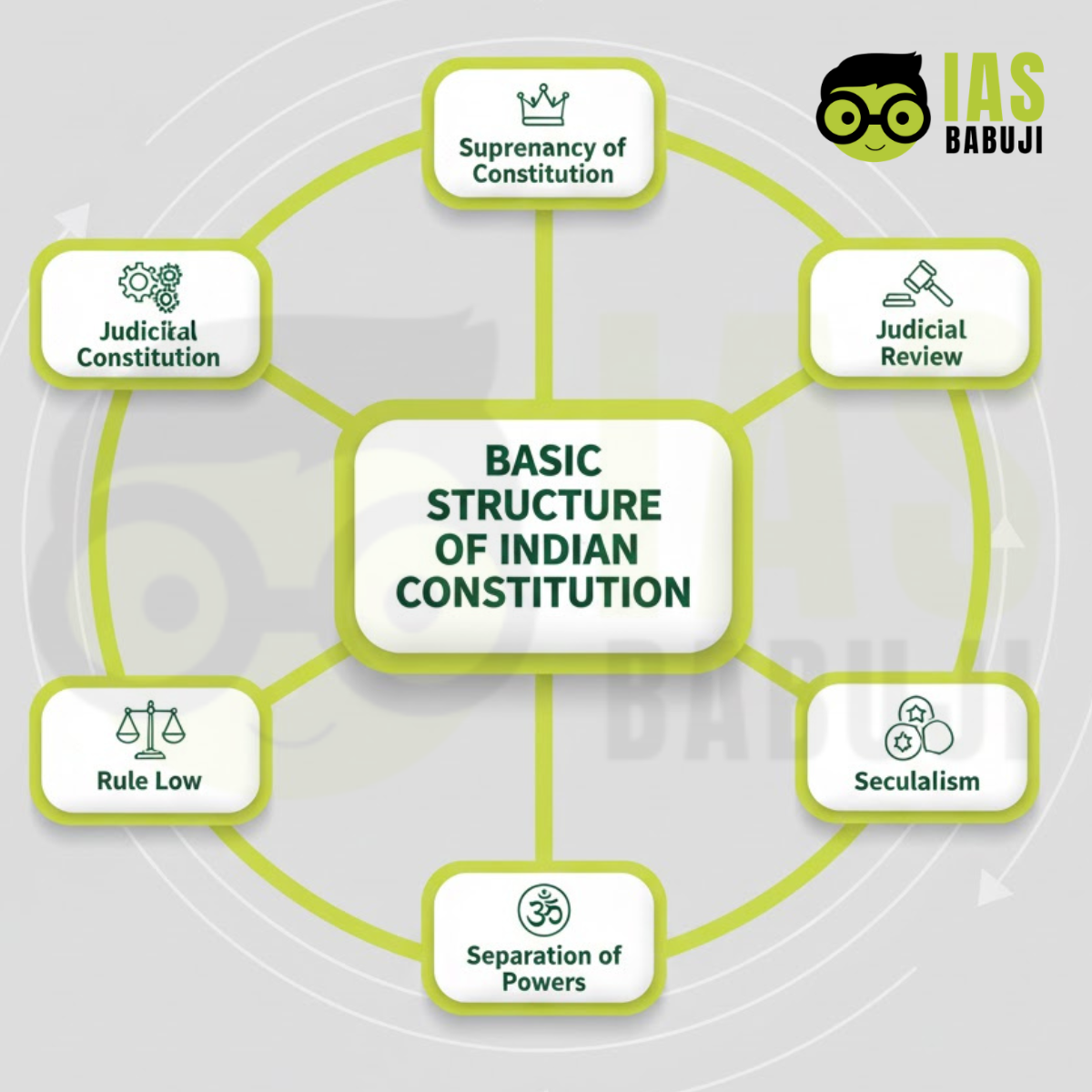
Key Elements of Basic Structure
- Supremacy of the Constitution
- Separation of powers
- Judicial review
- Federalism
- Secularism
UPSC Relevance
- Most cited case in Polity answers
- Frequently asked in Prelims
- Foundation of constitutional supremacy
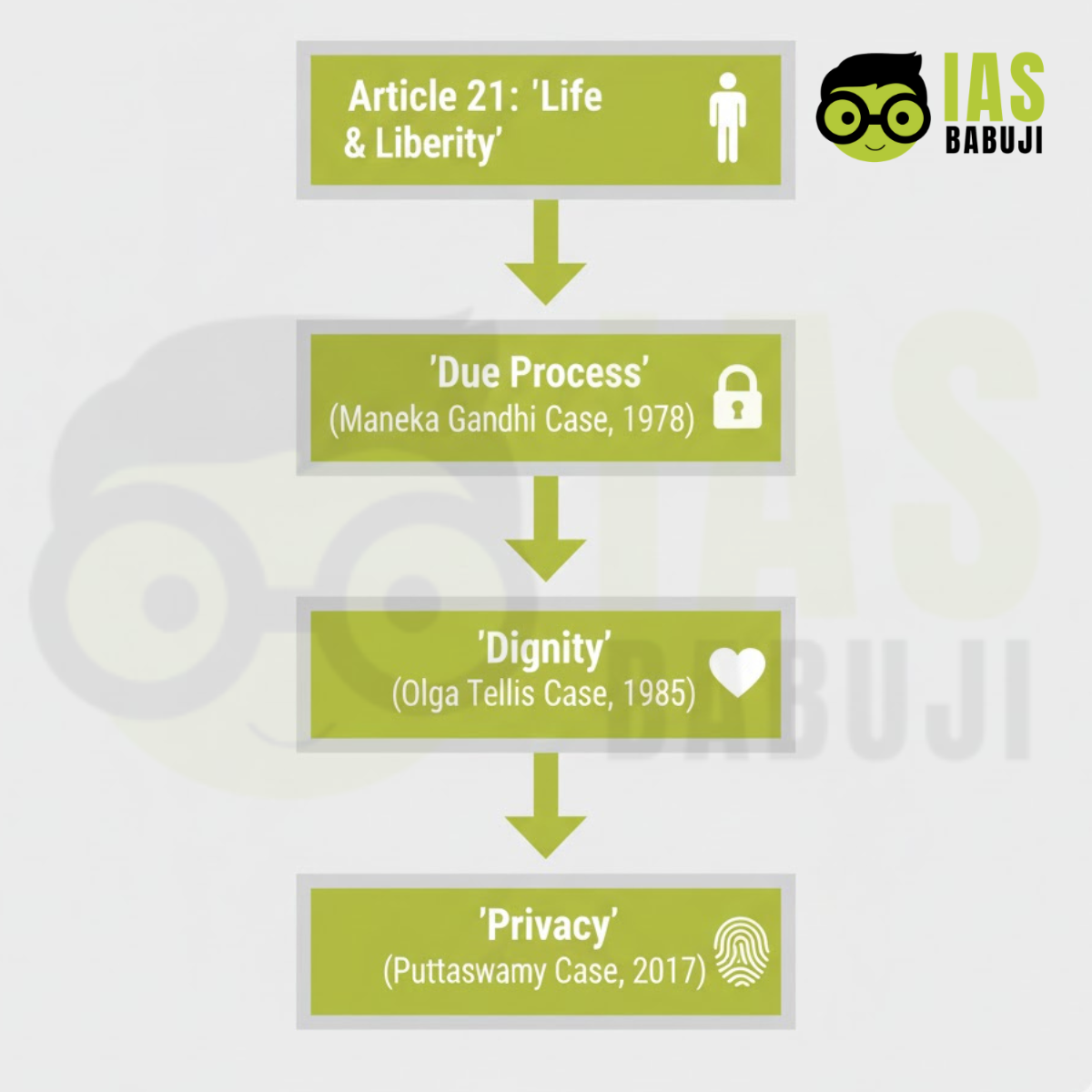
Maneka Gandhi Case (1978) – Expansion of Article 21
Background
Maneka Gandhi Case (1978): Maneka Gandhi’s passport was impounded without giving reasons.
Supreme Court Verdict
- Right to Life = Right to live with dignity
- A procedure established by law must be just, fair, and reasonable
- Articles 14, 19, and 21 are interlinked
Impact
- Expanded scope of personal liberty
- Foundation of human rights jurisprudence in India
UPSC Relevance
- Core GS-II topic
- Frequently used in Ethics & Essay
Golaknath Case (1967) – Fundamental Rights Are Inviolable
Supreme Court Verdict
- Parliament cannot amend Fundamental Rights
(Later partially overturned by Kesavananda Bharati)
Significance
- Strengthened Fundamental Rights
- Led to the evolution of the Basic Structure Doctrine
UPSC Angle
- Understanding constitutional evolution
- Useful in comparative analysis questions
Indira Nehru Gandhi v. Raj Narain (1975) – Rule of Law
Background
Challenged the election of Prime Minister Indira Gandhi.
Supreme Court Verdict
- Struck down Article 329A
- Declared Rule of Law as part of Basic Structure
Significance
- Judiciary asserted independence during the Emergency era
- Strengthened democratic values
UPSC Relevance
-
Democracy, elections, constitutional morality
Minerva Mills Case (1980) – Limited Amending Power
Supreme Court Verdict
- Parliament’s amending power is limited
- Balance between Fundamental Rights and DPSPs
Key Principle
“The Constitution is founded on harmony, not conflict.”
UPSC Use
- GS-II answers on constitutional balance
- Direct Prelims questions possible
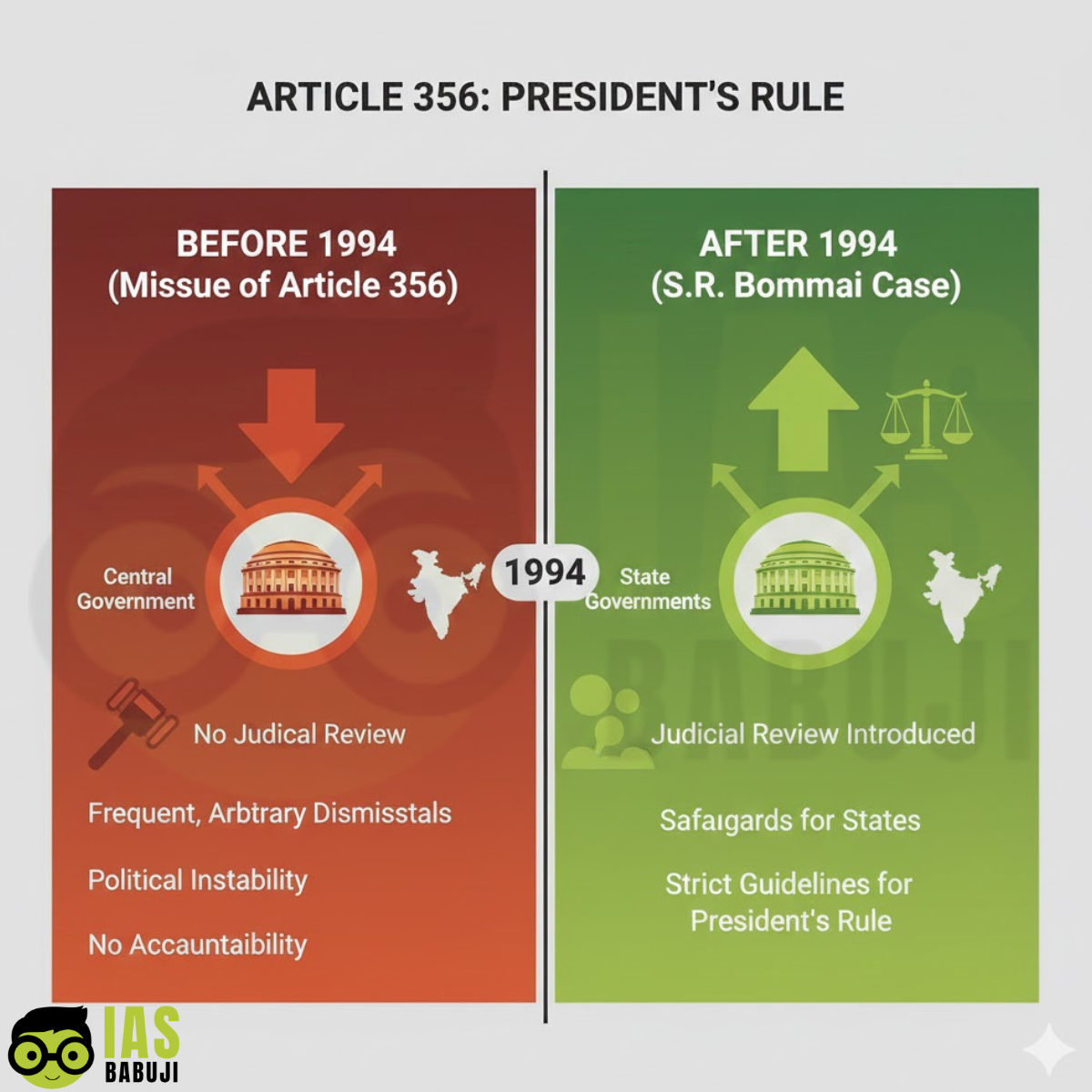
S.R. Bommai Case (1994) – Federalism & President’s Rule
Supreme Court Verdict
- Imposed strict conditions on Article 356
- The majority will be tested on the floor of the House
- Federalism is part of the Basic Structure
Impact
- Reduced misuse of the President’s Rule
- Strengthened state autonomy
UPSC Relevance
- Federalism, Centre-State relations
- Highly relevant for Mains
Vishaka Case (1997) – Sexual Harassment Guidelines
Supreme Court Action
- Issued Vishaka Guidelines in the absence of legislation
- Based on the CEDAW international conventions
Outcome
-
Foundation of POSH Act, 2013
UPSC Relevance
- Social justice
- Judicial activism
- Women empowerment
Puttaswamy Case (2017) – Right to Privacy
Supreme Court Verdict
- Right to Privacy is a Fundamental Right
- Integral to Article 21
Implications
- Affects Aadhaar
- Data protection laws
- Surveillance debates
UPSC Angle
- Digital rights
- Ethics, governance, technology
Navtej Singh Johar Case (2018) – LGBTQ+ Rights
Supreme Court Verdict
- Decriminalized consensual same-sex relations
- Struck down Section 377 (partially)
Constitutional Values
- Equality
- Dignity
- Individual autonomy
UPSC Relevance
- Society & ethics
- Human rights discourse
Shayara Bano Case (2017) – Triple Talaq
Supreme Court Verdict
-
Declared instant triple talaq unconstitutional
Significance
- Gender justice
- Reform within personal laws
UPSC Use
- GS-I society
- GS-II governance & minority rights
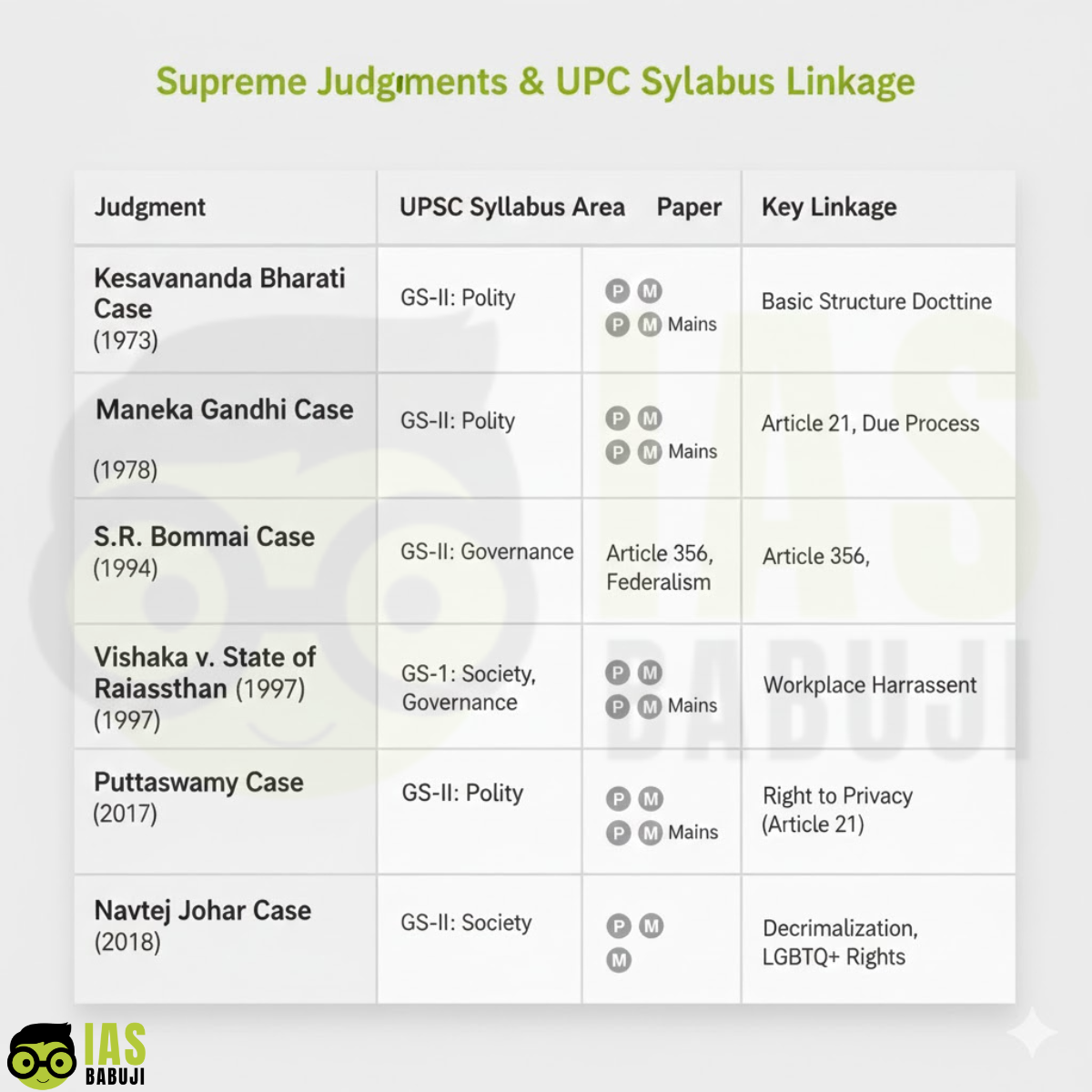
Why These Judgments Matter for UPSC
- Frequently linked with current affairs
- Used as examples in Mains answers
- Demonstrate constitutional philosophy
- Help in answer enrichment
Conclusion
The Supreme Court of India has played a decisive role in shaping the constitutional and democratic framework of the country. Through its landmark judgments, the Court has expanded the scope of Fundamental Rights, strengthened federalism, upheld the rule of law, and ensured social justice. These decisions reflect the evolving interpretation of the Constitution in response to changing social, political, and technological realities.
For UPSC aspirants, Supreme Court judgments are not merely legal precedents but essential tools for enriching answers in Prelims, Mains, and Essays. A clear understanding of the context, constitutional principles, and long-term impact of these rulings helps in presenting balanced and well-substantiated arguments. Rather than rote memorisation, aspirants should focus on analytical application and linkage with current affairs. Mastering landmark judgments enables candidates to demonstrate constitutional awareness, critical thinking, and governance insight—key attributes expected of future civil servants.
FAQs on 10 Supreme Court Judgments Every UPSC Aspirant Must Know
Q1. Which Supreme Court judgment is most important for UPSC?
Kesavananda Bharati Case (1973) due to the Basic Structure Doctrine.
Q2. Are Supreme Court judgments asked directly in Prelims?
Yes, especially landmark cases related to Fundamental Rights and federalism.
Q3. How should judgments be used in Mains answers?
As constitutional backing, examples, and to support arguments.
Q4. Is it necessary to remember case years?
Yes, especially for Prelims and answer credibility.
Q5. How many judgments should an aspirant prepare?
At least 20–25 landmark judgments across Polity, Society, and Governance.