• Home
  • Exam Details
  • Strategy
  • Books
  • Current Affairs
  • Contact Us
IAS Babu Ji
Advertise With Us!
  • Home
  • Exam Details
  • Strategy
  • Books
  • Current Affairs
  • State PSC Exams
  • About Us
No Result
View All Result
  • Home
  • Exam Details
  • Strategy
  • Books
  • Current Affairs
  • State PSC Exams
  • About Us
No Result
View All Result
IAS Babu Ji
No Result
View All Result
Home UPSC Study Material Indian Polity

Kesavananda Bharati Case (1973)

by editorialteam
in Indian Polity
Reading Time: 5 mins read
0
Kesavananda Bharati Case (1973)

Kesavananda Bharati Case (1973)

Share on FacebookShare on WhatsAppShare on Twitter

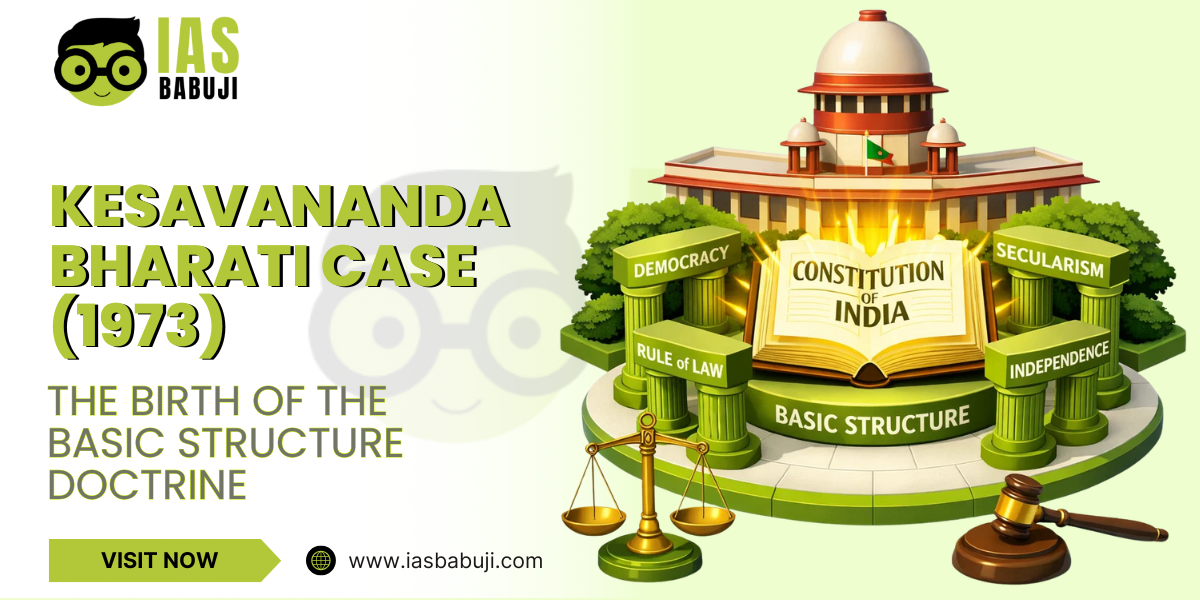
Kesavananda Bharati Case (1973): The Birth of the Basic Structure Doctrine

Introduction

The Kesavananda Bharati v. State of Kerala (1973) judgment is regarded as the most important constitutional case in Indian history. It decisively settled the conflict between Parliament’s power to amend the Constitution and the Supreme Court’s role as guardian of constitutional values. By propounding the Basic Structure Doctrine, the Supreme Court ensured that while the Constitution may evolve, its core principles remain inviolable.

For UPSC aspirants, this case is a foundational pillar of Indian Polity, frequently cited in Prelims, GS-II Mains answers, and Essay papers.
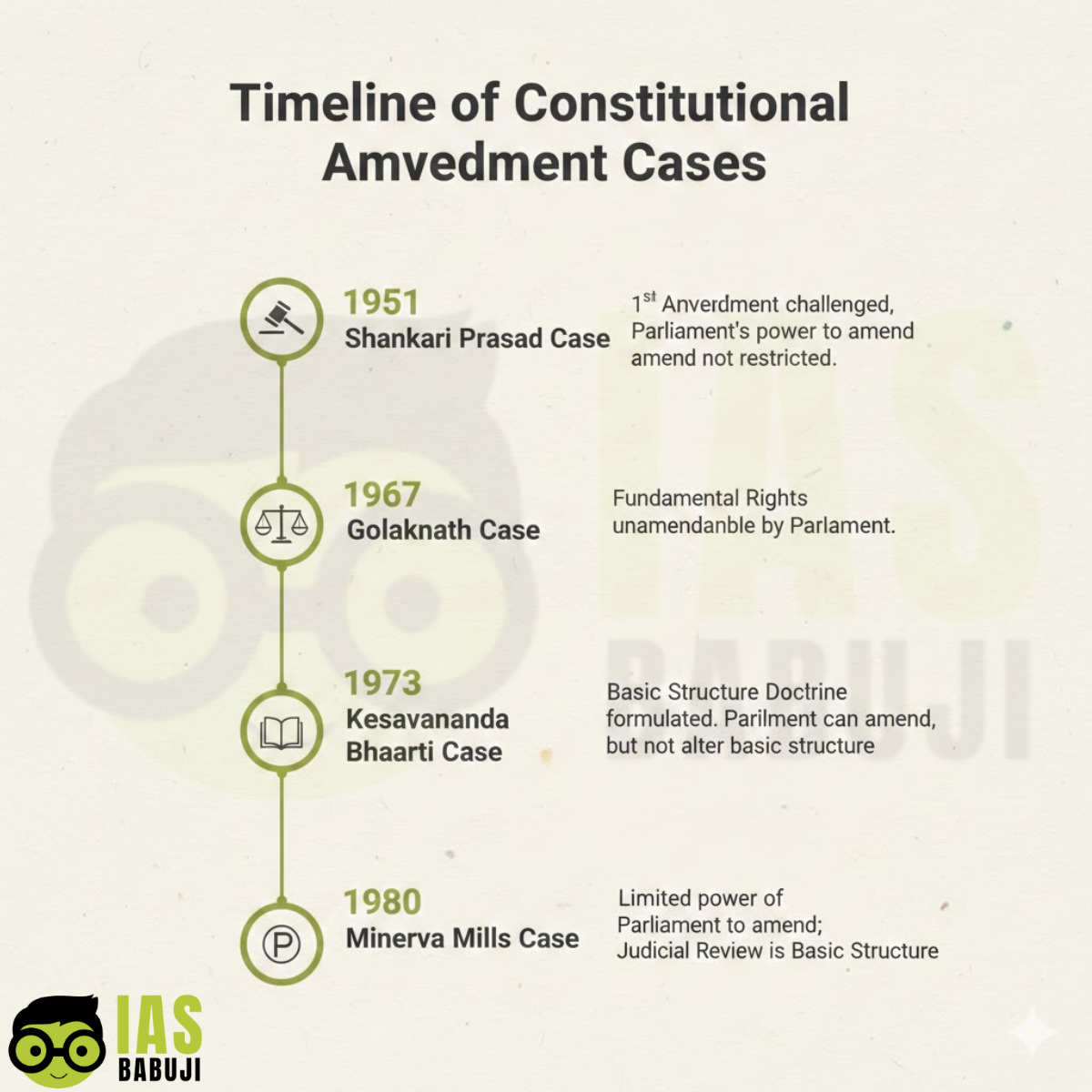
Timeline of Constitutional Amendment Cases

Background of the Case

Swami Kesavananda Bharati was the head of the Edneer Mutt, a religious institution in Kerala. The Kerala government attempted to acquire the mutt’s land under its land reform laws. Challenging this, Kesavananda Bharati approached the Supreme Court under Article 32, alleging violation of Fundamental Rights, particularly Article 25 (Freedom of Religion) and Article 31 (Right to Property).

However, the case soon transcended the land dispute and raised a far larger constitutional question:

Does Parliament have unlimited power to amend the Constitution under Article 368?


Constitutional Provisions Involved

  • Article 13 – Laws inconsistent with Fundamental Rights
  • Article 25 – Freedom of religion
  • Article 31 – Right to Property (as it existed then)
  • Article 368 – Power of Parliament to amend the Constitution

Core Issue Before the Supreme Court

The central issue was:

Can Parliament amend any part of the Constitution, including Fundamental Rights, without any limitation?

This question arose due to earlier conflicting judgments:

  • Shankari Prasad Case (1951) – Parliament can amend Fundamental Rights
  • Golaknath Case (1967) – Parliament cannot amend Fundamental Rights

Supreme Court Verdict (1973)

A historic 13-judge Constitution Bench delivered the judgment with a 7:6 majority.

Key Rulings

  • Parliament can amend any part of the Constitution, including Fundamental Rights
  • BUT it cannot alter or destroy the “Basic Structure” of the Constitution
  • Article 368 does not grant unlimited amending power

This principle came to be known as the Basic Structure Doctrine.
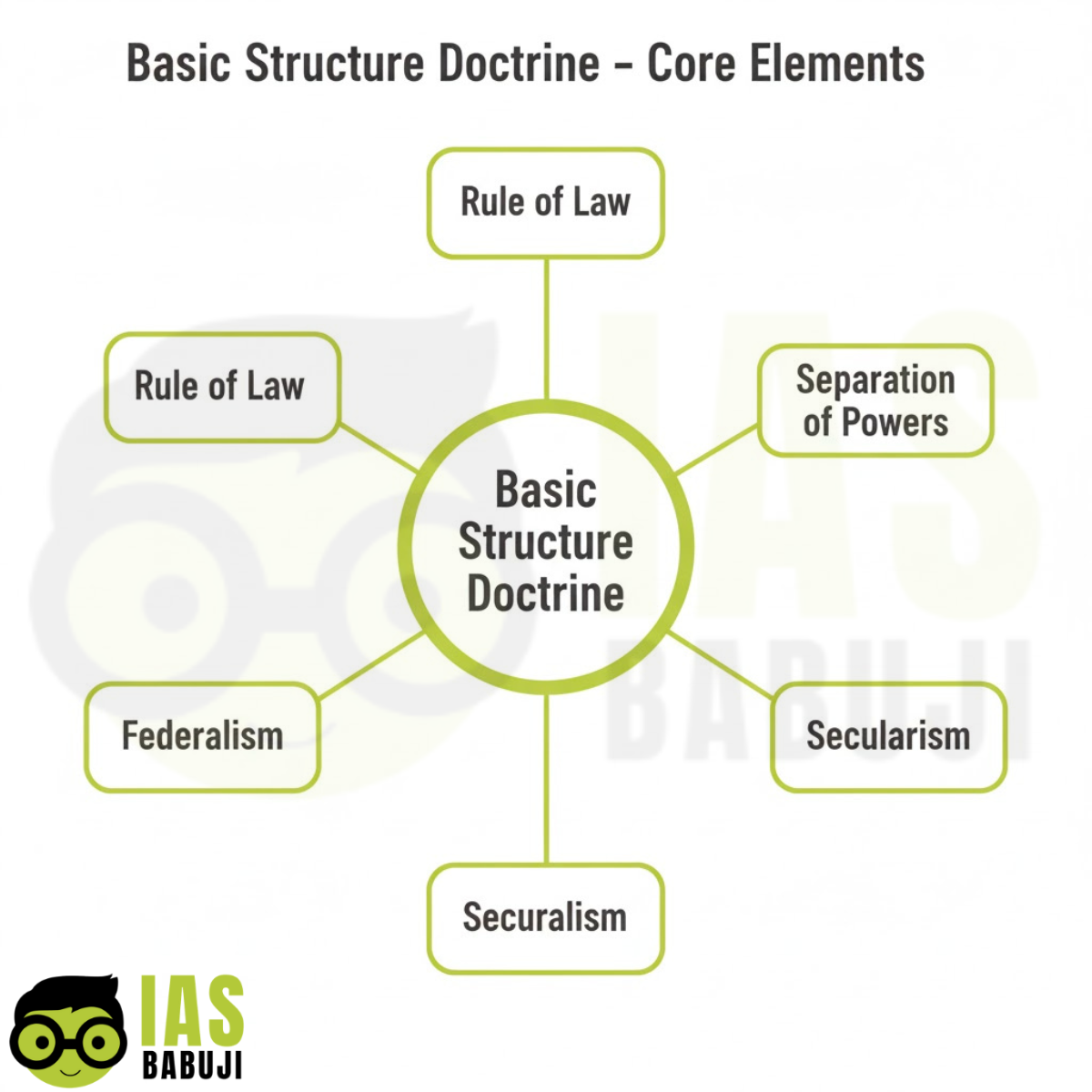
Basic Structure Doctrine – Core Elements

What Is the Basic Structure Doctrine?

The Supreme Court did not provide an exhaustive list but identified certain core constitutional principles that cannot be amended.

Elements of the Basic Structure (Illustrative)

  • Supremacy of the Constitution
  • Rule of Law
  • Separation of Powers
  • Judicial Review
  • Federalism
  • Secularism
  • Sovereign, Democratic Republic
  • Free and fair elections

Significance of the Judgment

1. Constitutional Supremacy

The Constitution is supreme, not Parliament.

2. Judicial Review Strengthened

Courts can review constitutional amendments.

3. Balance Between Rigidity and Flexibility

Allows constitutional evolution without destroying its soul.

4. Protection Against Authoritarianism

Played a crucial role during the Emergency (1975–77).


Impact on Later Judgments

The Basic Structure Doctrine was reaffirmed in:

  • Indira Gandhi v. Raj Narain (1975)
  • Minerva Mills Case (1980)
  • S.R. Bommai Case (1994)

This shows its enduring relevance.


Criticism of the Judgment

  • Critics argue the doctrine is judicial overreach
  • Parliament’s sovereignty is curtailed
  • “Basic Structure” is not clearly defined

Despite criticism, the doctrine is widely regarded as a constitutional safeguard.


UPSC Prelims & Mains Relevance

Prelims

  • Year: 1973
  • Largest Constitution Bench (13 judges)
  • Doctrine: Basic Structure

Mains (GS-II)

  • Role of the judiciary in protecting the Constitution
  • Parliament vs Supreme Court
  • Constitutional amendments & limitations

Essay

  • Constitutionalism in India
  • Democracy & rule of law

Previous Year Question (PYQ)

UPSC Mains 2019:
“The judiciary in India has played an important role in preventing the executive from usurping the powers of Parliament and upholding the Constitution.” Discuss.

👉 Kesavananda Bharati Case is a core example.


Conclusion

The Kesavananda Bharati judgment stands as a constitutional milestone that preserved the balance between democratic governance and constitutional supremacy. By propounding the Basic Structure Doctrine, the Supreme Court ensured that while Parliament retains the power to amend the Constitution, it cannot alter its foundational values. This judgment transformed the Indian Constitution from a purely legal document into a living framework guided by core principles such as rule of law, judicial review, and federalism. For UPSC aspirants, the case is not just a legal precedent but a powerful illustration of constitutionalism in action. Understanding its philosophy, implications, and application is essential for writing high-quality answers in Polity, Governance, and Ethics papers.


FAQs

Q1. Why is Kesavananda Bharati case important for UPSC?
It introduced the Basic Structure Doctrine.

Q2. Can Parliament amend Fundamental Rights after this case?
Yes, but without violating the Basic Structure.

Q3. Which Article gives amending power to Parliament?
Article 368.

Q4. Is Basic Structure defined in the Constitution?
No, it is a judicial doctrine.
Post Views: 4
Tags: Article 368 Explainedbasic structure doctrineGS 2 JudiciaryIndian Constitution PolityKesavananda Bharati CaseSupreme Court Judgments UPSCUPSC Polity Notes
ShareSendTweet
Previous Post

10 Supreme Court Judgments Every UPSC Aspirant Must Know

Next Post

Maneka Gandhi Case (1978)

Related Posts

Maneka Gandhi Case (1978)
Indian Polity

Maneka Gandhi Case (1978)

by editorialteam
10 Supreme Court Judgments Every UPSC Aspirant Must Know
Indian Polity

10 Supreme Court Judgments Every UPSC Aspirant Must Know

by editorialteam
New Criminal Laws Explained of India in Depth
Indian Polity

New Criminal Laws Explained of India

by editorialteam
Indian Polity for UPSC – Indian Constitution Notes & PDF
Indian Polity

Indian Polity for UPSC – Indian Constitution Notes & PDF

by Research Team of IAS Babu Ji
Next Post
Maneka Gandhi Case (1978)

Maneka Gandhi Case (1978)

Recent Posts

  • Maneka Gandhi Case (1978)
  • Kesavananda Bharati Case (1973)
  • 10 Supreme Court Judgments Every UPSC Aspirant Must Know
  • Supreme Court Defines Uniform Aravalli Hills Protection
  • Ordinance-Making Power in India
  • Supreme Court Role in Protecting Federalism
  • Top 10 Mistakes UPSC Aspirants Make in Prelims Preparation

Browse by Category

  • 2019
  • Admit Card
  • Age Limit
  • Andhra Pradesh Public Service Commission (APPSC)
  • Assam Public Service Commission (APSC)
  • Bihar Public Service Commission (BPSC)
  • CAPF
  • CDS
  • Chhattisgarh Public Service Commission (CGPSC)
  • CMS
  • Cut Off Marks
  • Economics
  • Economics Books
  • Editorial Articles
  • Eligibility Criteria
  • EPFO
  • Essay Writing
  • Ethics Books
  • Exam Pattern
  • Geography
  • Geography Books
  • Gujarat Public Service Commission (GPSC)
  • Haryana Public Service Commission (HPSC)
  • Himachal Pradesh Public Service Commission (HPPSC)
  • Hindi Medium
  • History
  • History Books
  • IAS
  • IAS & IPS Officers
  • IAS Exam (CSE)
  • IES
  • IFS
  • IFS
  • Indian Polity
  • IPS
  • IRS
  • ISS
  • Jammu and Kashmir Public Service Commission (JKPSC)
  • Jharkhand Public Service Commission (JPSC)
  • Karnataka Public Service Commission (KPSC)
  • Kerala Public Service Commission (KPSC)
  • Kurukshetra Magazine
  • Madhya Pradesh Public Service Commission (MPPSC)
  • Maharashtra Public Service Commission (MPSC)
  • Mains General Studies
  • Mains Syllabus
  • Mathematics
  • NCERT Books
  • NDA
  • Notification
  • Odisha Public Service Commission (OPSC)
  • Offline Coaching
  • Online Application
  • Online Coaching
  • Optional Subjects
  • Prelims Books
  • Prelims Exam
  • Prelims General Studies
  • Prelims Syllabus
  • Press Information Bureau (PIB)
  • Public Administration
  • Punjab Public Service Commission (PPSC)
  • Rajasthan Public Service Commission (RPSC)
  • RSTV
  • SCRA
  • Sociology
  • State Public Service Commission
  • Tamil Nadu Public Service Commission (TNPSC)
  • The Hindu
  • The Indian Express
  • Uncategorized
  • UPSC Books
  • UPSC Coaching
  • UPSC CSE Subjects
  • UPSC Current Affairs
  • UPSC Exam Details
  • UPSC Exams
  • UPSC Interview Process
  • UPSC Posts
  • UPSC Question Papers
  • UPSC Strategy
  • UPSC Study Material
  • UPSC Syllabus
  • UPSC Test Series
  • UPSC Training
  • Uttar Pradesh Public Service Commission (UPPSC)
  • Uttarakhand Public Service Commission (UKPSC)
  • West Bengal Public Service Commission (WBPSC)
  • Yojana Magazine

Browse by Tags

basic structure doctrine British India Centre State Relations Current Affair Dam Economy Exam Topper Foreign Relations Government Scheme Government Schemes Head of State History IAS IAS Coaching IAS Officer IAS Officer Power IFS Officer Informative Content IPS Officer MBA CET strategy MPSC Political Leader PSC Rajasthan Public Service Commission RBI Revolution RPSC Strategy for UPSC Interview Process The Prayas India UPSC UPSC 2026 Study Plan UPSC Books UPSC Calendar UPSC CAPF Exam UPSC CDS Exam UPSC Coaching UPSC Geography Books UPSC History Books UPSC Polity Notes UPSC Prelims Syllabus UPSC Preparation UPSC Question Paper UPSC Smart Elimination Techniques UPSC Weightage Analysis War WBPSC
  • Home
  • Exam Details
  • Strategy
  • Books
  • Current Affairs
  • Contact Us
Contact us at [email protected]

© 2021 IAS BABU JI - One-Stop Solution for UPSC Exam Aspirants

No Result
View All Result
  • Home
  • Exam Details
  • Strategy
  • Books
  • Current Affairs
  • Contact Us

© 2021 IAS BABU JI - One-Stop Solution for UPSC Exam Aspirants

Are you sure want to unlock this post?
Unlock left : 0
Are you sure want to cancel subscription?