
India’s Maritime Security Strategy in the Indo-Pacific: Challenges and Opportunities
Introduction
The Indo-Pacific has emerged as the most strategically significant maritime region of the 21st century. Stretching from the eastern coast of Africa to the western shores of the Americas, this region carries nearly two-thirds of global trade and hosts some of the world’s most critical Sea Lines of Communication (SLOCs). For India, whose geography is deeply maritime in nature and whose trade, energy security, and strategic interests are tied to the Indian Ocean, maritime security in the Indo-Pacific is not a choice but a necessity. In recent years, increasing geopolitical competition, China’s expanding naval footprint, non-traditional security threats, and disruptions to global trade have compelled India to recalibrate its maritime strategy.
Understanding Maritime Security in the Indo-Pacific Context
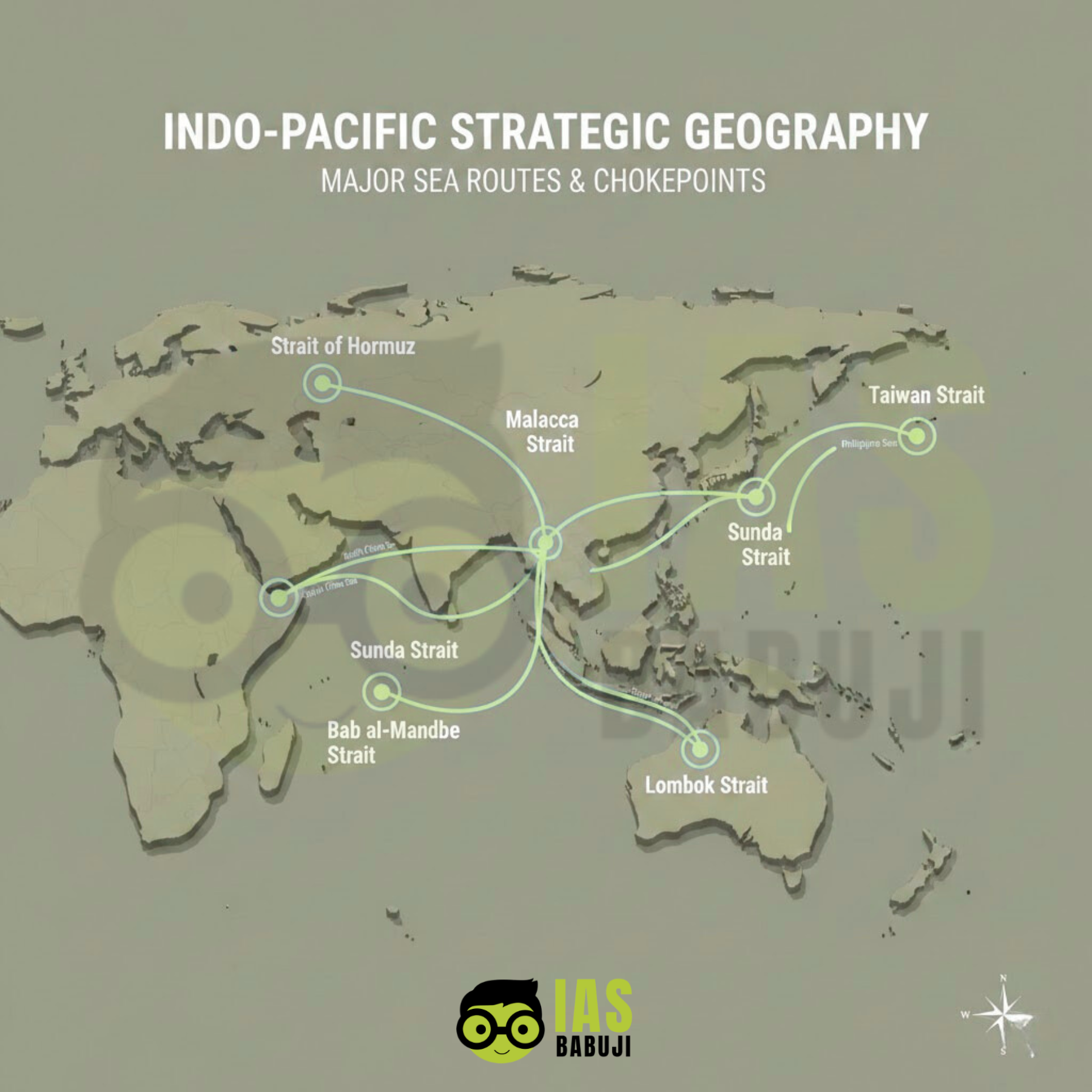
Maritime security goes beyond naval defence. It includes the protection of trade routes, prevention of piracy, the safeguarding of offshore resources, humanitarian assistance, disaster relief, and ensuring freedom of navigation under international law. In the Indo-Pacific context, maritime security has acquired a strategic dimension due to rising power rivalry, militarisation of seas, and the contest for influence over the Malacca Strait, Bab-el-Mandeb, and the Strait of Hormuz.
India’s vision of the Indo-Pacific is inclusive and rule-based, emphasising respect for sovereignty, international law, and peaceful resolution of disputes.
India’s Strategic Importance in the Indo-Pacific
India occupies a central geographical position in the Indian Ocean, with a coastline of over 7,500 km and proximity to major maritime chokepoints. Over 95 percent of India’s trade by volume (as of 2025) and a majority of its energy imports move through the Indian Ocean Region (IOR). Any instability in the Indo-Pacific directly affects India’s economic growth, energy security, and strategic autonomy.
India’s island territories such as the Andaman and Nicobar Islands provide strategic depth and surveillance advantage, making India a natural net security provider in the region.
Pillars of India’s Maritime Security Strategy
1. Naval Modernisation and Force Projection
India has focused on enhancing the Indian Navy’s blue-water capabilities through aircraft carriers, nuclear submarines, long-range maritime patrol aircraft, and network-centric warfare systems. Emphasis is placed on deterrence, sea control, and sea denial.
2. Strategic Partnerships and Multilateral Engagement
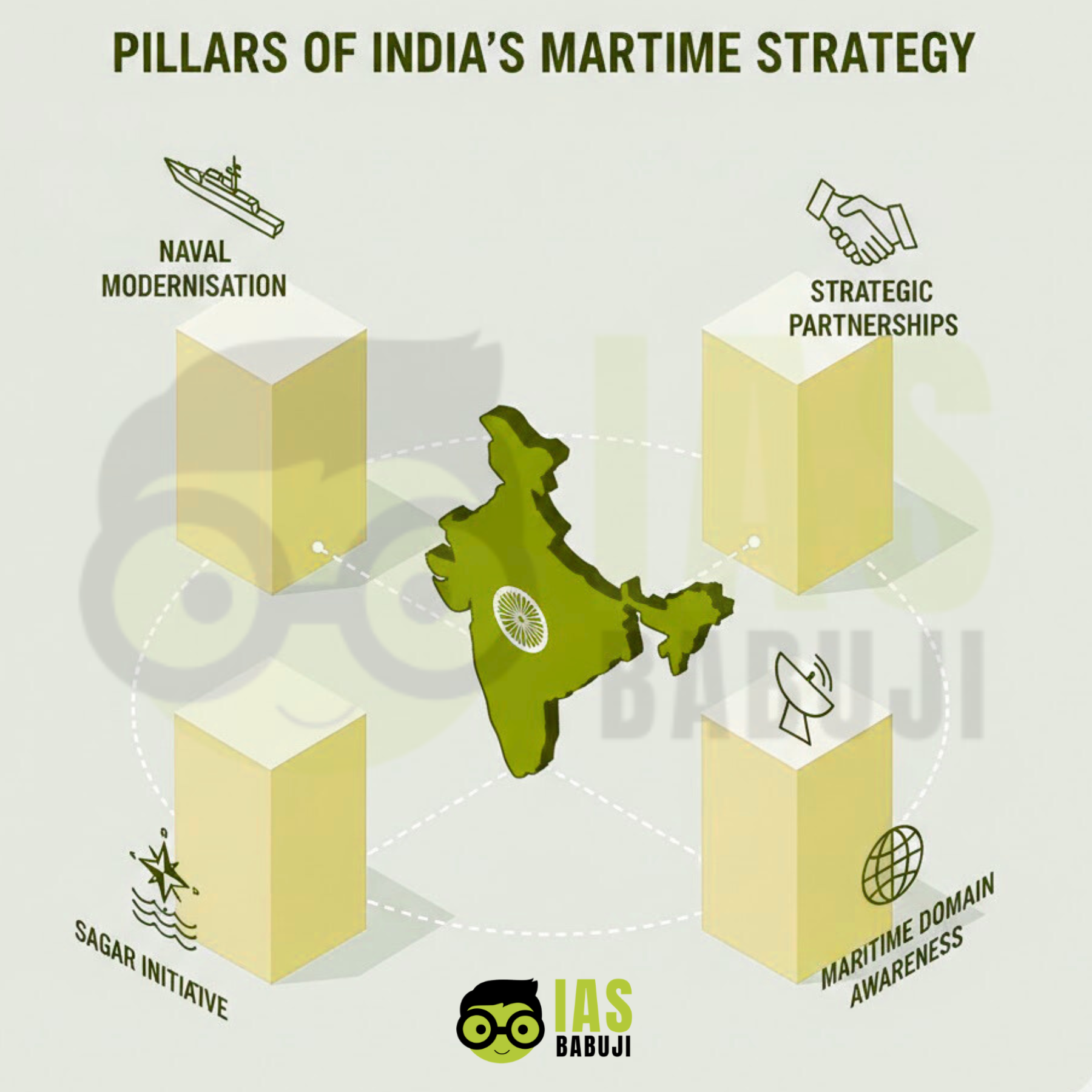
India actively engages with regional and extra-regional partners through platforms such as QUAD, ASEAN-led mechanisms, Indian Ocean Naval Symposium (IONS), and bilateral maritime exercises. These partnerships enhance interoperability, intelligence sharing, and collective maritime domain awareness.
3. SAGAR Initiative and Regional Outreach
India’s SAGAR (Security and Growth for All in the Region) doctrine underlines cooperative maritime security, capacity building of smaller littoral states, and humanitarian assistance. This soft-power-driven approach strengthens India’s leadership role in the IOR.
4. Maritime Domain Awareness (MDA)
India has invested heavily in coastal surveillance networks, information fusion centres, and satellite-based monitoring to track maritime activities and counter threats such as piracy, illegal fishing, and trafficking.
Key Challenges to India’s Maritime Security
China’s Expanding Naval Presence
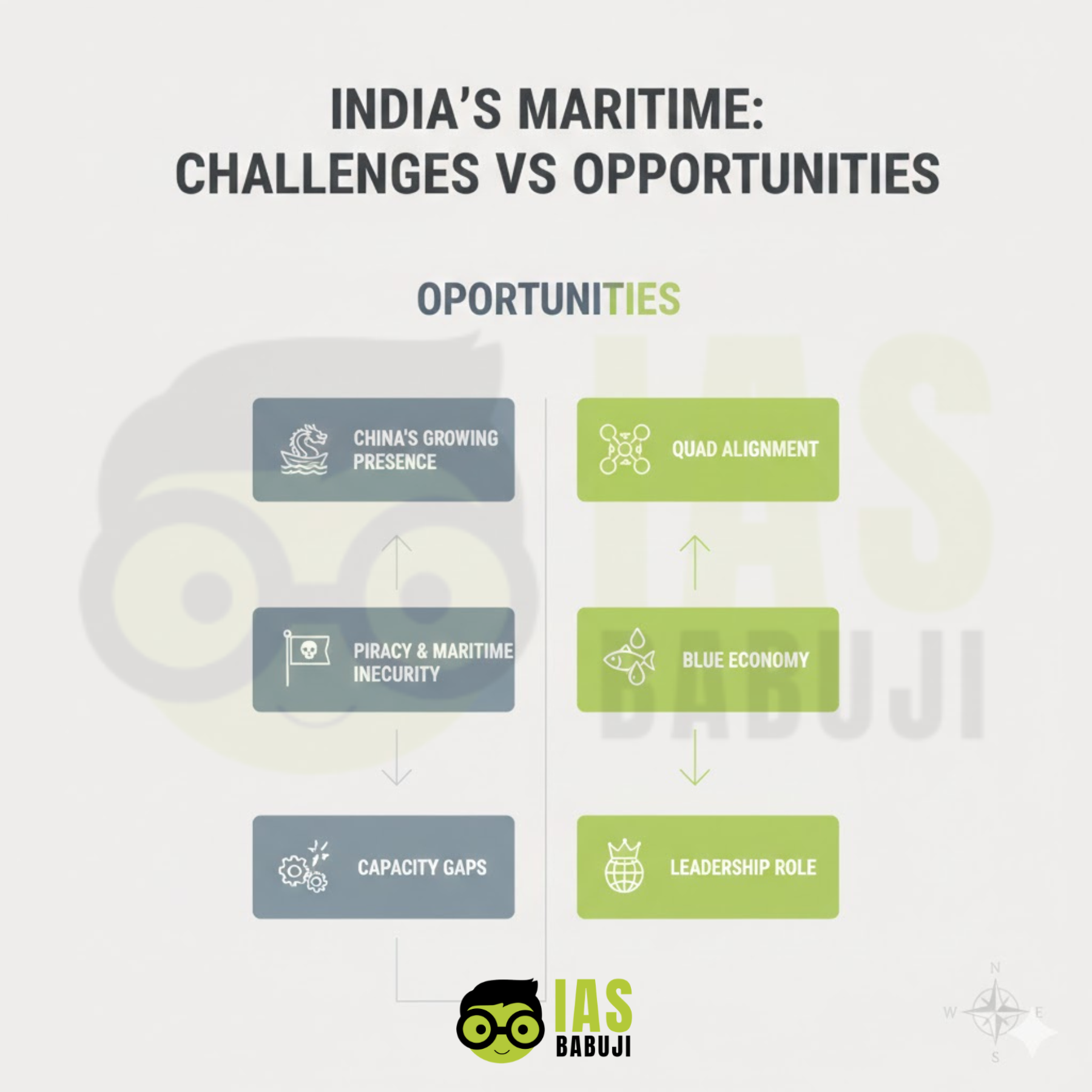
China’s growing presence in the Indian Ocean through ports, bases, and dual-use infrastructure has altered the regional balance. Increased PLA Navy deployments and submarine activity pose strategic challenges for India.
Non-Traditional Security Threats
Piracy, maritime terrorism, illegal fishing, human trafficking, and cyber threats to port infrastructure continue to undermine maritime stability.
Resource Constraints and Capacity Gaps
Despite modernisation efforts, budgetary limitations and delays in indigenous shipbuilding affect India’s naval readiness.
Geopolitical Fragmentation
Divergent interests among Indo-Pacific nations and lack of a formal security architecture limit coordinated responses to common threats.
Emerging Opportunities for India
Leadership as a Net Security Provider
India’s credibility in humanitarian assistance, disaster relief, and maritime patrol operations enhances its role as a stabilising force.
Strengthening QUAD and Minilateral Frameworks
QUAD cooperation in maritime surveillance, logistics, and infrastructure resilience offers India strategic leverage without formal alliances.
Indigenous Defence and Maritime Technology
Initiatives under Atmanirbhar Bharat promote indigenous shipbuilding, maritime drones, and surveillance technologies, reducing dependence on imports.
Blue Economy and Sustainable Seas
India’s maritime strategy increasingly integrates economic growth, environmental protection, and sustainable resource utilisation.
Way Forward
India’s maritime security strategy must balance deterrence with diplomacy. Strengthening naval capabilities, deepening regional partnerships, investing in maritime infrastructure, and upholding international law are essential. A comprehensive Indo-Pacific approach that integrates security, economy, environment, and governance will allow India to safeguard its interests while contributing to regional stability.
| UPSC Paper | Topics | Marks Potential |
|---|---|---|
| GS-II (60%) | QUAD, SAGAR, ASEAN, China encirclement | 15-20 marks |
| GS-III (40%) | Naval modernization, MDA, piracy | 10-15 marks |
Conclusion
The Indo-Pacific is central to India’s strategic future. As maritime competition intensifies, India’s ability to protect its interests while promoting a free, open, and inclusive maritime order will define its global standing. India’s evolving maritime security strategy reflects a mature understanding of power, partnership, and responsibility. By combining naval strength with diplomatic outreach and regional cooperation, India is well-positioned to navigate the challenges and seize the opportunities of the Indo-Pacific era.
UPSC GS Paper Mapping
- GS Paper II: International Relations, India’s foreign policy, regional groupings
- GS Paper III: Internal Security, Defence, Security challenges, Infrastructure
- Essay Paper: India’s role in global order, maritime power and diplomacy
FAQs India’s Maritime Security Strategy in the Indo-Pacific
Why is the Indo-Pacific important for India?
It is critical for India’s trade, energy security, and strategic influence due to major sea routes and chokepoints.
What is India’s SAGAR initiative?
SAGAR stands for Security and Growth for All in the Region, India’s maritime security doctrine since 2015.
How does QUAD support India’s maritime strategy?
QUAD enhances maritime surveillance, interoperability, and collective response to regional challenges.
What are non-traditional maritime security threats?
Piracy, illegal fishing, trafficking, maritime terrorism, and cyber threats to port infrastructure.
Which UPSC paper covers maritime security?
Primarily GS Paper II and GS Paper III, with relevance for the Essay paper.