

Elimination Technique for UPSC Prelims MCQs: Smart Option Tricks & Examples
Smart Option Elimination Tricks with Practical Examples
UPSC Prelims is not only a test of knowledge but also a test of strategy, logic, and decision-making under pressure. Many aspirants fail not because they lack knowledge, but because they do not use smart elimination techniques to narrow down options in Multiple Choice Questions (MCQs).
Mastering the Elimination Technique can significantly increase accuracy, reduce negative marking, and improve overall score — even when the question is partially unknown.
This article explains powerful option elimination tricks, UPSC-relevant logic patterns, and realistic examples to help aspirants maximize their Prelims performance.
Why the Elimination Technique is Crucial in UPSC Prelims
In UPSC Prelims:
- Questions are tricky and analytical
- Options are closely framed
- Guesswork leads to negative marking
- Full certainty is not always possible
Elimination helps aspirants:
- Reduce wrong options
- Increase the probability of correct answers
- Attempt more questions with confidence
- Minimize negative marks
- Score better even with limited knowledge
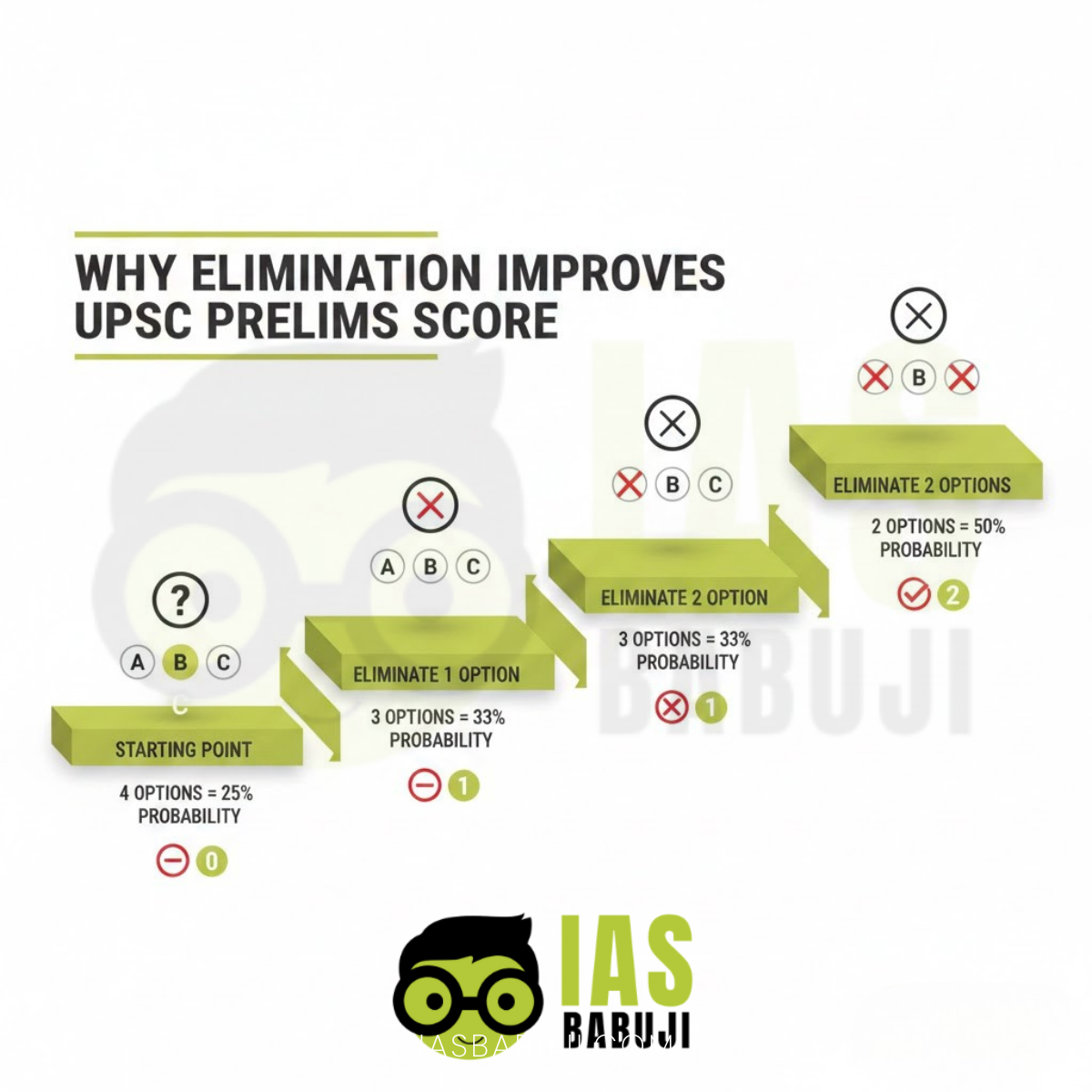
Core Principle of Option Elimination
The idea is simple:
You do not need to know the correct answer — you just need to identify incorrect ones.
Even eliminating 1–2 options improves chances from:
-
25% → 33% → 50% probability
This is a massive advantage in a competitive exam like UPSC.
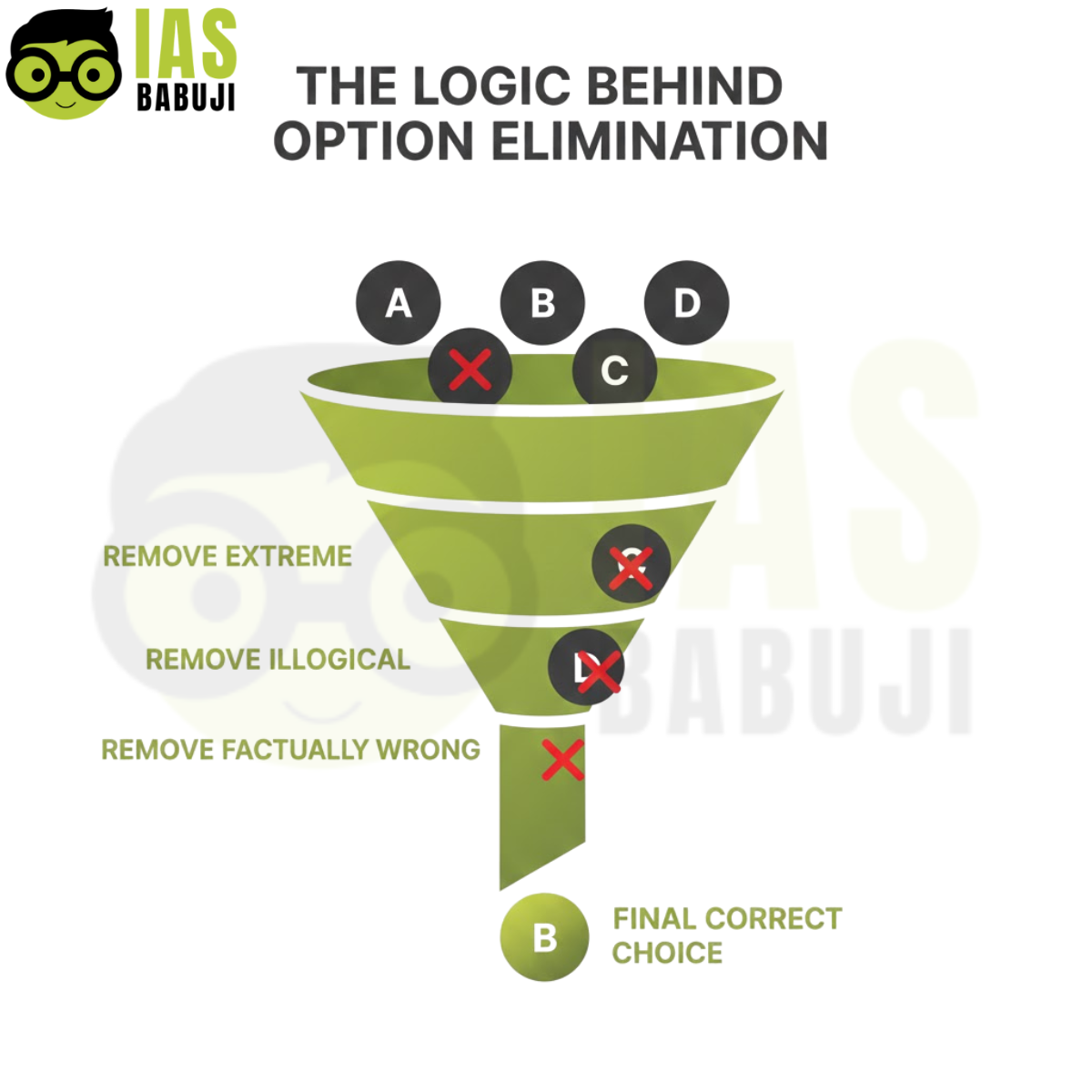
Technique 1: Identify Extreme or Absolute Statements
Options containing words like:
- Always
- Never
- Completely
- Only
- Must
are often incorrect because UPSC prefers balanced and nuanced statements.
Example
Which statement about Fundamental Rights is correct?
A. Fundamental Rights are absolute
B. Fundamental Rights can be reasonably restricted
C. Fundamental Rights cannot be amended
D. Fundamental Rights apply only to citizens
Elimination logic:
- A is extreme (incorrect)
- C is incorrect (they can be amended)
- D is incorrect (some apply to non-citizens)
Correct answer: B
Technique 2: Use Conceptual Contradictions
If two options contradict each other, one of them is likely correct.
Example
Which statement about inflation is correct?
A. Inflation increases purchasing power
B. Inflation decreases purchasing power
C. Inflation has no impact on the money value
D. Inflation only affects the government
A and B contradict each other.
Correct answer is B
Technique 3: Eliminate Factually Incorrect or Illogical Options
Even partial knowledge helps eliminate factually impossible statements.
Example
Which organization is part of the United Nations?
A. NATO
B. UNESCO
C. OPEC
D. SAARC
Only UNESCO belongs to the UN system.
Correct answer: B
Technique 4: Use Relative Comparison Among Options
If multiple options seem similar:
-
Choose the most comprehensive
-
Eliminate overly narrow or incomplete options
Example
Which factor influences monsoon rainfall?
A. El Niño
B. Indian Ocean Dipole
C. Jet Streams
D. All of the above
Correct answer: D because it is inclusive.
Technique 5: Chronology & Timeline Elimination
In history questions, incorrect sequences can be eliminated.
Example
Arrange events chronologically:
- Quit India Movement
- Non-Cooperation Movement
- Civil Disobedience Movement
Correct sequence:
Non-Cooperation → Civil Disobedience → Quit India
Incorrect sequences can be eliminated.
Technique 6: Use Logical Association
UPSC options often include one odd or unrelated option.
Example
Which pair is correctly matched?
A. RBI – Monetary policy
B. NITI Aayog – Judicial body
C. ISRO – Health ministry
D. WTO – Defense alliance
Only A makes sense.
Technique 7: Avoid Emotionally Appealing Options
UPSC avoids:
- Emotional language
- Moral exaggeration
- Overly patriotic statements
Example
Which statement about the Indian Constitution is correct?
A. The Constitution guarantees unlimited freedom
B. The Constitution balances liberty with responsibility
C. The Constitution ensures complete equality in all conditions
D. The Constitution eliminates all injustice
Correct answer: B
Technique 8: Two-Statement Logic in Assertion-Reason Questions
If the assertion is true but the reason is false, eliminate options accordingly.
Check:
- Truth of the statement
- Logical connection
Technique 9: Use Previous Year Question Patterns
UPSC repeats logic patterns, not exact questions.
Examples:
- Eliminating extreme statements
- Choosing balanced options
- Avoiding overly technical wrong answers
Regular PYQ practice sharpens the elimination instinct.
Technique 10: Intelligent Guessing After Partial Elimination
If you can eliminate two options, the probability becomes 50%.
This is called educated guessing, not blind guessing.
Guideline:
- Attempt only when at least one option is eliminated
- Skip when fully unsure

Sample UPSC-Style Practice with Elimination
Question
Which statement about Biodiversity Hotspots is correct?
A. They cover more than 50% of Earth’s land
B. They contain only endangered species
C. They have high endemic species and habitat loss
D. They exist only in tropical rainforests
Elimination:
- A incorrect
- B incorrect
- D incorrect
Correct answer: C
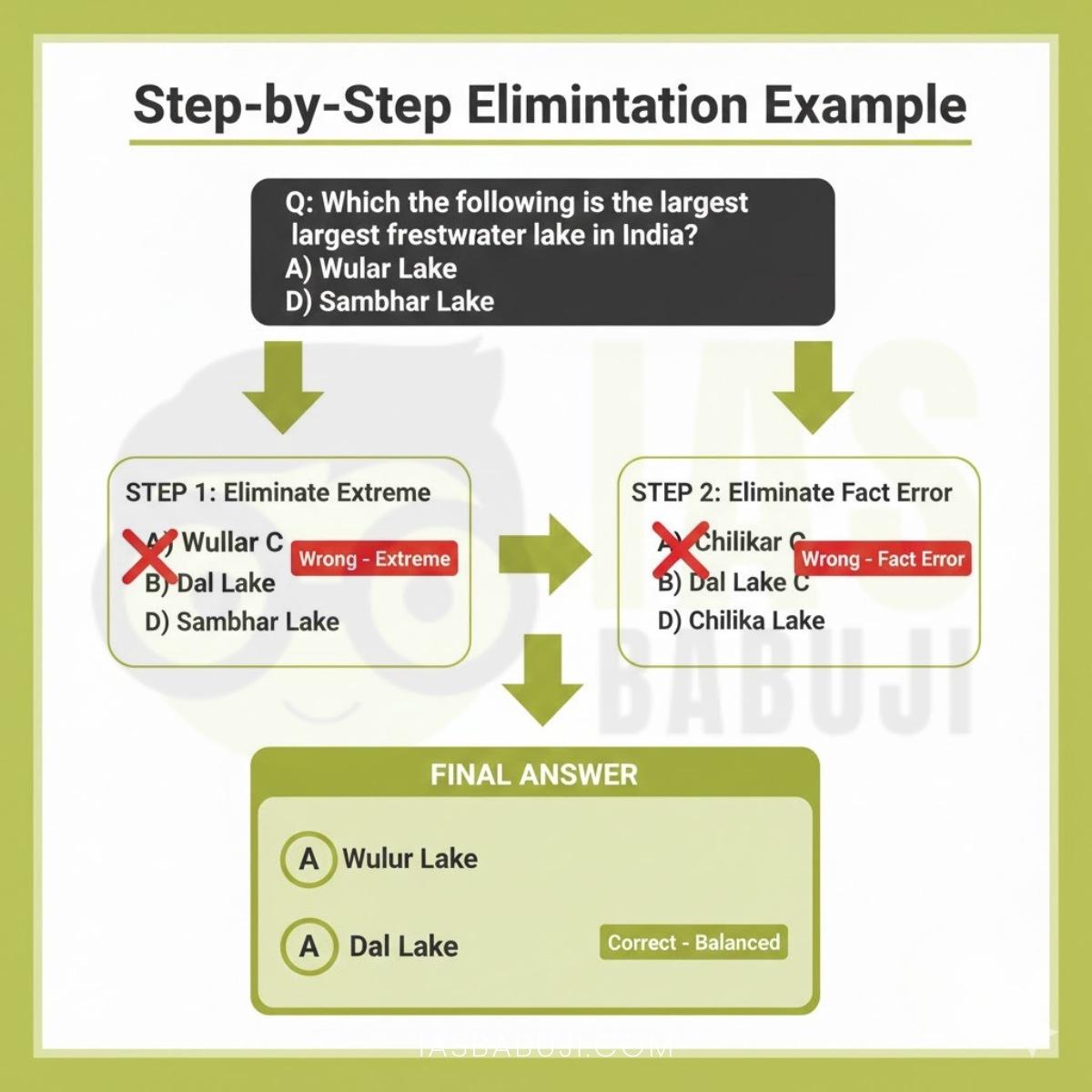
Common Mistakes While Using Elimination
- Overthinking simple questions
- Ignoring basic concepts
- Using emotional bias
- Blind guessing without elimination
- Eliminating correct options due to confusion
How to Practice Elimination Daily
Daily practice plan:
- Solve 30–50 MCQs
- Mark eliminated options
- Analyze why an option was wrong
- Maintain an error notebook
- Track improvement in accuracy

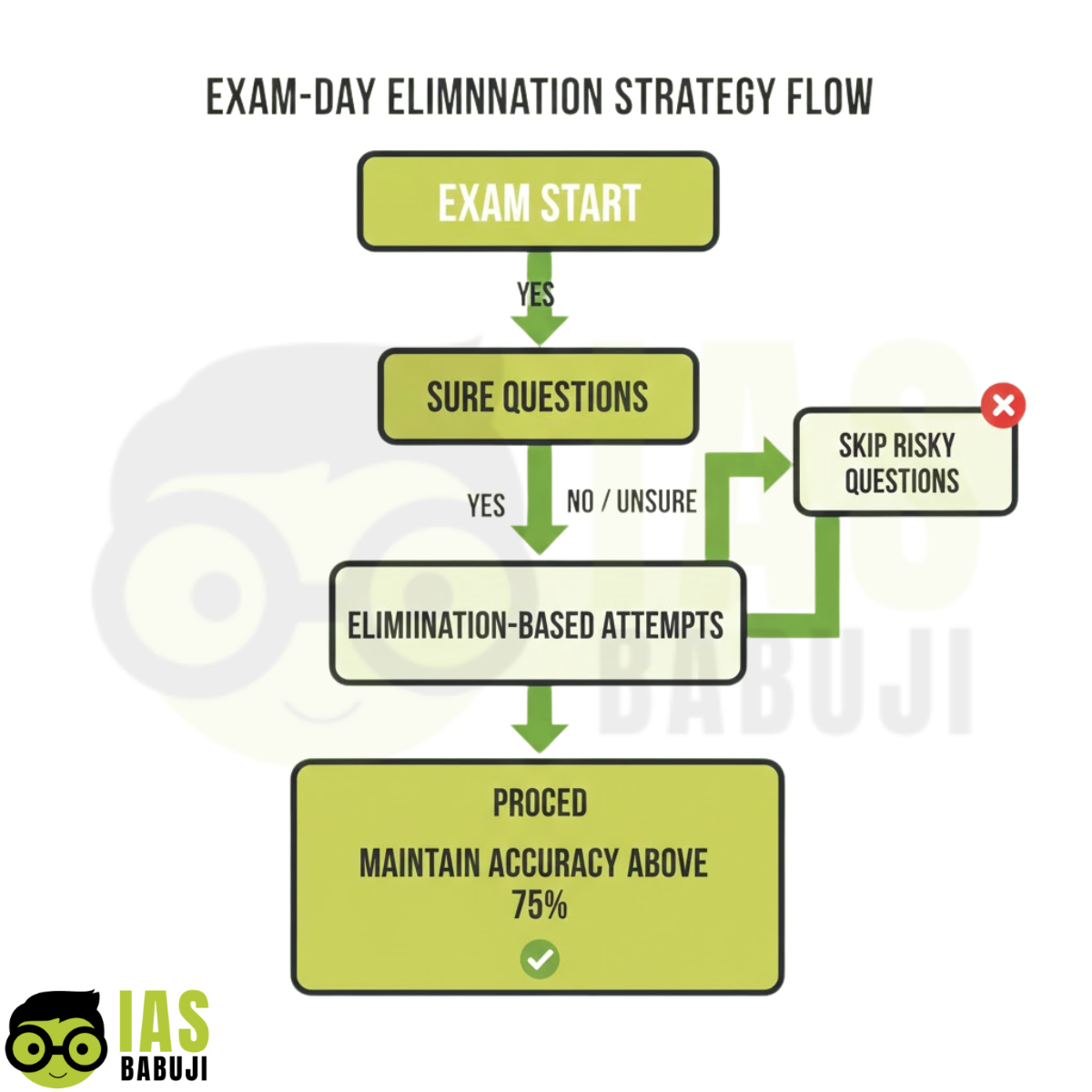
Exam-Day Strategy Using Elimination Technique
Recommended attempt plan:
- Attempt sure questions first
- Attempt elimination-based questions next
- Skip high-risk guesses
- Keep accuracy above 75%
Final Takeaway
The Elimination Technique transforms UPSC Prelims preparation from memory-based answering to logic-based scoring. Aspirants who master elimination:
- Attempt more questions safely
- Reduce negative marking
- Improve accuracy and confidence
- Gain a competitive edge
UPSC Prelims success depends not only on knowledge, but on how smartly you use it.
FAQs – Elimination Technique for UPSC Prelims
1. What is the elimination technique in UPSC Prelims?
The elimination technique is a strategy where aspirants remove incorrect answer options to increase the probability of selecting the correct one, even with partial knowledge.
2. How effective is elimination in improving UPSC Prelims score?
Elimination can significantly improve accuracy, reduce negative marking, and increase the number of safe attempts, leading to a higher overall score.
3. Can the elimination technique be used without full subject knowledge?
Yes. Even partial conceptual understanding helps eliminate extreme, incorrect, or illogical options, making it a powerful strategy for difficult questions.
4. How many options should be eliminated before attempting a question?
Ideally, aspirants should attempt a question only after eliminating at least one or two options. Eliminating two options increases the success probability to 50%.
5. Is intelligent guessing allowed in UPSC Prelims?
Yes, but only after logical elimination. Blind guessing is risky due to negative marking, while educated guessing improves scoring chances.
6. Which types of UPSC questions benefit most from elimination?
Elimination works best in:
- Polity
- Economy
- Environment
- History chronology
- Current Affairs–based MCQs
7. How can aspirants practice elimination skills daily?
By solving daily MCQs, analyzing wrong answers, maintaining an error notebook, and practicing Previous Year Questions with elimination logic.
8. Does UPSC repeat elimination patterns from previous years?
Yes. UPSC often repeats logical patterns in framing options, making PYQ-based elimination practice extremely useful.
9. What is the biggest mistake aspirants make while using elimination?
The biggest mistake is overthinking and eliminating correct options due to assumptions or emotional bias instead of factual reasoning.
10. Is the elimination technique more important than memorization?
Both are important, but elimination provides an extra advantage when memory fails, especially in tricky and analytical questions.