
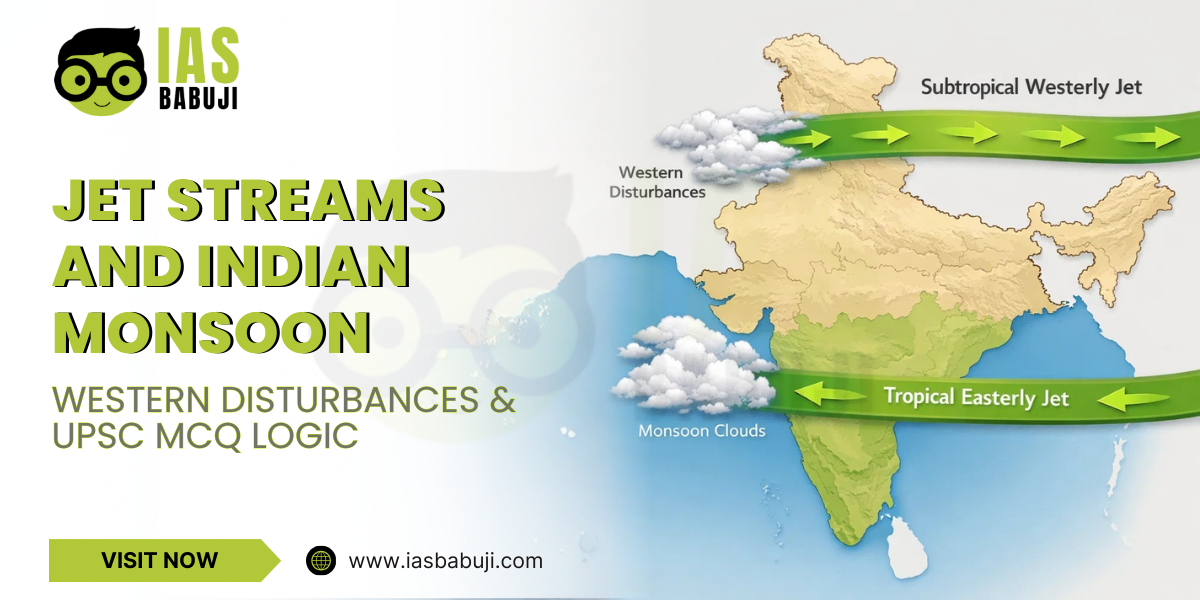
Jet Streams and Indian Monsoon: Concept + MCQ Logic
Focus: Western Disturbances, Subtropical Jet | GS Paper 1 (Geography)
Jet streams are one of the most frequently asked concepts in UPSC Prelims Geography because they connect multiple high-scoring topics such as:
- Indian monsoon mechanism
- Western disturbances
- El Niño/La Niña influence
- Subtropical westerly jet (STWJ)
- Tropical easterly jet (TEJ)
- Seasonal reversal of winds
Many UPSC questions do not ask direct definitions. Instead, they test cause-effect, seasonal shift, and location-based elimination logic. This article explains jet streams in a simple but exam-focused way.
What are Jet Streams?
Jet streams are narrow bands of very fast winds flowing in the upper troposphere, typically at altitudes of:
-
9 km to 16 km (near the tropopause)
They generally blow from west to east (westerlies), though some seasonal jets like TEJ are easterlies.
Key Features of Jet Streams
- Very high wind speed: often 150–300 km/h
- Found near the tropopause
- Strongest in winter
- Follow temperature gradients between air masses
- Influence weather systems and rainfall patterns
Why Jet Streams Matter for India?
Jet streams strongly influence:
- Onset and strength of the Indian monsoon
- Winter rainfall in North India
- Formation of cyclones and depressions
- Path of Western disturbances
- Heat waves and cold waves
For UPSC, jet streams act as a link topic between:
Atmosphere → Winds → Monsoon → Rainfall → Agriculture → Climate anomalies
Types of Jet Streams Relevant for UPSC
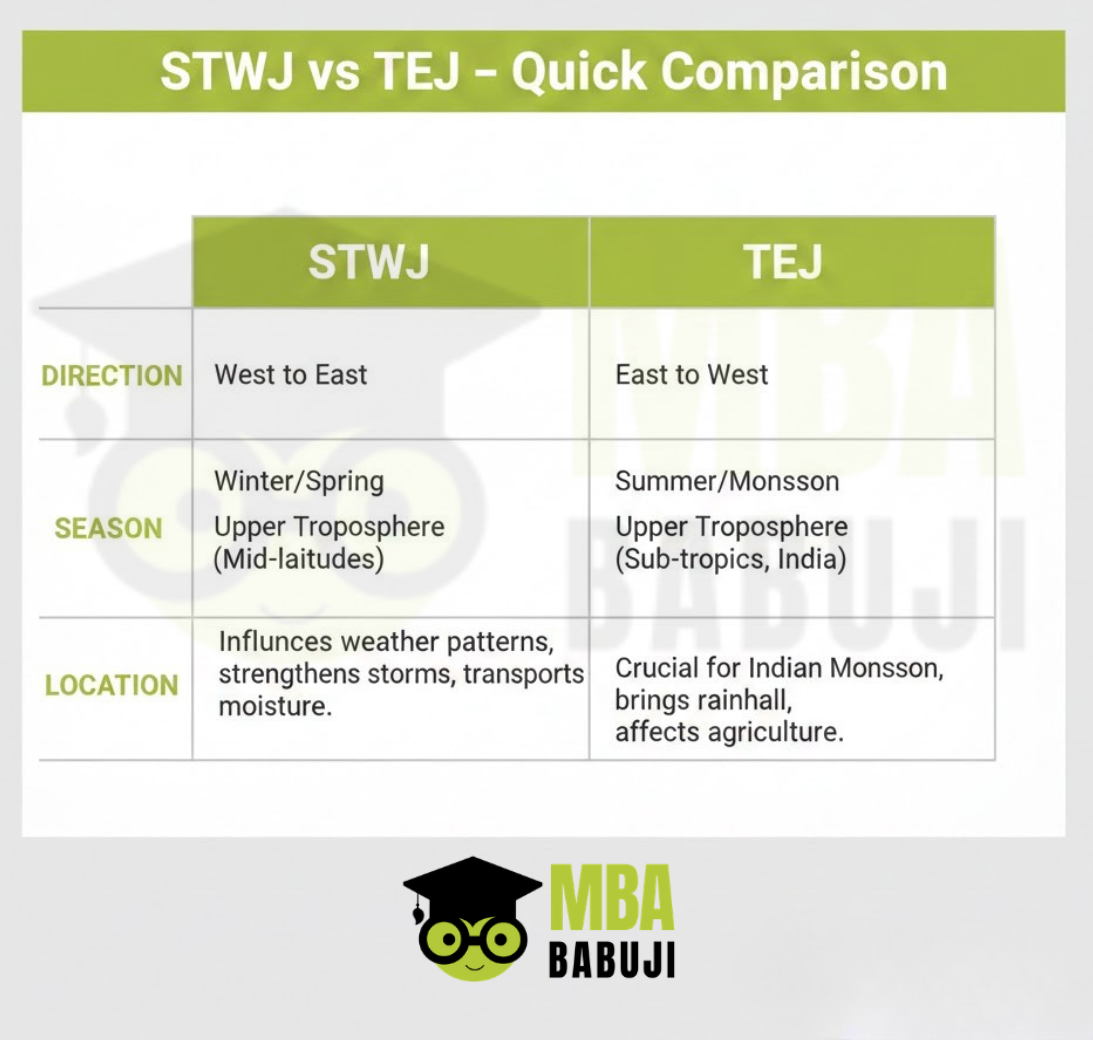
UPSC mainly focuses on:
1. Subtropical Westerly Jet (STWJ)
- Found around 25°N to 35°N
- Flows from west to east
- Strong during winter
- Associated with Western disturbances
2. Tropical Easterly Jet (TEJ)
- Found around 5°N to 20°N
- Flows from east to west
- Strong during summer
- Supports monsoon rainfall
Subtropical Westerly Jet (STWJ) – The UPSC Favourite
The Subtropical Westerly Jet is the most important jet stream for Indian winter weather.
Key Characteristics
- Blows from west to east
- Located north of India in winter
- Strongest in December–February
- Responsible for steering Western disturbances
Role in the Indian Climate
During winter, STWJ passes over:
- Afghanistan
- Pakistan
- Northern India
It brings moisture-bearing systems from the Mediterranean region, leading to:
- Winter rainfall in Punjab, Haryana, Delhi
- Snowfall in Jammu & Kashmir and Himachal Pradesh
- Rain in parts of Rajasthan and western UP
Western Disturbances and Jet Streams
What are Western Disturbances?
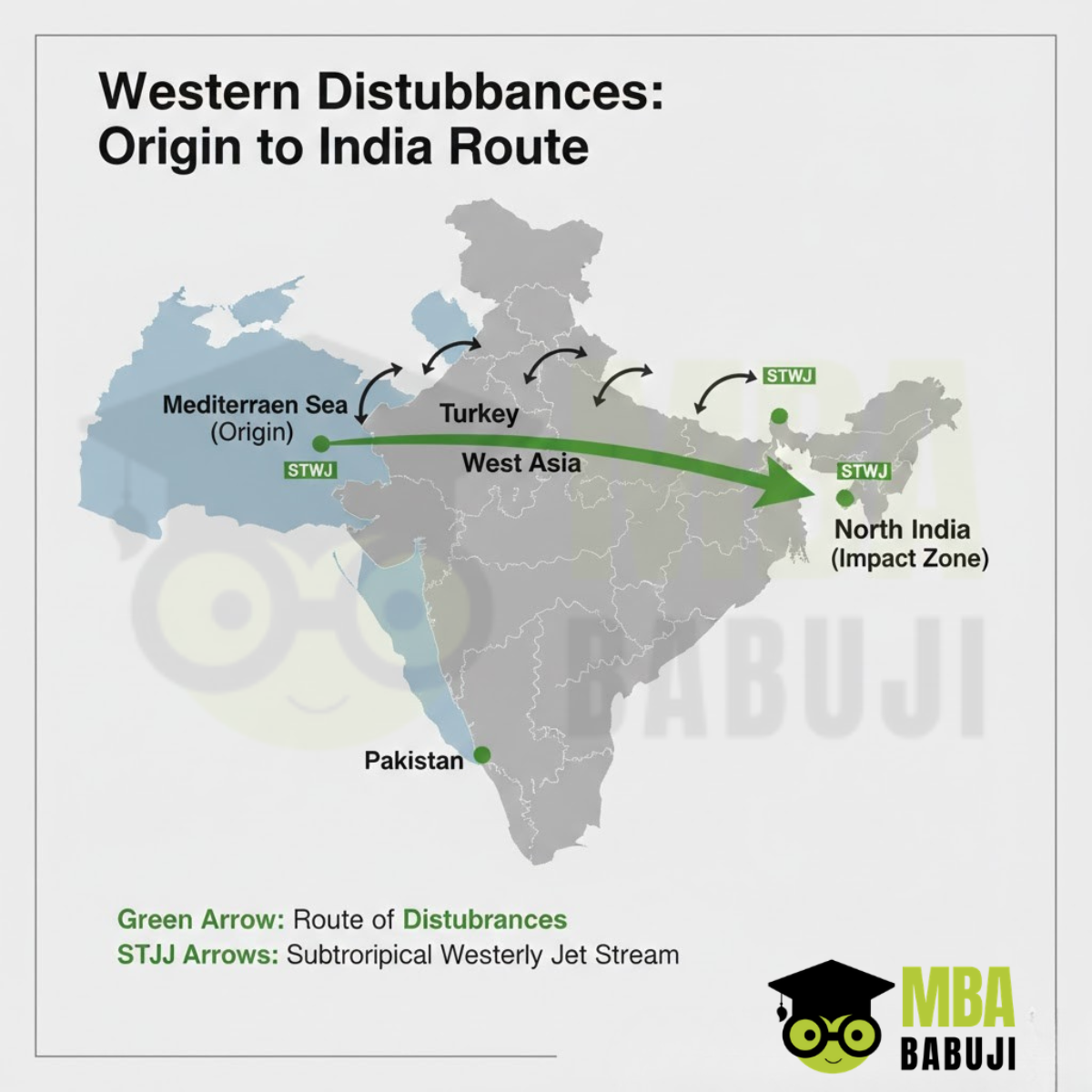
Western disturbances are extra-tropical cyclones that originate near:
- Mediterranean Sea
- Caspian Sea
- West Asia
They move towards India with the help of the Subtropical Westerly Jet.
Why They Matter?
Western disturbances cause:
- Winter rain is crucial for Rabi crops (especially wheat)
- Snowfall in the Himalayan region
- Cold waves and fog conditions in North India
Monsoon Onset and Jet Stream Shift
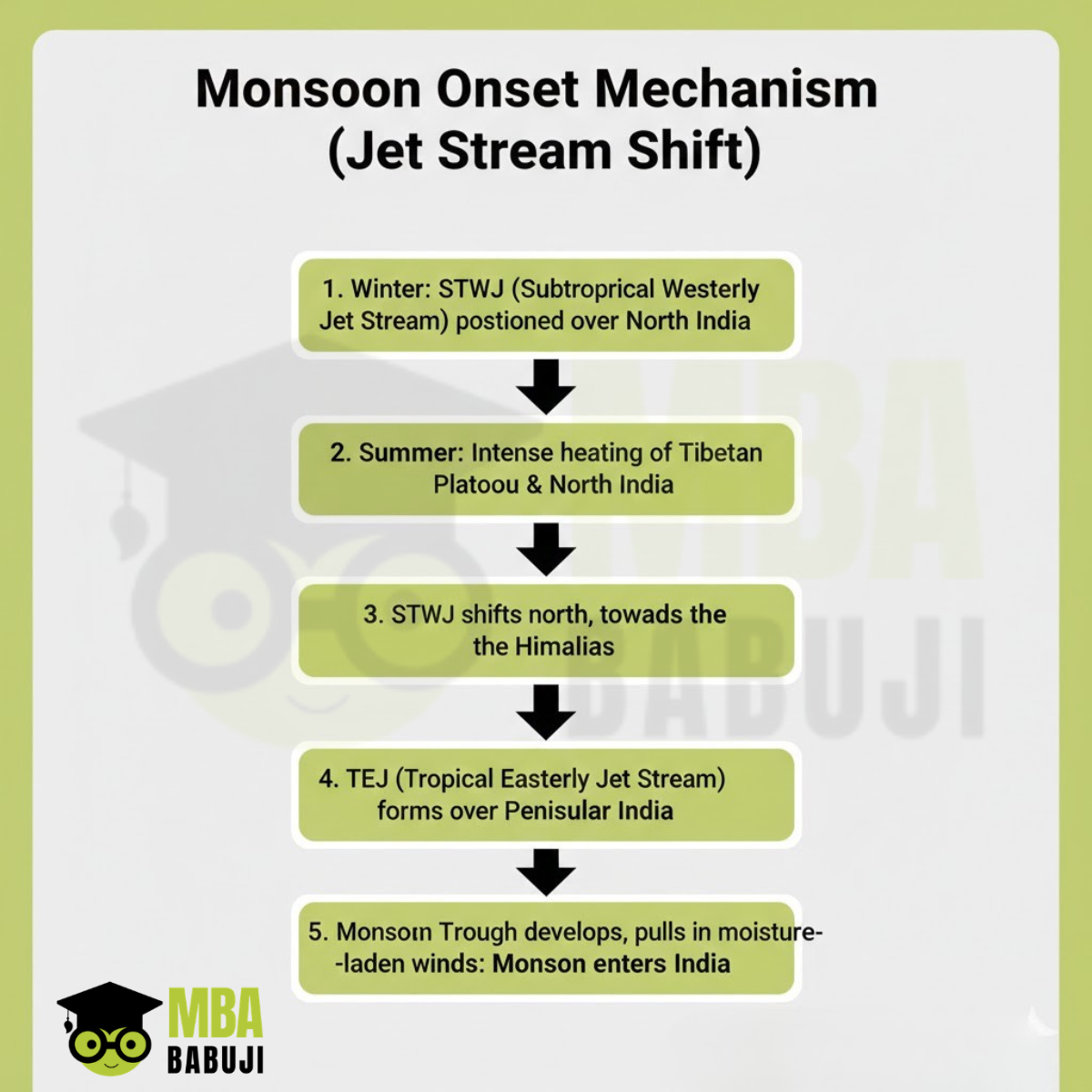
A key monsoon concept in UPSC is:
The monsoon begins when the Subtropical Westerly Jet shifts north and the Tropical Easterly Jet becomes strong.
What happens in the summer?
- Land heats up strongly in India
- Low pressure develops over NW India and Tibet
- STWJ shifts north of the Himalayas
- TEJ develops over peninsular India
This allows moisture-laden monsoon winds to enter India.
Tropical Easterly Jet (TEJ) and Monsoon Strength
The TEJ is closely linked to:
- Monsoon intensity
- Rainfall distribution
- Strength of monsoon circulation
Key Points
- TEJ develops due to heating over the Tibetan Plateau
- Flows from east to west
- Strong TEJ supports a strong monsoon
Jet Streams and Monsoon Failure: The Conceptual Link
Monsoon failure or delayed onset may occur when:
- STWJ does not shift north properly
- TEJ remains weak
- Heat at low temperatures does not develop strongly
- Tibetan Plateau heating is insufficient
UPSC sometimes asks such cause-and-effect questions indirectly.
Jet Streams and Elimination Logic for UPSC MCQs
UPSC frequently frames MCQs using:
- Wrong direction of wind
- Wrong season
- Wrong location
- Confusing Western disturbances with monsoon winds
MCQ Logic Rule 1: Western Disturbances = Winter + Westerlies
If the question mentions:
- Mediterranean origin
- Winter rain
- Snowfall in Himalayas
Then the correct link is:
Western Disturbances + Subtropical Westerly Jet
MCQ Logic Rule 2: TEJ = Summer + Monsoon Support
If the question mentions:
- Monsoon onset
- Tibetan Plateau heating
- Summer winds
Then likely:
Tropical Easterly Jet
MCQ Logic Rule 3: Jet Streams are Upper Air Winds
If options say:
- “Jet streams blow near the surface.”
Eliminate immediately.
Jet streams operate in the upper troposphere, not atthe surface level.
Common UPSC Traps (Very Important)
Trap 1: Western Disturbances are NOT monsoon winds
Western disturbances are:
- Extra-tropical
- Winter systems
- Driven by westerlies
Monsoon winds are:
- Tropical
- Summer systems
- Driven by seasonal reversal
Trap 2: STWJ does not cause summer monsoon rainfall
STWJ is dominant in winter.
Monsoon rainfall is linked to TEJ + ITCZ shift + low pressure.
Trap 3: Jet Streams are not permanent at one location
They shift seasonally:
- STWJ moves south in winter
- Moves north in summer
Why UPSC Asks Jet Streams So Often?
Because jet streams connect:
- Climate mechanisms
- Seasonal rainfall
- Agriculture
- Disaster management
- Weather phenomena
Also, they allow UPSC to test:
- Concept + logic + elimination
instead of pure factual memory.
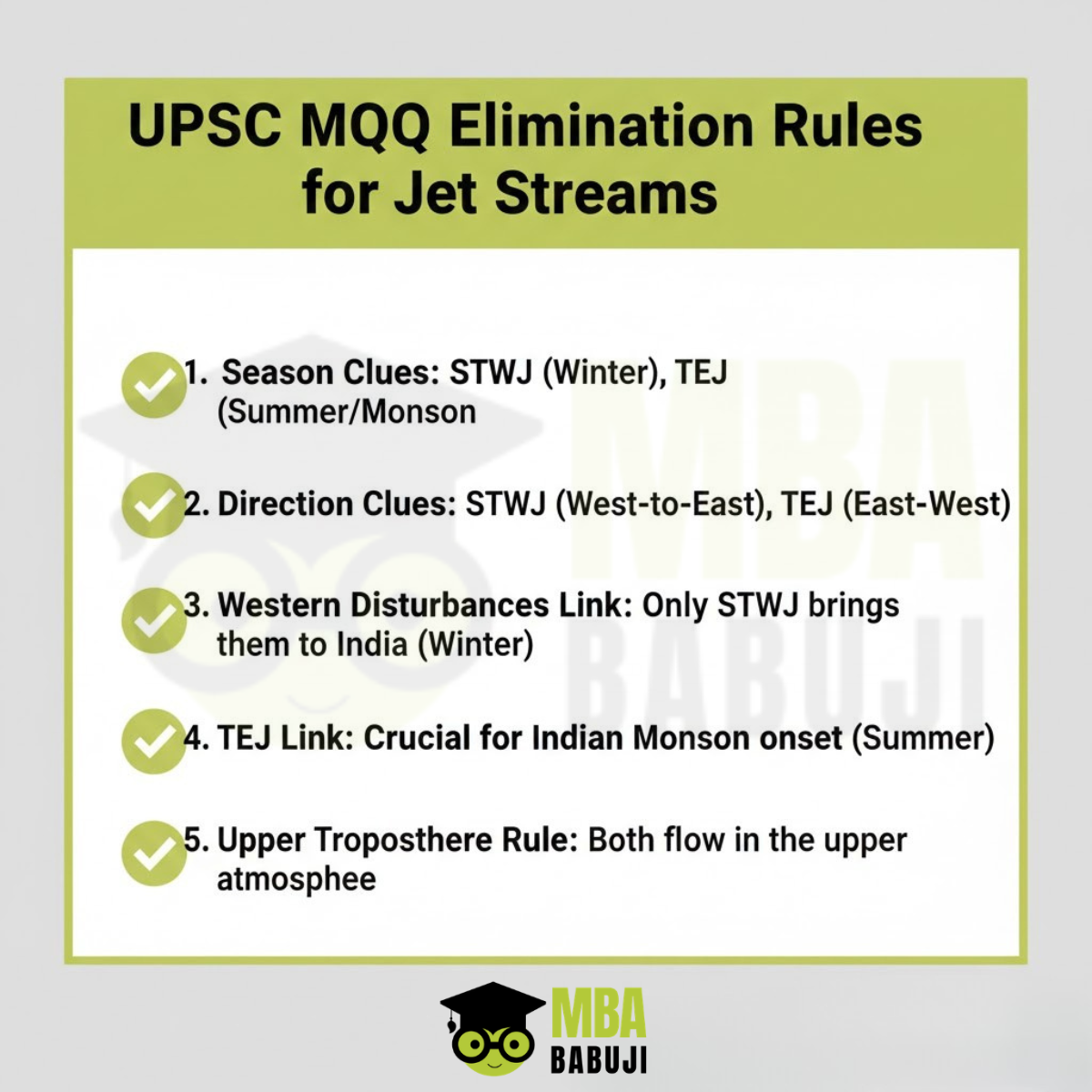
Quick Revision Notes (Prelims Ready)
Subtropical Westerly Jet (STWJ)
- Season: Winter
- Direction: West → East
- Associated with: Western disturbances
- Weather impact: Winter rain in North India
Tropical Easterly Jet (TEJ)
- Season: Summer
- Direction: East → West
- Associated with: Monsoon strength
- Weather impact: Supports monsoon rainfall
Conclusion
Jet streams are a high-yield topic for UPSC Prelims because they provide a direct conceptual base for understanding:
- Western disturbances
- Winter rainfall and snowfall
- Monsoon onset
- Seasonal reversal of winds
Aspirants who master jet stream logic can solve many MCQs using elimination even when the question looks tricky.
FAQs – Jet Streams and Indian Monsoon (UPSC)
1. What is the Subtropical Westerly Jet?
It is a fast upper-air wind blowing west to east in the subtropics, strongest in winter, and linked to Western disturbances.
2. Which jet stream is associated with Western disturbances?
The Subtropical Westerly Jet (STWJ).
3. Which jet stream supports Indian monsoon rainfall?
The Tropical Easterly Jet (TEJ) supports monsoon circulation.
4. Why does the monsoon begin when STWJ shifts north?
Because the northward shift removes the winter westerly influence and allows monsoon circulation to dominate.
5. Do jet streams flow near Earth’s surface?
No. Jet streams flow in the upper troposphere near the tropopause.
6. Why are Western disturbances important for India?
They bring winter rainfall and snowfall, supporting Rabi crops and Himalayan snow accumulation.