Role of Speaker in Indian Parliament: Neutrality vs Political Bias
Introduction
The Speaker of the Lok Sabha occupies a central position in India’s parliamentary democracy. As the presiding officer of the Lower House, the Speaker ensures the smooth functioning of parliamentary proceedings, maintains order, and safeguards democratic principles.
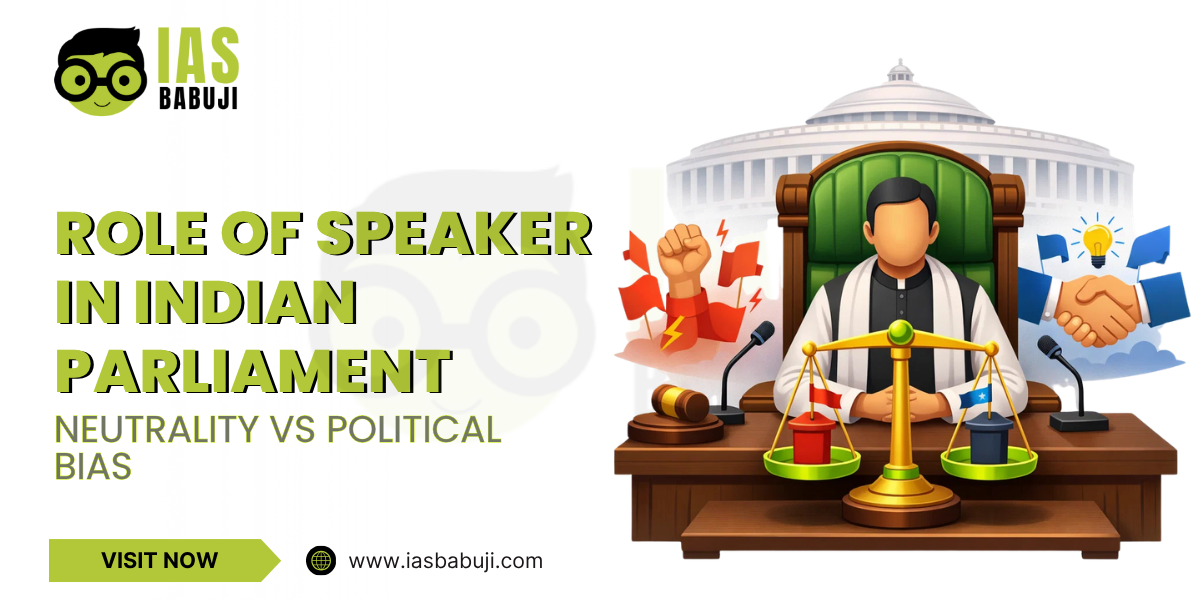
Ideally, the Speaker is expected to act in a neutral and impartial manner. However, over time, concerns have been raised regarding political bias, especially in matters such as disqualification of members and classification of bills. This has sparked a debate on whether the office of the Speaker remains truly independent.
Constitutional Position of the Speaker
The office of the Speaker is defined under the Constitution of India:
- Article 93 – Provides for election of Speaker
- Article 94
- Article 100 – Speaker casts vote in case of tie
The Speaker is elected by the Lok Sabha from among its members and remains in office during the life of the House.
Powers and Functions of the Speaker
1. Presiding Over Proceedings
Maintains order and decorum in the House.
2. Interpretation of Rules
Interprets parliamentary rules and procedures.
3. Decision on Money Bills
The Speaker decides whether a bill is a Money Bill under Article 110, and this decision is final.
4. Disqualification under Anti-Defection Law
Under the Tenth Schedule, the Speaker decides on disqualification of members.
5. Casting Vote
Exercises a casting vote in case of a tie.
6. Committee Functions
Appoints members to parliamentary committees and oversees their functioning.
Importance of the Speaker’s Role
1. Guardian of Parliamentary Democracy
Ensures proper functioning of legislative processes.
2. Protector of Members’ Rights
Safeguards the rights and privileges of MPs.
3. Ensures Discipline
Maintains decorum and order in the House.
4. Facilitates Law-Making
Ensures smooth passage of bills.
Neutrality of the Speaker: Constitutional Expectation
The Speaker is expected to be impartial and above party politics.
- Inspired by the British parliamentary tradition
- Expected to resign from party affiliations in spirit (though not mandatory in India)
- Acts as a neutral arbiter between government and opposition
Concerns Regarding Political Bias
1. Anti-Defection Decisions
Speakers have been accused of delaying or selectively deciding disqualification cases.
2. Money Bill Certification
Controversies have arisen over classification of bills as Money Bills to bypass the Rajya Sabha.
3. Partisan Conduct
Allegations of favoring ruling party during debates and proceedings.
4. Lack of Accountability
Speaker’s decisions are often difficult to challenge.
Judicial Observations
The Supreme Court has intervened in several cases to address concerns:
- Emphasized timely decisions under the Tenth Schedule
- Highlighted the need for fairness and transparency
- Suggested reforms to reduce bias
Judicial review acts as a check on the arbitrary decisions of the Speaker.
Arguments in Favour of the Current System
1. Institutional Authority
Speaker’s powers ensure the effective functioning of Parliament.
2. Quick Decision-Making
Centralized authority avoids delays.
3. Parliamentary Sovereignty
Maintains the independence of the legislature from external interference.
Criticism of the Current System
1. Conflict of Interest
Speaker is often a member of the ruling party.
2. Delay in Decisions
Disqualification cases sometimes remain pending for long periods.
3. Misuse of Powers
Especially in Money Bill certification.
Suggested Reforms
1. Independent Tribunal
Transfer anti-defection decisions to an independent body.
2. Time-bound Decisions
Set deadlines for deciding disqualification cases.
3. Codification of Powers
Clear guidelines on discretionary powers.
4. Strengthening Neutrality
Encourage resignation from party positions after election as Speaker.
5. Judicial Oversight
Allow limited judicial review to ensure fairness.
Role of Speaker in Strengthening Democracy
A neutral Speaker can:
- Promote fair debates
- Protect opposition rights
- Ensure transparency
- Strengthen public trust in Parliament
Way Forward
- Balance between authority and accountability
- Institutional reforms to ensure neutrality
- Strengthening democratic norms and conventions
Conclusion
The Speaker of the Lok Sabha is a key pillar of India’s parliamentary democracy. While the office carries immense authority, its effectiveness depends on neutrality, integrity, and adherence to constitutional values.
Ensuring the impartial functioning of the Speaker is essential for maintaining the credibility of Parliament and the health of Indian democracy.
FAQs
1. Who elects the Speaker of Lok Sabha?
Members of the Lok Sabha elect the Speaker.
2. What is the role of the Speaker in anti-defection cases?
The Speaker decides on disqualification under the Tenth Schedule.
3. Can Speaker’s decisions be challenged?
Yes, under judicial review in certain cases.
4. What is a Money Bill?
A bill defined under Article 110, certified by the Speaker.
5. Why is neutrality important?
To ensure fairness and maintain democratic principles.
6. What reforms are suggested?
Independent tribunal, time-bound decisions, and stronger neutrality norms.