• Home
  • Exam Details
  • Strategy
  • Books
  • Current Affairs
  • Contact Us
IAS Babu Ji
Advertise With Us!
  • Home
  • Exam Details
  • Strategy
  • Books
  • Current Affairs
  • State PSC Exams
  • About Us
No Result
View All Result
  • Home
  • Exam Details
  • Strategy
  • Books
  • Current Affairs
  • State PSC Exams
  • About Us
No Result
View All Result
IAS Babu Ji
No Result
View All Result
Home UPSC Study Material GS II

Jan Vishwas (Amendment of Provisions) Bill, 2026

by editorialteam
in GS II
Reading Time: 5 mins read
0
Jan Vishwas (Amendment of Provisions) Bill, 2026

Jan Vishwas (Amendment of Provisions) Bill, 2026

Share on FacebookShare on WhatsAppShare on Twitter

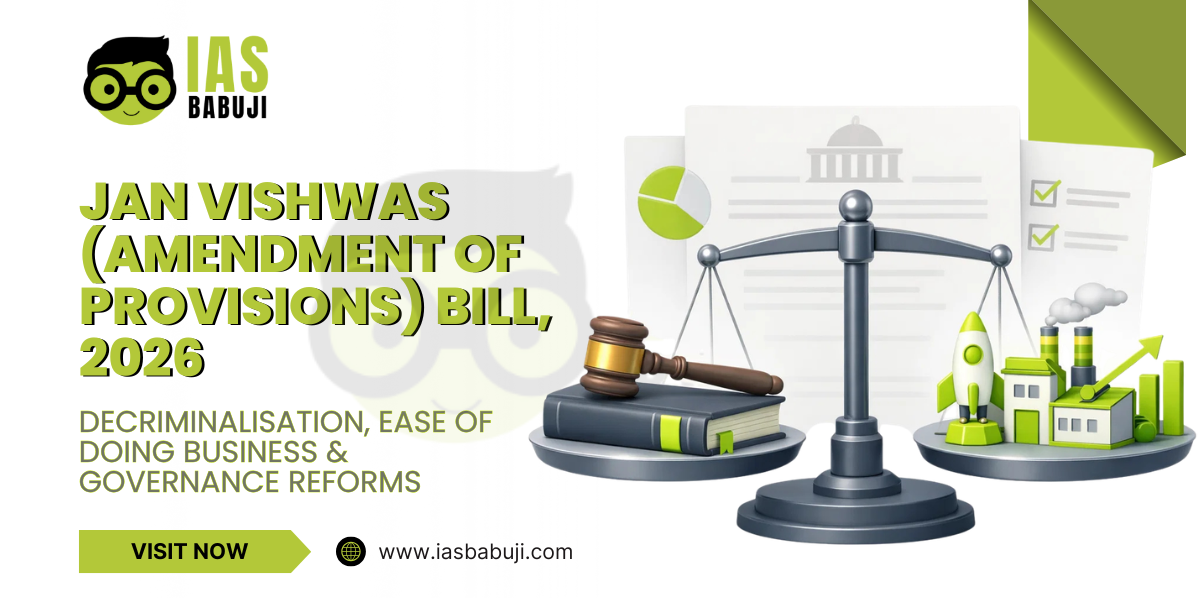
Jan Vishwas (Amendment of Provisions) Bill, 2026: Decriminalisation, Ease of Doing Business & Governance Reforms

Introduction

In recent years, India has focused on improving the ease of doing business and reducing regulatory burdens. A key step in this direction is the Jan Vishwas (Amendment of Provisions) Bill, 2026, which aims to decriminalise minor offences and rationalise penalties across multiple laws.

The Bill builds upon earlier reforms to promote trust-based governance, reduce compliance burdens, and create a more business-friendly regulatory environment.


Background and Rationale

India’s regulatory framework historically included criminal penalties for minor technical and procedural violations, leading to:

  • Fear of prosecution among businesses
  • Increased compliance costs
  • Burden on judicial system
  • Hindrance to investment and innovation

The Jan Vishwas initiative seeks to shift from a punitive approach to a facilitative one, aligning with the philosophy of “minimum government, maximum governance.”


Objectives of the Bill

1. Decriminalisation of Minor Offences

Replace imprisonment provisions with monetary penalties for minor violations.

2. Rationalisation of Penalties

Ensure penalties are proportionate and reasonable.

3. Ease of Doing Business

Reduce compliance burden and improve business confidence.

4. Trust-based Governance

Promote voluntary compliance instead of fear-driven regulation.


Key Features of the Bill

1. Amendment of Multiple Laws

The Bill amends provisions across various central laws to remove criminal liability for minor offences.

2. Replacement of Criminal Penalties

  • Imprisonment provisions replaced with financial penalties
  • Focus on civil rather than criminal liability

3. Introduction of Adjudication Mechanism

  • Appointment of adjudicating officers
  • Faster resolution of cases

4. Reduction of Litigation Burden

  • Fewer criminal cases in courts
  • Streamlined dispute resolution

5. Digitisation and Compliance Reforms

Encouragement of online compliance systems and transparency.


Significance of the Bill

1. Boost to Business Environment

Encourages entrepreneurship and reduces fear of legal action.

2. Judicial Efficiency

Reduces burden on courts by limiting criminal cases.

3. Administrative Efficiency

Simplifies regulatory enforcement.

4. Alignment with Global Practices

Moves India closer to international regulatory standards.


Impact on Governance

1. Shift from Punitive to Facilitative Approach

Government acts as a facilitator rather than enforcer.

2. Improved Compliance Culture

Encourages voluntary adherence to laws.

3. Transparency and Accountability

Clear penalty structures reduce arbitrariness.


Criticism and Concerns

1. Risk of Reduced Deterrence

Removal of criminal penalties may weaken deterrence.

2. Scope of Decriminalisation

Concerns about whether some offences should retain stricter penalties.

3. Implementation Challenges

Need for capacity building of adjudicating authorities.

4. Possibility of Misuse

Risk of businesses treating penalties as routine costs.


Comparison with Earlier Reforms

The 2026 Bill builds upon earlier efforts to:

  • Decriminalise economic laws
  • Simplify compliance frameworks
  • Promote investor confidence

It represents a continuation of structural reforms in governance.


Way Forward

1. Balanced Approach

Ensure serious offences continue to attract strict penalties.

2. Strengthening Enforcement

Improve monitoring mechanisms.

3. Capacity Building

Train adjudicating officers and regulatory bodies.

4. Public Awareness

Educate businesses about compliance requirements.

5. Periodic Review

Assess effectiveness and update provisions regularly.


Conclusion

The Jan Vishwas (Amendment of Provisions) Bill, 2026 marks a significant step toward modernising India’s regulatory framework. By reducing criminalisation and promoting trust-based governance, it aims to create a more efficient, transparent, and business-friendly environment.

However, its success will depend on effective implementation, balanced enforcement, and continuous evaluation to ensure that ease of doing business does not compromise regulatory integrity.


FAQs for UPSC Preparation

1. What is the Jan Vishwas Bill 2026?

It is a legislative reform aimed at decriminalising minor offences and improving ease of doing business.

2. What is the main objective?

To replace criminal penalties with civil penalties and promote trust-based governance.

3. How does it impact businesses?

It reduces compliance burden and fear of prosecution.

4. What is decriminalisation?

Removing imprisonment provisions and replacing them with fines.

5. What are the concerns?

Reduced deterrence and implementation challenges.

6. Which GS paper is it relevant for?

GS Paper 2 – Governance and Government Policies.

Post Views: 0
Tags: Decriminalisation IndiaEase of Doing BusinessGovernment Reforms IndiaGS2 GovernanceJan Vishwas Bill 2026Policy Reform IndiaUPSC Current Affairs
ShareSendTweet
Previous Post

Role of Speaker in Indian Parliament

Related Posts

Role of Speaker in Indian Parliament
GS II

Role of Speaker in Indian Parliament

by editorialteam
Delimitation in India
GS II

Delimitation in India

by editorialteam
Reforming the Rajya Sabha
GS II

Reforming the Rajya Sabha

by editorialteam
Judicial Activism in India
GS II

Judicial Activism in India

by editorialteam
Electoral Bonds Case
GS II

Electoral Bonds Case

by editorialteam

Recent Posts

  • Jan Vishwas (Amendment of Provisions) Bill, 2026
  • Role of Speaker in Indian Parliament
  • Coalition Politics in India
  • Delimitation in India
  • Reforming the Rajya Sabha
  • Judicial Activism in India
  • Electoral Bonds Case

Browse by Category

  • 2019
  • Admit Card
  • Age Limit
  • Andhra Pradesh Public Service Commission (APPSC)
  • Assam Public Service Commission (APSC)
  • Bihar Public Service Commission (BPSC)
  • CAPF
  • CDS
  • Chhattisgarh Public Service Commission (CGPSC)
  • CMS
  • Cut Off Marks
  • Economics
  • Economics
  • Economics Books
  • Editorial Articles
  • Eligibility Criteria
  • Environment & Ecology
  • EPFO
  • Essay Writing
  • Ethics
  • Ethics Books
  • Exam Pattern
  • Geography
  • Geography Books
  • GS II
  • GS III
  • Gujarat Public Service Commission (GPSC)
  • Haryana Public Service Commission (HPSC)
  • Himachal Pradesh Public Service Commission (HPPSC)
  • Hindi Medium
  • History
  • History
  • History Books
  • IAS
  • IAS & IPS Officers
  • IAS Exam (CSE)
  • IES
  • IFS
  • IFS
  • Indian Polity
  • Internal Security
  • International Relations
  • IPS
  • IRS
  • ISS
  • Jammu and Kashmir Public Service Commission (JKPSC)
  • Jharkhand Public Service Commission (JPSC)
  • Karnataka Public Service Commission (KPSC)
  • Kerala Public Service Commission (KPSC)
  • Kurukshetra Magazine
  • Madhya Pradesh Public Service Commission (MPPSC)
  • Maharashtra Public Service Commission (MPSC)
  • Mains General Studies
  • Mains Syllabus
  • Mathematics
  • NCERT Books
  • NDA
  • Notification
  • Odisha Public Service Commission (OPSC)
  • Offline Coaching
  • Online Application
  • Online Coaching
  • Optional Subjects
  • Prelims Books
  • Prelims Exam
  • Prelims General Studies
  • Prelims Syllabus
  • Press Information Bureau (PIB)
  • Public Administration
  • Punjab Public Service Commission (PPSC)
  • Rajasthan Public Service Commission (RPSC)
  • RSTV
  • Science & Technology
  • SCRA
  • Sociology
  • State Public Service Commission
  • Tamil Nadu Public Service Commission (TNPSC)
  • The Hindu
  • The Indian Express
  • Uncategorized
  • UPSC Books
  • UPSC Coaching
  • UPSC CSE Subjects
  • UPSC Current Affairs
  • UPSC Exam Details
  • UPSC Exams
  • UPSC Interview Process
  • UPSC Posts
  • UPSC Question Papers
  • UPSC Strategy
  • UPSC Study Material
  • UPSC Syllabus
  • UPSC Test Series
  • UPSC Training
  • Uttar Pradesh Public Service Commission (UPPSC)
  • Uttarakhand Public Service Commission (UKPSC)
  • West Bengal Public Service Commission (WBPSC)
  • Yojana Magazine

Browse by Tags

basic structure doctrine British India Centre State Relations Current Affair Dam Economy Empathy in Governance Exam Topper Federalism India Foreign Relations Government Scheme Government Schemes GS 2 Judiciary GS 2 Polity GS2 Polity GS II polity History IAS IAS Officer IAS Officer Power IFS Officer Inclusive Growth Indian Constitution Indian Democracy Indian Economy Inflation in India Informative Content IPS Officer judicial review India Kesavananda Bharati Case net zero 2070 India Political Leader PSC RBI Supreme Court Judgments UPSC UPSC Calendar UPSC CAPF Exam UPSC CDS Exam UPSC Coaching UPSC Current Affairs UPSC GS III Economy UPSC Polity Notes UPSC Preparation UPSC Question Paper War
  • Home
  • Exam Details
  • Strategy
  • Books
  • Current Affairs
  • Contact Us
Contact us at [email protected]

© 2021 IAS BABU JI - One-Stop Solution for UPSC Exam Aspirants

No Result
View All Result
  • Home
  • Exam Details
  • Strategy
  • Books
  • Current Affairs
  • Contact Us

© 2021 IAS BABU JI - One-Stop Solution for UPSC Exam Aspirants

Are you sure want to unlock this post?
Unlock left : 0
Are you sure want to cancel subscription?