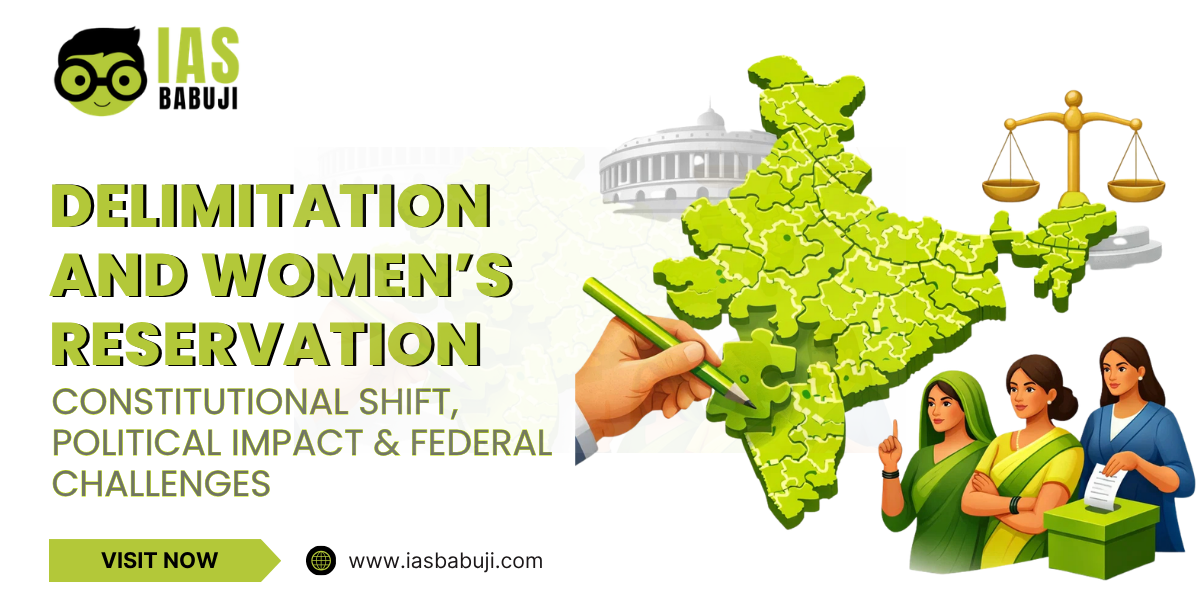
Delimitation and Women’s Reservation: Constitutional Shift, Political Impact & Federal Challenges
Introduction
India stands at a crucial juncture in its democratic evolution with the proposed linkage between delimitation and women’s political representation. On 16 April 2026, the Union Government initiated a special parliamentary session to deliberate on the Constitution (131st Amendment) Bill, 2026 and the Delimitation Bill, 2026.
These reforms aim to fast-track the implementation of 33% women’s reservation in the Lok Sabha by decoupling it from a future Census. While this move is seen as progressive, it has triggered intense debates on representation, federal balance, and democratic fairness.
Background: Women’s Reservation and Delimitation Link
The Nari Shakti Vandan Adhiniyam mandated that women’s reservation would come into effect only after:
- Conduct of the next Census
- Subsequent delimitation exercise
However, delays in the Census (originally scheduled for 2021) created uncertainty.
The Shift: Fast-Tracking Women’s Reservation
To overcome delays, the government has proposed a major shift:
Key Change:
- Use of 2011 Census data instead of waiting for a fresh Census
- Immediate delimitation to enable reservation
Target:
- Implementation of 33% reservation (approx. 273 seats)
- Effective from 2029 General Elections
This marks a significant move toward accelerating women’s political participation.
Understanding Delimitation
Delimitation refers to the redrawing of electoral boundaries to ensure equal representation.
Constitutional Basis:
- Article 81
- Article 82
Traditionally, delimitation follows a Census to reflect population changes.
Reshaping Lok Sabha Representation
1. Expansion of Lok Sabha
To accommodate women’s reservation without reducing existing seats:
- Proposed increase from 543 seats to ~816–850 seats
2. Constitutional Changes Required
- Amendment to Article 81 (seat allocation)
- Amendment to Article 82 (delimitation process)
- Removal of the 1976 freeze on seat increase
3. Improved Representation
- Smaller constituencies
- Better MP-to-voter ratio (currently ~2.5 million voters per MP)
Federal Challenges and North-South Divide
The most critical debate revolves around federal balance.
1. Demographic Imbalance
- Northern states (e.g., Uttar Pradesh, Bihar) have higher population growth
- Southern states (e.g., Tamil Nadu, Kerala) have controlled population
Result:
- Northern states may gain seats
- Southern states may lose relative representation
2. “Demographic Penalty” Concern
States that successfully implemented population control policies fear being penalized politically.
3. Fiscal Implications
- Representation affects tax devolution and policy influence
- Economically stronger states may have reduced political weight
4. Projection-Based Concerns
- Northern states may gain 40+ seats
- Southern states could face a net loss in influence
Legislative and Institutional Changes
1. New Delimitation Commission
A fresh Delimitation Commission of India will:
- Be chaired by a former Supreme Court judge
- Redraw constituency boundaries
- Issue decisions with force of law (non-justiciable)
2. Simple Majority Trigger
The proposed amendment allows delimitation to be initiated by a simple parliamentary majority, increasing flexibility but raising concerns about executive dominance.
Significance of the Reform
1. Boost to Women’s Representation
- Historic step toward gender equality in politics
- Potential to reshape legislative priorities
2. Electoral Reform
- Updates outdated constituency structures
3. Governance Efficiency
- Smaller constituencies → better accessibility
Criticism and Concerns
1. Federal Imbalance
Risk of weakening cooperative federalism
2. Political Controversy
Seen by critics as using women’s reservation as a policy lever for delimitation
3. Democratic Fairness
Debate on whether population alone should determine representation
4. Institutional Concerns
Reduced scope for judicial review and increased executive discretion
Way Forward
1. Balanced Formula
Adopt a weighted model combining:
- Population
- Development indicators
- Governance performance
2. Protect Federalism
Ensure fair representation for all regions.
3. Transparent Process
- Public consultations
- Parliamentary debates
4. Strengthen Consensus
Build agreement among states to avoid political conflict.
Conclusion
The proposed linkage between delimitation and women’s reservation represents a major structural reform in Indian democracy. While it promises enhanced representation and gender inclusion, it also raises serious concerns regarding federal balance and regional equity.
The success of this reform will depend on achieving a delicate balance between democratic representation, gender justice, and cooperative federalism.
FAQs for UPSC Preparation
1. What is delimitation?
It is the process of redrawing electoral boundaries based on population.
2. What is the Women’s Reservation Act 2023?
It provides 33% reservation for women in Lok Sabha and State Assemblies.
3. Why is delimitation linked to women’s reservation?
Reservation implementation requires redrawing constituencies.
4. What is the key change in 2026 proposals?
Using 2011 Census data instead of waiting for a new Census.
5. What is the major concern?
North-South imbalance in political representation.
6. Which GS paper is it relevant for?
GS Paper 2 – Polity & Governance.