
How to Crack UPSC While Working Full-Time
Many working professionals clear UPSC every year by following a focused, realistic plan instead of waiting for “free time.” It is less about how many hours you have and more about how consistently and intelligently you use them. “It’s not about time availability, but time optimization” perfectly captures the mindset required to crack UPSC while working full-time.
Introduction
Preparing for UPSC CSE while managing a full-time job is challenging but absolutely achievable with the right strategy. Long office hours, stress, commuting, and family responsibilities often make aspirants feel they are starting with a disadvantage. Yet, year after year, candidates from IT, banking, teaching, corporate roles and government services successfully clear the exam while working. The key is to design a realistic UPSC study plan for working professionals that maximizes limited time through structure, prioritization, and consistency. Instead of chasing ideal conditions, focus on optimizing what you already have and building a sustainable routine.
Can Working Professionals Clear UPSC? (Reality Check)
Many successful officers were once full-time employees who prepared alongside demanding jobs. Working professionals bring crucial advantages: discipline built through daily office routines, financial stability that reduces anxiety, and maturity in decision-making. These factors often help them handle UPSC’s long preparation cycle better than some full‑time aspirants. However, mental barriers can be stronger than practical constraints. Guilt about not studying enough, burnout after hectic days, and comparing oneself with full-time aspirants can be more damaging than any timetable issue. The first step is to accept that your journey will look different, but it is equally capable of reaching the final list.
Key Challenges Faced by Working Professionals
Working aspirants typically struggle with a cluster of predictable challenges:
- Long or unpredictable working hours, including overtime, meetings or urgent tasks.
- Limited weekday study windows, often restricted to early morning and late night.
- Fatigue and mental exhaustion after office, reducing concentration.
- Difficulty in maintaining a strong revision cycle, leading to quick forgetting.
- Less time for answer writing, MCQs and mock tests compared to full-time aspirants.
- Irregular weekends because of social commitments, travel or office work.
- Overall inconsistency: some very productive days, followed by complete breaks.
Designing an IAS preparation strategy for working people means directly addressing these realities instead of ignoring them.
UPSC Preparation Strategy for Working People
a) Time Audit and Goal Setting
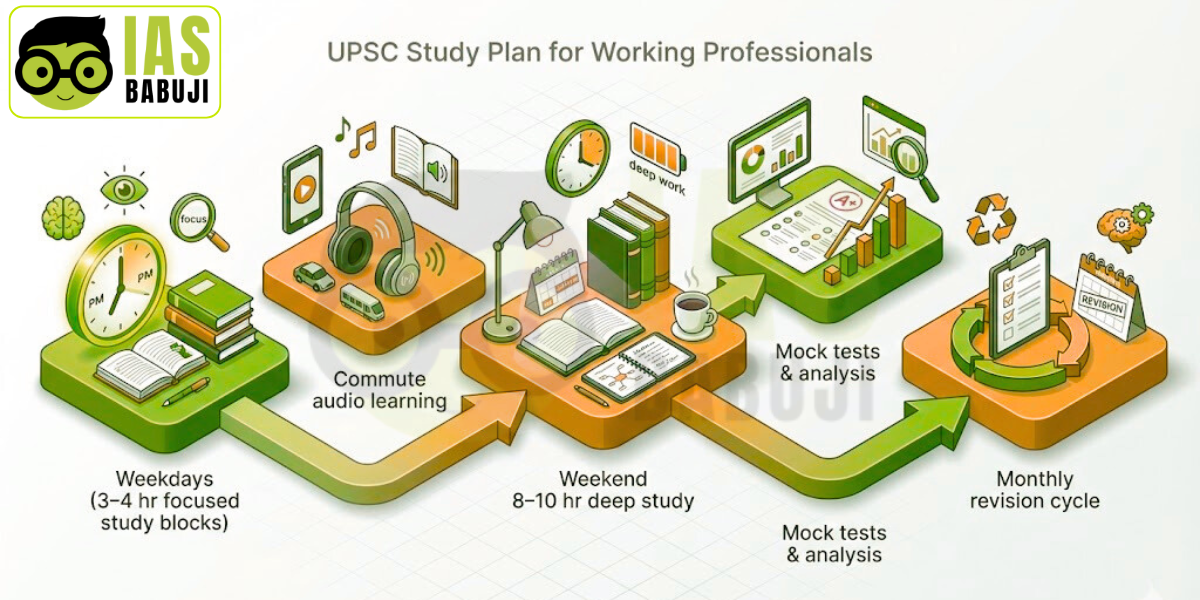
Start with a one-week time audit. Track how many hours you spend on sleep, work, commute, meals, social media, entertainment and family. Most employed aspirants can carve out 3–4 focused hours on weekdays and 8–10 hours on weekends once low-value activities are reduced. Define clear monthly and weekly targets: for example, “Finish Polity basics by Week 4” or “Complete 10 full-length GS mocks by Month 6.” Convert vague dreams into measurable goals.
b) The 3–4 Hour Weekday Strategy
A realistic UPSC study plan for working professionals relies on 3–4 productive hours each weekday:
- Morning slot (60–90 minutes): Fresh, distraction-free time for core GS or optional theory. Aim for one subtopic per morning.
- Commute learning (30–45 minutes): Use audio lectures, podcasts, or recorded discussions for current affairs, economy or ethics.
- Evening slot (60–90 minutes): Practice-heavy work: MCQs, answer-writing, map work or revision.
- 10-minute night revision: Before sleeping, quickly recap key points in a notebook or app. This micro-revision reinforces memory.
Even with this modest structure, you add 15–20 quality hours per week, enough to build a strong foundation over months.
c) Weekend Power Plan
Weekends are the backbone of UPSC preparation tips for working professionals:
- 8–10 hours per day in 2–3 hour blocks with proper breaks.
- One full-length mock test (Prelims or Mains) every weekend, followed by at least 1–2 hours of analysis.
- Use Saturdays primarily for GS subject completion (e.g., Polity chapters, Modern History units).
- Reserve half of Sunday for optional subject: building notes, practicing questions, or covering one major theme.
- The remaining time is for current affairs compilation: revising the week’s newspaper notes, monthly magazine highlights, and government reports.
d) The 60–30–10 Rule
To prevent imbalance, use this simple distribution:
- 60% time – GS (Prelims + Mains): Polity, History, Geography, Economy, Environment, Ethics.
- 30% time – Optional subject: Even for working aspirants, optional must not be ignored.
- 10% time – Current Affairs: Daily newspaper, weekly compilations and issue-based notes.
This ratio keeps your IAS preparation strategy for working people aligned with actual marks distribution.
e) The 90-Day Foundation Strategy
For the first three months:
- Complete key NCERTs (Class 6–12 selectively) for Polity, History, Geography, Economics and Science.
- Build a basic newspaper summary habit: one page per day covering only exam-relevant issues.
- Start optional basics: standard textbook first reading, chapter-wise note-making.
- Introduce answer writing early: 2–3 questions every alternate day, even if answers are short.
This foundation phase ensures that later advanced sources and mock tests actually make sense.
Smart Study Techniques to Maximize Limited Time
a) Pomodoro + Deep Work
Use 25–30 minute “deep work” sessions followed by 5-minute breaks. During a session, keep phone away, close all extra tabs, and commit to finishing one small task (e.g., “Laxmikanth – President and Governor” or “10 MCQs on Environment”). After 3–4 cycles, take a longer 20-minute break.
b) Focus on High-Return Topics
Working aspirants cannot afford to be perfectionists in every micro-area. Give extra focus to:
- Polity (Constitution, Parliament, Judiciary, Federalism, Rights).
- Economy (basic concepts, budget, monetary/fiscal policy, inclusive growth).
- Geography (physical, Indian geography, mapping).
- Environment (biodiversity, climate change, laws and institutions).
- Modern History and Freedom Struggle.
- Selected Science & Tech (space, biotech, ICT, environment-linked tech).
These areas are heavily represented across both Prelims and Mains.
c) Newspaper in 20 Minutes
UPSC study plan for working professionals demands efficient newspaper reading:
- Use a fixed time cap – 20 minutes.
- Focus on national issues, economy, important judgments, governance, environment and international relations.
- Skip routine political fights, celebrity news and pure crime reports.
- Maintain short bullet-point notes by theme (e.g.,
- Themes like “health policy”, “energy transition”, “urban governance”) instead of date-wise clippings. This makes revision faster and connects directly with the UPSC Mains syllabus.
d) Mini Revision Sessions
Throughout the day, insert 5–10 minute micro‑revisions:
- Flashcards for important articles, schemes, and definitions.
- One-page mind maps for subjects like Polity or Ethics.
- Quick mental quizzes during walks or coffee breaks.
These small revisions multiply your effective study time without feeling like heavy sessions.
Best Online Resources for Working Aspirants
Working professionals should lean heavily on concise, reliable online resources:
- PIB summaries: For government schemes, policy updates, and official terminology in answer writing.
- Rajya Sabha TV / Sansad TV discussions: High-quality debates on governance, policy and international relations; excellent for Mains GS2/GS3 and essay ideas.
- NCERT PDFs and e-books: Free official materials for conceptual clarity in History, Geography, Polity, Economics and Science.
- Government reports and websites: NITI Aayog, Economic Survey highlights, India Year Book chapters; use summary versions first.
- Mock test platforms: Online Prelims tests and Mains test series allow you to practice from home on weekends.
- Current affairs apps: Daily news capsules and quizzes during commute or breaks.
- Telegram/online forums (optional): For doubt discussions and PDF sharing—use cautiously to avoid distraction.
Subject‑Wise Preparation Plan
Polity
- Core book: one standard textbook like Laxmikanth for concepts and static theory.
- Strategy:
- Weekdays: 1–2 sub-topics per session (e.g., Fundamental Rights, Parliament).
- Weekend: revise chapters via MCQs and short notes.
- Integrate current issues like ordinances, bills, and Supreme Court judgments with static topics.
Economy
- Start with school-level economics NCERTs and a basic macroeconomics book.
- Add Budget and Economic Survey summaries closer to the exam.
- Practice conceptual MCQs on inflation, GDP, deficits, monetary/fiscal tools, and welfare schemes.
History
- Modern History: one go-to book like Spectrum with focus on freedom struggle, movements, and personalities.
- Ancient/Medieval: selective NCERT coverage, mainly for culture and Art & Culture topics.
- Use timelines and charts to remember sequences.
Geography
- Read relevant NCERTs (6–12) + one atlas.
- Make your own maps for rivers, mountains, soil types, climate and important locations.
- Focus on India-centric aspects: monsoon, agriculture, resources, disasters.
Environment
- Standard reference (e.g., Shankar IAS-type book) plus current affairs on conventions, species, climate negotiations, and national parks.
- Practice integrated MCQs combining geography and environment.
Science & Tech
- Conceptual understanding of space, nuclear tech, biotech, IT, cyber security, AI, and their applications in governance and environment.
- Rely more on newspaper and monthly compilations than thick textbooks.
Optional Subject Strategy
- Pick an optional you can study even after a tiring day (interest matters more than trend).
- Break syllabus into 8–10 modules and target one module per month.
- Use weekends for theory and weekday nights for answer writing and revision.
- Build 1–2 model answers per topic and gradually refine them.
Mock Tests Strategy for Working Professionals
Mocks are non‑negotiable, but you must schedule them wisely.
- Prelims:
- First 3–4 months: 1 test every 2 weeks.
- Next phase: 1 test every weekend, increasing to 2 closer to the exam.
- Daily habit: 10–20 MCQs with detailed review.
- Mains:
- One GS answer-writing session on 2–3 weekdays (2–3 questions each).
- One full GS paper or essay every 2 weeks on weekends.
- Analysis:
- Identify question types you frequently miss.
- Separate errors into knowledge gaps, silly mistakes, and time-management issues.
- Revise related concepts immediately after each test.
Stress Management & Productivity Tips
Working aspirants often burn out because they treat UPSC prep like a sprint instead of a marathon.
- Sleep schedule: Aim for 6.5–7.5 hours of quality sleep; chronic sleep debt destroys retention and focus.
- Digital minimalism: Uninstall non-essential social media apps or restrict them to 15–20 minutes per day.
- Movement breaks: Short walks, stretching, or light exercise to reset energy between work and study.
- Music & environment: Use calm instrumental music, clean desk, and good lighting to signal “study mode.”
- Light Sundays every 3–4 weeks: Take a half‑day break with guilt‑free rest to prevent long-term burnout.
- Handling demotivation: Revisit your reasons for attempting UPSC, talk to mentors/peers, and re‑plan instead of quitting after a bad week.
Sample Weekly Timetable for Working Professionals
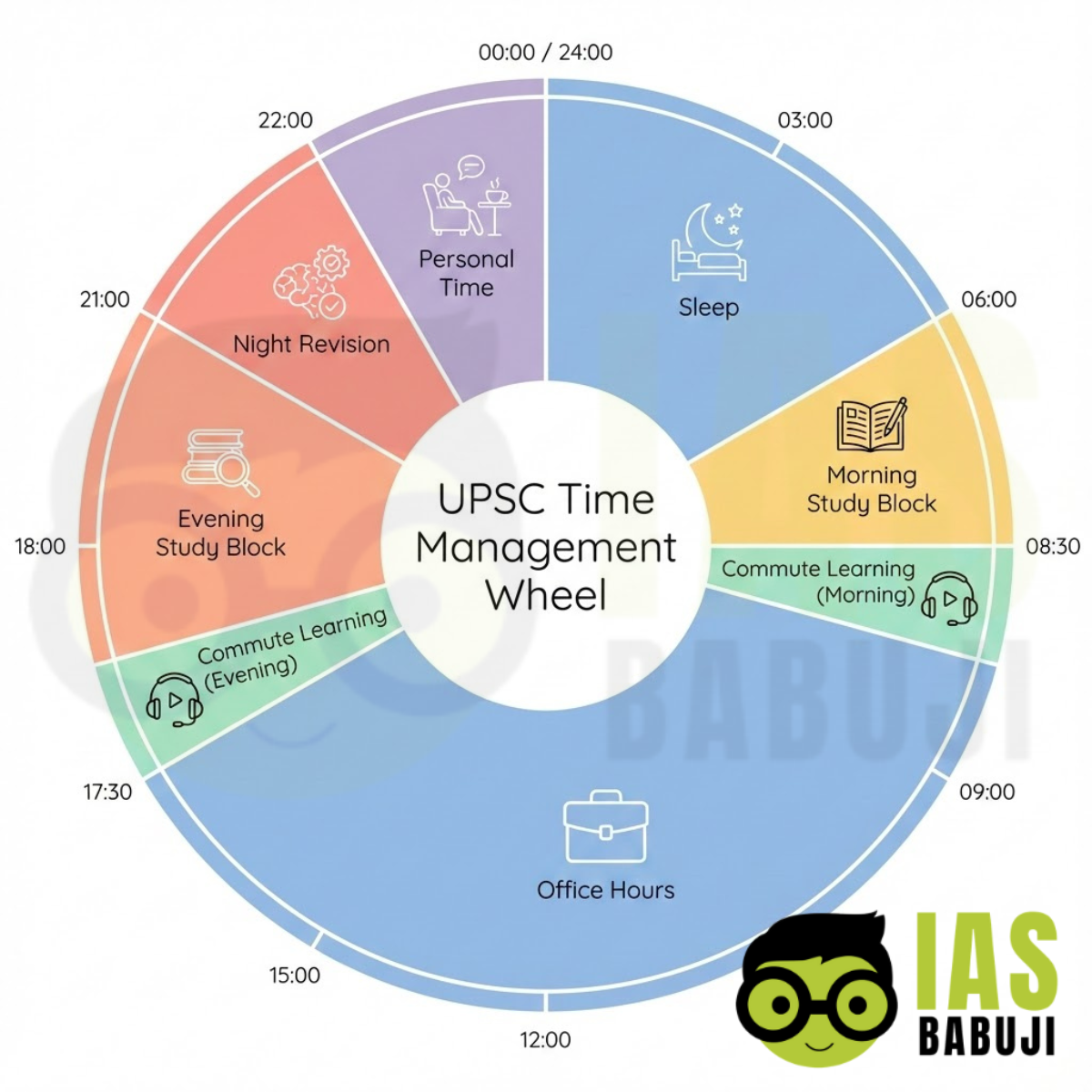
Below are sample structures you can customize.
a) Five‑Day Office (Mon–Fri), Weekends Off
| Day | Morning (1–1.5 hrs) | Commute (30–45 mins) | Evening (1.5–2 hrs) | Night (10 mins) |
|---|---|---|---|---|
| Mon–Thu | Core GS topic | Audio lectures / news recap | MCQs + short answer writing | Quick revision |
| Friday | Optional subject | Current affairs audio | Optional revision + mapping | Weekly review |
| Saturday | 2–3 hr GS block + 2–3 hr GS | CA compilation + video debates | Prelims mock / Mains practice | Summary notes |
| Sunday | Optional subject (3–4 hrs) | Essay / Ethics practice | Light revision + planning next week | Rest / relax |
b) Six‑Day Office (Half‑Day Saturday)
| Slot | Plan |
|---|---|
| Weekdays | Same 3–4 hour strategy; decrease answer writing frequency slightly. |
| Saturday | After work: 2–3 hours – mock test or optional. |
| Sunday | 6–8 intense hours: GS completion, optional, and current affairs. |
c) Rotational Shifts
- Fix two anchor blocks: one before shift, one after.
- If night shifts, treat daytime as your “evening” and keep one main 2–3 hour block plus one lighter 1–1.5 hour block.
- Use days off for mock tests and long theory sessions.
d) Work‑From‑Home Aspirants
- Higher flexibility but more distraction risk.
- Use 3 big blocks of 1.5–2 hours (morning, afternoon, evening) around work slots.
- Keep strict boundaries: specific hours for office tasks, specific hours for UPSC.
Do’s and Don’ts for Working Professionals
Do’s
- Do prioritize basics (NCERTs, core GS, and optional foundation) in the first 6 months.
- Do maintain a minimum daily streak—at least 60 minutes of meaningful study even on the worst days.
- Do use weekends for mocks and heavy theory.
- Do integrate current affairs with static topics regularly.
Don’ts
- Don’t overburden weekdays with unrealistic 6–7 hour plans; failure will break confidence.
- Don’t skip weekend tests; they show you reality and guide revision
Don’t compare your routine with full-time aspirants who can study 8–10 hours daily; your advantage is efficiency and maturity, not raw hours. Don’t keep changing books and sources; stick to one core book per subject and one main test series.
Conclusion
Cracking UPSC while working full-time is demanding but absolutely possible with a smart plan, realistic expectations, and disciplined execution. Thousands of aspirants from IT, banking, teaching, corporate and government jobs prove every year that consistent 3–4 hours on weekdays plus strong weekend efforts can match full-time preparation. Treat your job as an asset that builds stability and discipline, not as an enemy of success. Focus on small daily wins, structured revision, and regular mock tests. Slow progress is still progress—if you keep moving in the right direction, the distance to the final list will keep shrinking.
FAQs on “How to Crack UPSC While Working Full-Time”
Q1. Can I clear UPSC in one year while working full time?
Yes, it is possible but challenging. One year is usually enough only if you already have basic awareness of subjects, can manage around 3–4 focused hours on weekdays and 8–10 hours on weekends, and follow a tight, non‑negotiable study plan. You must minimize book hopping, rely on limited but high-quality sources, and write regular mocks. For true beginners, one year is more realistic for building a strong base and gaining exam experience, even if final selection takes slightly longer.
Q2. Is 4 hours a day enough for UPSC preparation?
Four high-quality hours a day, combined with heavy weekends, can be sufficient over 12–18 months if used wisely. The key is focus and continuity: using those hours for core GS, optional, revision and answer writing—not scattered reading and passive videos. If you maintain 4 hours on weekdays and 8–10 hours on weekends for a sustained period, you effectively reach 30–35 hours per week, which is comparable to many full-time aspirants. Consistency matters far more than occasional 8–10 hour bursts.
Q3. How do working professionals manage optional subjects?
Working professionals should treat the optional like a long-term project. Break the syllabus into 8–10 modules and assign one module per month, using weekends for theory and weekdays for 1–2 hours of revision or answer writing. Start with one standard textbook and class notes or a reliable guide, then gradually build topic‑wise notes and model answers. Integrate optional practice in your weekend schedule: at least 1–2 optional answers every week initially, rising to mini tests once a fortnight as the exam nears.
Q4. Should I leave my job for UPSC?
Leaving your job is a personal and financial decision, not a requirement for success. Many aspirants clear the exam while working, using their salary to fund materials and maintain mental security. If your job is extremely demanding with no predictable study time, you might consider switching roles, reducing hours, or taking a sabbatical instead of fully quitting. Always evaluate your savings, family responsibilities and backup plans before resigning. A stable mind and realistic risk management often matter more than a few extra study hours.
Q5. How can night‑shift employees prepare for UPSC?
Night‑shift aspirants should invert the typical timetable while protecting sleep. Use 2–3 hours after waking (before reporting for duty) as your main “morning” block for GS or optional. During the shift’s low‑work periods and breaks, revise notes, read current affairs, or solve a small set of MCQs. After work, do only 30–40 minutes of light revision and avoid heavy theory before sleeping. Use weekly off days aggressively for mocks and long study sessions, but still retain at least one partial rest block to avoid burnout.
Q6. How do working aspirants handle answer writing and essay practice?
Start small: 2–3 GS questions twice a week on weekdays, focusing first on structure (intro–body–conclusion, subheadings, examples). On weekends, write one 10‑question mini test or one full GS paper every 2–3 weeks. For essays, aim for one essay every 2 weeks initially, then weekly closer to Mains. After writing, compare with topper copies or good model answers, mark gaps in content and structure, and rewrite partial answers to internalize the improvements. Over time, your speed and coherence will improve without needing daily long sessions.