• Home
  • Exam Details
  • Strategy
  • Books
  • Current Affairs
  • Contact Us
IAS Babu Ji
Advertise With Us!
  • Home
  • Exam Details
  • Strategy
  • Books
  • Current Affairs
  • State PSC Exams
  • About Us
No Result
View All Result
  • Home
  • Exam Details
  • Strategy
  • Books
  • Current Affairs
  • State PSC Exams
  • About Us
No Result
View All Result
IAS Babu Ji
No Result
View All Result
Home UPSC Study Material Indian Polity

Indira Nehru Gandhi vs Raj Narain (1975)

by editorialteam
in Indian Polity
Reading Time: 5 mins read
0
Indira Nehru Gandhi vs Raj Narain (1975)

Indira Nehru Gandhi vs Raj Narain (1975)

Share on FacebookShare on WhatsAppShare on Twitter

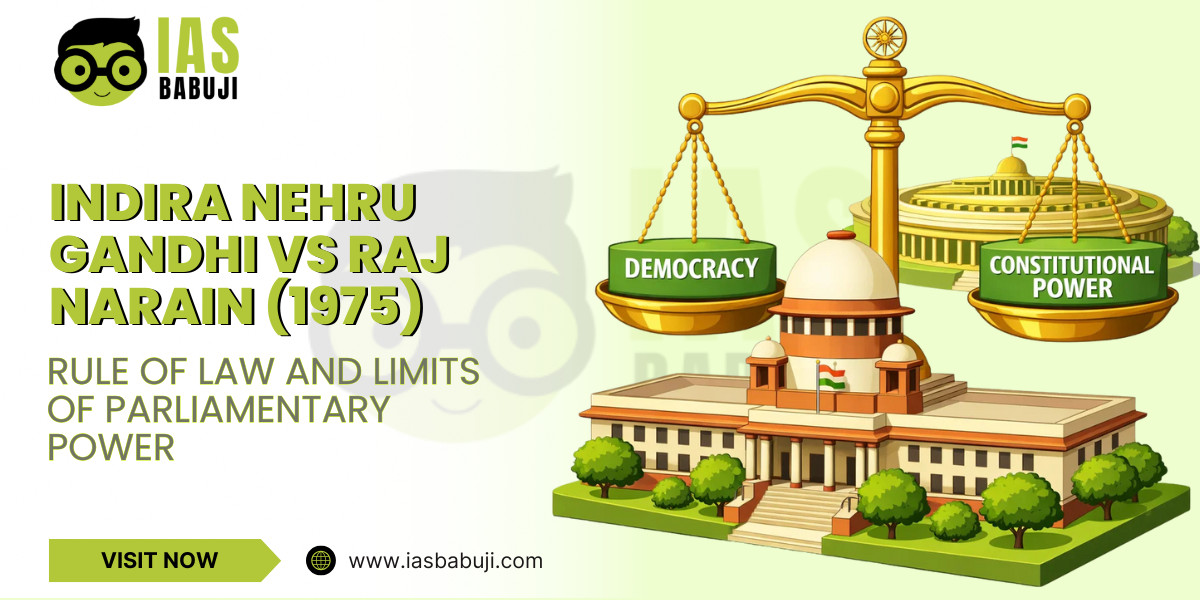
Indira Nehru Gandhi vs Raj Narain (1975): Rule of Law and Limits of Parliamentary Power

Introduction

The Indira Nehru Gandhi v. Raj Narain (1975) case is one of the most politically significant judgments in Indian constitutional history. Delivered at a critical moment in India’s democratic journey, the verdict reinforced the supremacy of the Constitution, upheld the rule of law, and placed clear limits on parliamentary power.

For UPSC aspirants, this case is essential to understand the relationship between democracy, elections, judicial review, and constitutional morality, especially in the context of the Emergency period.


Background of the Case

  • Raj Narain challenged the election of Indira Gandhi to the Lok Sabha from Rae Bareli constituency
  • He alleged misuse of government machinery and corrupt electoral practices
  • The Allahabad High Court found Indira Gandhi guilty of electoral malpractice and invalidated her election in 1975
  • This judgment triggered a constitutional and political crisis, leading to the declaration of an emergency
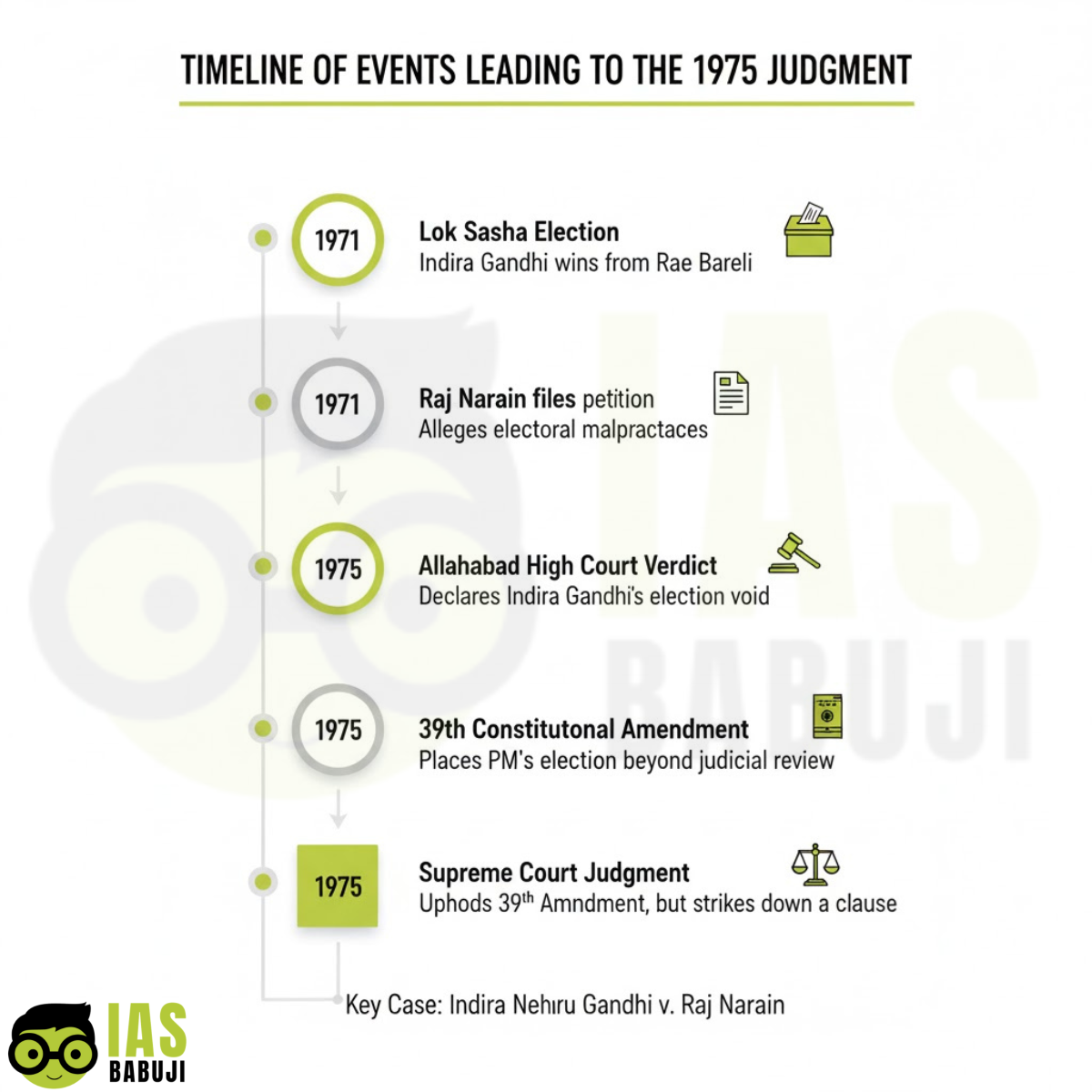
Timeline of Events Leading to the 1975 Judgment

Constitutional Provisions Involved

  • Article 329A – Special provisions regarding elections to Parliament
  • Article 368 – Power of Parliament to amend the Constitution
  • Article 14 – Equality before the law
  • Article 21 – Right to life and personal liberty

Key Issues Before the Supreme Court

  1. Can Parliament place the election of the Prime Minister beyond judicial scrutiny?
  2. Does a constitutional amendment override the rule of law?
  3. Is a free and fair election a basic feature of the Constitution?

Supreme Court Judgment (1975)

The Supreme Court delivered a split verdict but struck down Clause (4) of Article 329A, which sought to validate Indira Gandhi’s election by removing judicial review.

Key Findings

  • Rule of Law is a part of the Basic Structure of the Constitution
  • Judicial review cannot be excluded from election disputes
  • Free and fair elections are essential for democracy
  • Parliament cannot use its amending power to destroy constitutional fundamentals

Significance of the Judgment

1. Assertion of Rule of Law

  • The judgment reaffirmed that no authority is above the Constitution
  • Even the Prime Minister is subject to constitutional scrutiny

2. Strengthening of Judicial Review

  • The Supreme Court protected its power to examine constitutional amendments
  • It prevented the misuse of Parliament’s amending power

3. Protection of Democratic Values

  • Elections were recognized as central to constitutional democracy
  • Prevented executive dominance during the Emergency

Impact on Constitutional Jurisprudence

  • Expanded the scope of the Basic Structure Doctrine
  • Influenced later cases such as Minerva Mills (1980)
  • Reinforced limits on Parliament’s constituent power

Criticism of the Judgment

  • Some viewed it as judicial interference in political matters
  • The split verdict created ambiguity on certain constitutional questions
  • Critics argued it deepened executive–judiciary conflict

Despite criticism, the judgment is widely seen as a guardian of constitutional democracy.


UPSC Prelims and Mains Relevance

Prelims Focus

  • Year of judgment – 1975
  • Linked with the Emergency period
  • Rule of Law declared part of Basic Structure

Mains (GS-II)

  • Role of the judiciary in preserving democracy
  • Judicial review of constitutional amendments
  • Elections and constitutional morality

Essay and Ethics

  • Abuse of power
  • Accountability of public office holders
  • Democratic governance

Previous Year Question (PYQ)

UPSC Mains 2017
“Discuss the role of the Supreme Court in maintaining constitutional balance during times of political crisis.”

This case serves as a strong example.
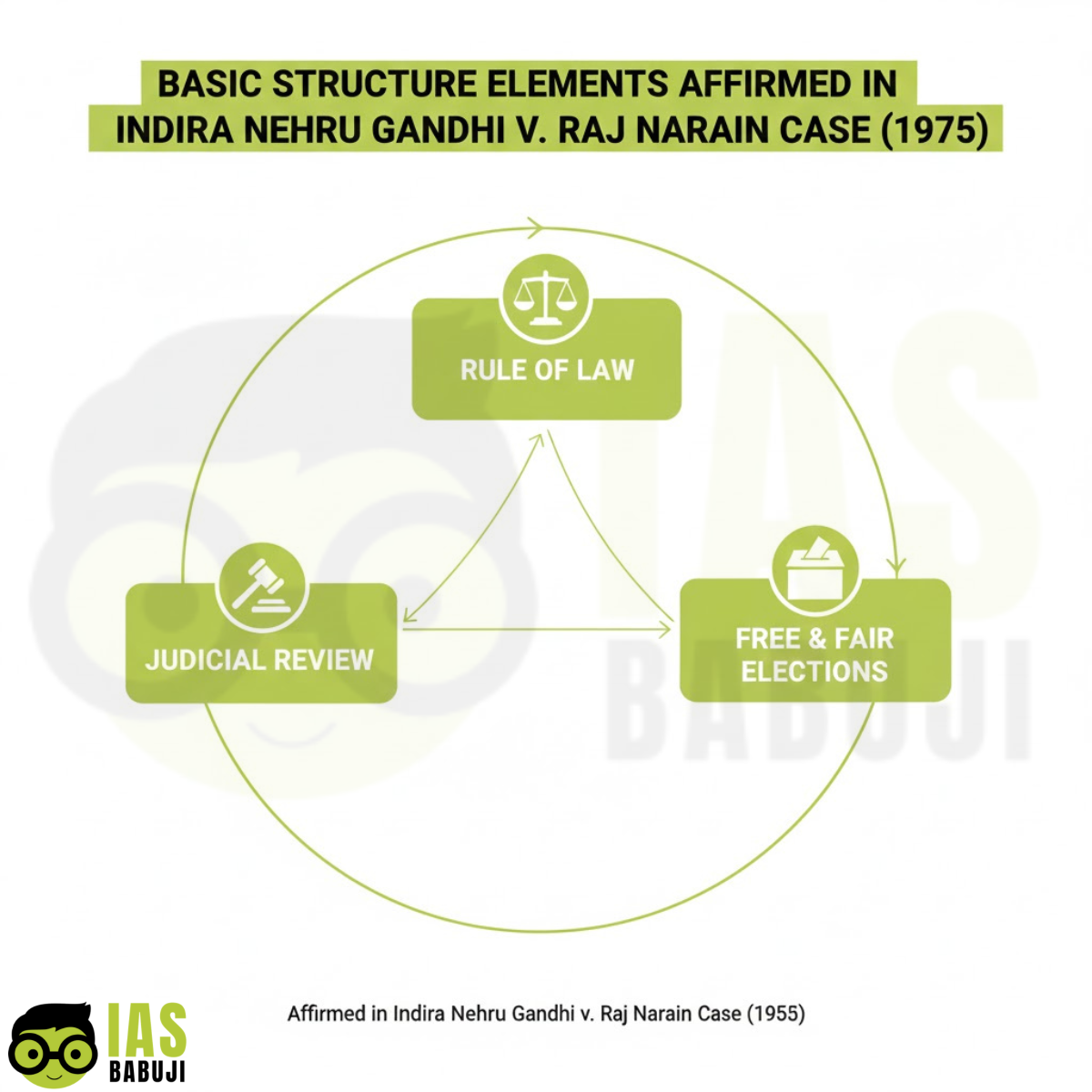
Basic Structure Elements Affirmed in the Case

Conclusion

The Indira Nehru Gandhi v. Raj Narain judgment stands as a powerful reminder that constitutional supremacy and rule of law are the cornerstones of Indian democracy. Delivered during a period of political upheaval, the Supreme Court reaffirmed that democratic principles cannot be sacrificed at the altar of political convenience. By striking down provisions that sought to place elections beyond judicial scrutiny, the Court protected the integrity of the electoral process and upheld constitutional morality. For UPSC aspirants, this case highlights the judiciary’s role as a constitutional sentinel, especially during crises. Its enduring relevance lies in its affirmation that power, no matter how high, remains accountable under the Constitution.


FAQs on Indira Nehru Gandhi vs Raj Narain (1975)

Q1. Why is the Indira Gandhi v. Raj Narain case important for UPSC?
It established the Rule of Law and free elections as part of the Basic Structure.

Q2. Which constitutional amendment was challenged in this case?
The 39th Constitutional Amendment Act, 1975.

Q3. What was Article 329A related to?
It dealt with election disputes involving high constitutional authorities.

Q4. Which doctrine was strengthened by this case?
The Basic Structure Doctrine.
Post Views: 32
Tags: basic structure doctrineEmergency and ConstitutionGS 2 Polity NotesIndira Gandhi Raj Narain CaseRule of Law UPSCSupreme Court Judgments India
ShareSendTweet
Previous Post

Golaknath Case (1967)

Next Post

Minerva Mills Case (1980)

Related Posts

Can Economic Growth Alone Deliver Social Justice in India?
Economics

Can Economic Growth Alone Deliver Social Justice in India?

by editorialteam
Role of the Governor in India’s Federal Structure
GS II

Role of the Governor in India’s Federal Structure

by editorialteam
Judicial Activism vs Judicial Overreach
Indian Polity

Judicial Activism vs Judicial Overreach

by editorialteam
Shayara Bano vs Union of India (2017)
Indian Polity

Shayara Bano vs Union of India (2017)

by editorialteam
Navtej Singh Johar vs Union of India (2018)
Indian Polity

Navtej Singh Johar vs Union of India (2018)

by editorialteam
Next Post
Minerva Mills Case (1980)

Minerva Mills Case (1980)

Recent Posts

  • Can Economic Growth Alone Deliver Social Justice in India?
  • Role of the Governor in India’s Federal Structure
  • Border Infrastructure as a Strategic Asset
  • Emotional Intelligence in Civil Services
  • India’s Indo-Pacific Maritime Strategy
  • India–China Border Tensions 2026
  • Role of Empathy in Public Service Delivery

Browse by Category

  • 2019
  • Admit Card
  • Age Limit
  • Andhra Pradesh Public Service Commission (APPSC)
  • Assam Public Service Commission (APSC)
  • Bihar Public Service Commission (BPSC)
  • CAPF
  • CDS
  • Chhattisgarh Public Service Commission (CGPSC)
  • CMS
  • Cut Off Marks
  • Economics
  • Economics Books
  • Editorial Articles
  • Eligibility Criteria
  • EPFO
  • Essay Writing
  • Ethics
  • Ethics Books
  • Exam Pattern
  • Geography
  • Geography Books
  • GS II
  • GS III
  • Gujarat Public Service Commission (GPSC)
  • Haryana Public Service Commission (HPSC)
  • Himachal Pradesh Public Service Commission (HPPSC)
  • Hindi Medium
  • History
  • History Books
  • IAS
  • IAS & IPS Officers
  • IAS Exam (CSE)
  • IES
  • IFS
  • IFS
  • Indian Polity
  • Internal Security
  • International Relations
  • IPS
  • IRS
  • ISS
  • Jammu and Kashmir Public Service Commission (JKPSC)
  • Jharkhand Public Service Commission (JPSC)
  • Karnataka Public Service Commission (KPSC)
  • Kerala Public Service Commission (KPSC)
  • Kurukshetra Magazine
  • Madhya Pradesh Public Service Commission (MPPSC)
  • Maharashtra Public Service Commission (MPSC)
  • Mains General Studies
  • Mains Syllabus
  • Mathematics
  • NCERT Books
  • NDA
  • Notification
  • Odisha Public Service Commission (OPSC)
  • Offline Coaching
  • Online Application
  • Online Coaching
  • Optional Subjects
  • Prelims Books
  • Prelims Exam
  • Prelims General Studies
  • Prelims Syllabus
  • Press Information Bureau (PIB)
  • Public Administration
  • Punjab Public Service Commission (PPSC)
  • Rajasthan Public Service Commission (RPSC)
  • RSTV
  • SCRA
  • Sociology
  • State Public Service Commission
  • Tamil Nadu Public Service Commission (TNPSC)
  • The Hindu
  • The Indian Express
  • Uncategorized
  • UPSC Books
  • UPSC Coaching
  • UPSC CSE Subjects
  • UPSC Current Affairs
  • UPSC Exam Details
  • UPSC Exams
  • UPSC Interview Process
  • UPSC Posts
  • UPSC Question Papers
  • UPSC Strategy
  • UPSC Study Material
  • UPSC Syllabus
  • UPSC Test Series
  • UPSC Training
  • Uttar Pradesh Public Service Commission (UPPSC)
  • Uttarakhand Public Service Commission (UKPSC)
  • West Bengal Public Service Commission (WBPSC)
  • Yojana Magazine

Browse by Tags

Article 368 Explained basic structure doctrine British India Centre State Relations Current Affair Dam Economy Empathy in Governance Exam Topper Federalism in India Government Scheme Government Schemes GS 2 Judiciary GS 2 Polity GS 2 Polity Notes History IAS IAS Officer IAS Officer Power IFS Officer Inclusive Growth Indian Constitution Indian Economy Inflation in India Informative Content IPS Officer judicial review India Kesavananda Bharati Case Macroeconomics Political Leader PSC Rajasthan Public Service Commission RBI Revolution Supreme Court Judgments UPSC UPSC CAPF Exam UPSC CDS Exam UPSC Coaching UPSC GS III Economy UPSC GS IV UPSC History Books UPSC Polity Notes UPSC Preparation UPSC Question Paper War
  • Home
  • Exam Details
  • Strategy
  • Books
  • Current Affairs
  • Contact Us
Contact us at [email protected]

© 2021 IAS BABU JI - One-Stop Solution for UPSC Exam Aspirants

No Result
View All Result
  • Home
  • Exam Details
  • Strategy
  • Books
  • Current Affairs
  • Contact Us

© 2021 IAS BABU JI - One-Stop Solution for UPSC Exam Aspirants

Are you sure want to unlock this post?
Unlock left : 0
Are you sure want to cancel subscription?