

Minerva Mills Case (1980): Balance Between Fundamental Rights and Directive Principles
Introduction
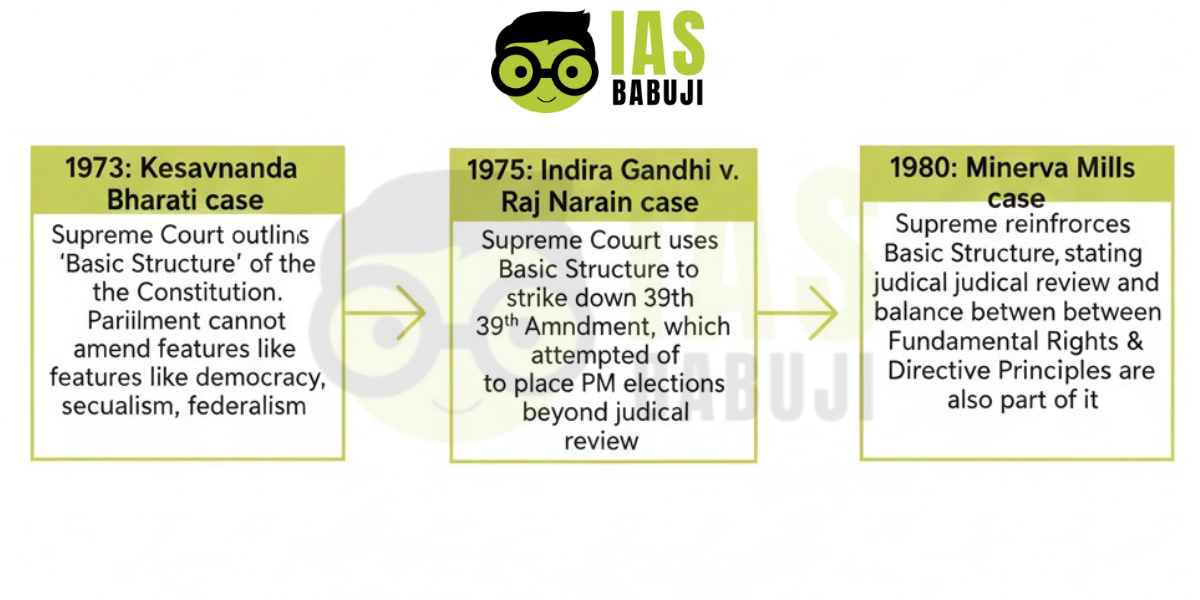
The Minerva Mills Ltd. v. Union of India (1980) case is a landmark Supreme Court judgment that reaffirmed the Basic Structure Doctrine and restored the constitutional balance between Fundamental Rights (FRs) and Directive Principles of State Policy (DPSPs). Delivered after the Emergency period, the judgment acted as a corrective step against excessive parliamentary dominance.
For UPSC aspirants, this case is crucial to understand limits on the amending power of Parliament, constitutional supremacy, and the principle of harmonious construction.
Background of the Case
- Minerva Mills was a textile company in Karnataka
- It was nationalised under government policy
- The company challenged the validity of certain provisions of the 42nd Constitutional Amendment Act, 1976
- The amendment had expanded Parliament’s power and curtailed judicial review
Constitutional Provisions Involved
- Article 368 – Power of Parliament to amend the Constitution
- Article 31C – Primacy of DPSPs over Fundamental Rights
- Articles 14, 19, and 21 – Core Fundamental Rights
Key Issues Before the Supreme Court
- Can Parliament amend the Constitution without any limitation?
- Can Directive Principles override Fundamental Rights completely?
- Is judicial review part of the Basic Structure?
Supreme Court Judgment (1980)
The Supreme Court struck down Sections 4 and 55 of the 42nd Constitutional Amendment as unconstitutional.
Key Observations
- The limited amending power of Parliament is part of the Basic Structure
- Judicial review is an essential feature of the Constitution
- The balance between Fundamental Rights and DPSPs is part of the Basic Structure
- Parliament cannot enlarge its own amending power

Doctrine of Harmonious Construction
The Court emphasized that:
- Fundamental Rights and Directive Principles are complementary
- One cannot destroy the other
- Social justice goals must be achieved without eroding individual freedoms
This principle became central to constitutional interpretation.
Significance of the Judgment
1. Restoration of Constitutional Balance
- Prevented absolute parliamentary supremacy
- Reaffirmed constitutional supremacy
2. Strengthening of Judicial Review
- Protected the courts’ power to test constitutional amendments
- Acted as a safeguard against authoritarianism
3. Reinforcement of Basic Structure Doctrine
- Built upon Kesavananda Bharati (1973)
- Clarified that Parliament’s power is not unlimited
Impact on Indian Polity
- Curbed the misuse of constitutional amendments
- Influenced later cases such as Waman Rao (1981)
- Restored democratic checks and balances after the Emergency
Criticism of the Judgment
- Critics argued it restricted socio-economic reforms
- Some viewed it as judicial overreach
- Others felt DPSPs were weakened
However, the judgment is widely accepted as essential for preserving democracy.
UPSC Prelims and Mains Relevance
Prelims Focus
- Year – 1980
- Related to the 42nd Constitutional Amendment
- Balance between FRs and DPSPs
Mains (GS-II)
- Limits on Parliament’s amending power
- Judicial review and constitutionalism
- Role of the judiciary post-Emergency
Essay and Ethics
- Abuse of power
- Constitutional morality
- Checks and balances
Conclusion
The Minerva Mills judgment reaffirmed that the Indian Constitution is founded on balance, not absolutism. By striking down provisions that sought to grant unlimited amending power to Parliament, the Supreme Court preserved the supremacy of the Constitution and reinforced democratic governance. The ruling clarified that neither Fundamental Rights nor Directive Principles can be given unchecked dominance; instead, both must coexist in harmony. For UPSC aspirants, this case illustrates how constitutional principles evolve through judicial interpretation while remaining anchored to core democratic values. Minerva Mills stands as a reminder that social and economic goals must be pursued within constitutional limits, ensuring that liberty, justice, and equality are protected together.
FAQs on Minerva Mills Case (1980)
Q1. Why is the Minerva Mills case important for UPSC?
It reaffirmed the Basic Structure Doctrine and limits on Parliament’s amending power.
Q2. Which amendment was challenged in this case?
The 42nd Constitutional Amendment Act, 1976.
Q3. What key principle emerged from this judgment?
Harmonious balance between Fundamental Rights and Directive Principles.
Q4. Which doctrine was strengthened?
Basic Structure Doctrine.