• Home
  • Exam Details
  • Strategy
  • Books
  • Current Affairs
  • Contact Us
IAS Babu Ji
Advertise With Us!
  • Home
  • Exam Details
  • Strategy
  • Books
  • Current Affairs
  • State PSC Exams
  • About Us
No Result
View All Result
  • Home
  • Exam Details
  • Strategy
  • Books
  • Current Affairs
  • State PSC Exams
  • About Us
No Result
View All Result
IAS Babu Ji
No Result
View All Result
Home UPSC Study Material Indian Polity

S.R. Bommai v. Union of India (1994)

by editorialteam
in Indian Polity, UPSC Study Material
Reading Time: 5 mins read
0
S.R. Bommai v. Union of India (1994)

S.R. Bommai v. Union of India (1994)

Share on FacebookShare on WhatsAppShare on Twitter

S.R. Bommai v. Union of India (1994): Federalism and Limits of Article 356

Introduction

The S.R. Bommai v. Union of India (1994) case is a landmark Supreme Court judgment that transformed the interpretation of Article 356 (President’s Rule) and strengthened the federal structure of India. Delivered in response to repeated misuse of central power, the judgment placed constitutional checks on arbitrary dismissal of state governments.

For UPSC aspirants, this case is essential for understanding Centre–State relations, federalism, constitutional morality, and judicial review.


Background of the Case

  • S.R. Bommai was the Chief Minister of Karnataka
  • His government was dismissed in 1989 under Article 356
  • The dismissal was based on the Governor’s report claiming loss of majority
  • The proclamation was challenged before the Supreme Court along with similar cases from other states

Constitutional Provisions Involved

  • Article 356 – Proclamation of President’s Rule
  • Article 355 – Duty of the Union to protect states
  • Article 74 – Aid and advice of the Council of Ministers
  • Article 164 – Collective responsibility of the Council of Ministers

Key Issues Before the Supreme Court

  1. Can the President’s satisfaction under Article 356 be judicially reviewed?
  2. Is the Governor’s report immune from scrutiny?
  3. What is the correct test to determine loss of majority in a state government?

Supreme Court Judgment (1994)

A nine-judge Constitution Bench delivered a unanimous and detailed judgment limiting arbitrary use of Article 356.

Key Findings

  • President’s Rule is subject to judicial review
  • The majority of a government must be tested on the floor of the House, not by the Governor
  • Secularism is part of the Basic Structure of the Constitution
  • If a proclamation is unconstitutional, the dismissed government can be restored

Guidelines Laid Down by the Court

The Court laid down clear constitutional safeguards:

  1. The floor test is the primary method to determine the majority
  2. Governor’s report is not final or binding
  3. Article 356 is an exceptional provision, not a routine tool
  4. Courts can examine the material on which the President’s satisfaction is based

S.R. Bommai v. Union of India (1994)


Significance of the Judgment

1. Strengthening Federalism

  • Reduced arbitrary interference by the Centre
  • Protected autonomy of state governments

2. Judicial Control over Executive Power

  • Established that executive discretion is not absolute
  • Reinforced constitutional accountability

3. Protection of Democratic Norms

  • Prevented misuse of the Governor’s office
  • Upheld elected governments

Impact on Centre–State Relations

  • Decline in misuse of President’s Rule after 1994
  • Shift towards cooperative federalism
  • Influenced later practices and conventions involving Governors

Criticism of the Judgment

  • Some argue that it has judicialised political questions
  • Implementation depends heavily on judicial intervention
  • Concerns over the delay in judicial review during political crises

Despite criticism, the judgment is widely regarded as a turning point in Indian federalism.


UPSC Prelims and Mains Relevance

Prelims Focus

  • Year – 1994
  • Article 356 and President’s Rule
  • Secularism as part of the Basic Structure

Mains (GS-II)

  • Centre–State relations
  • Role of the judiciary in the federal balance
  • Governor’s discretion and accountability

Essay and Ethics

  • Abuse of power
  • Constitutional morality
  • Federal democracy

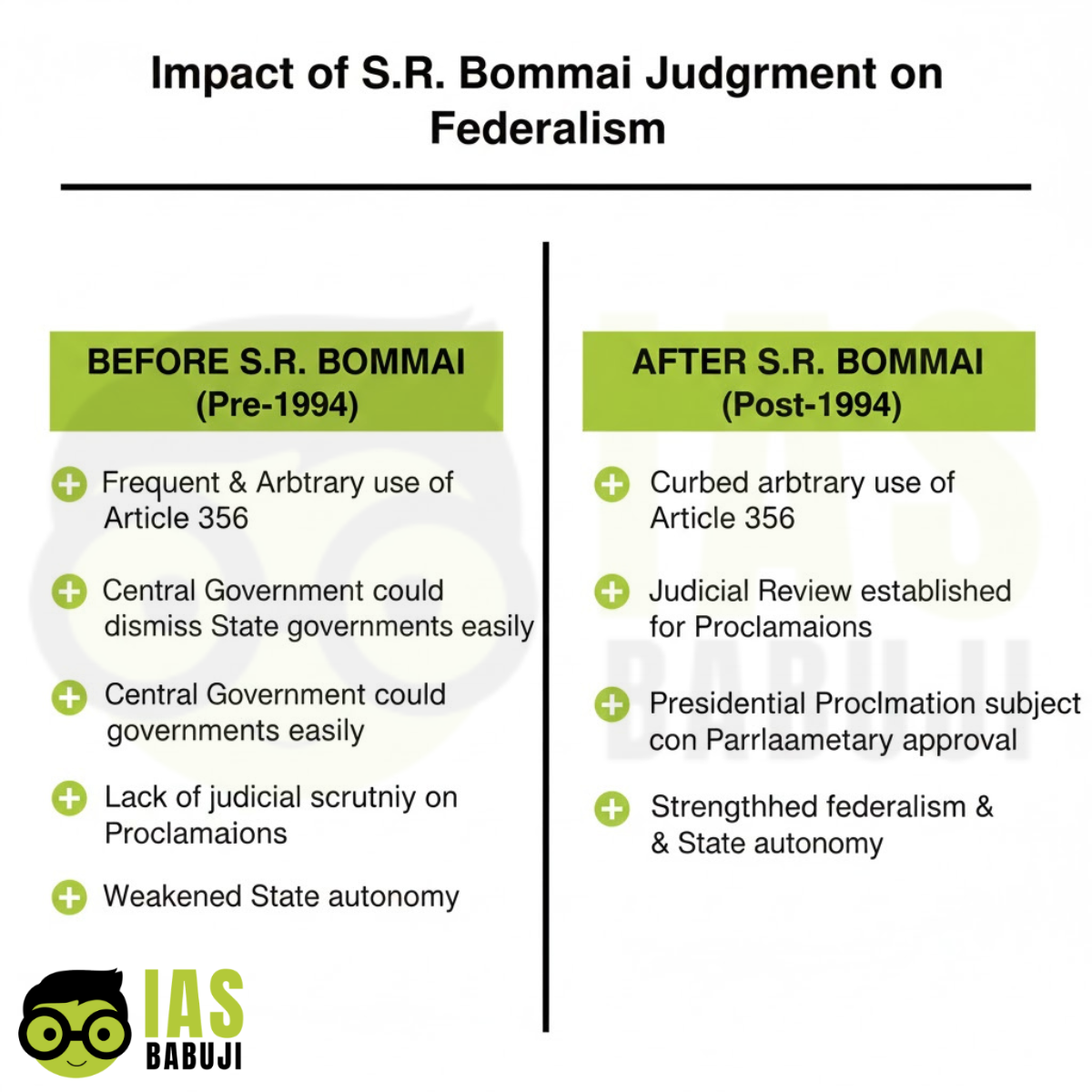
Impact of S.R. Bommai Judgment on Federalism

Conclusion

The S.R. Bommai judgment marked a decisive shift towards constitutional federalism by curbing arbitrary use of President’s Rule. By subjecting presidential proclamations to judicial review and emphasizing floor tests as the sole democratic method to assess majority, the Supreme Court strengthened democratic accountability and state autonomy. The ruling also elevated secularism to the status of a Basic Structure principle, reinforcing India’s pluralistic constitutional identity. For UPSC aspirants, this case serves as a classic example of how judicial intervention can restore constitutional balance and protect democratic institutions. Its enduring relevance lies in its clear message that federalism and democracy cannot be compromised for political convenience.


FAQs on S.R. Bommai v. Union of India (1994)

Q1. Why is the S.R. Bommai case important for UPSC?
It limited misuse of Article 356 and strengthened federalism.

Q2. What key principle was established regarding majority testing?
Majority must be proven on the floor of the House.

Q3. Which constitutional value was declared part of Basic Structure?
Secularism.

Q4. Can courts restore dismissed state governments?
Yes, if the President’s Rule is found unconstitutional.


Infographic Prompts (With Placement)

Infographic 1 – After Guidelines Section

Title: When Can Article 356 Be Applied
Prompt:
Flowchart infographic showing constitutional conditions for President’s Rule, including Governor’s report, floor test, and judicial review. Clean academic style, white background, accent color #b3c839.


Infographic 2 – Before Conclusion

Title: Impact of S.R. Bommai Judgment on Federalism
Prompt:
Comparison infographic showing Centre–State relations before and after 1994. Minimal academic layout, accent color #b3c839.


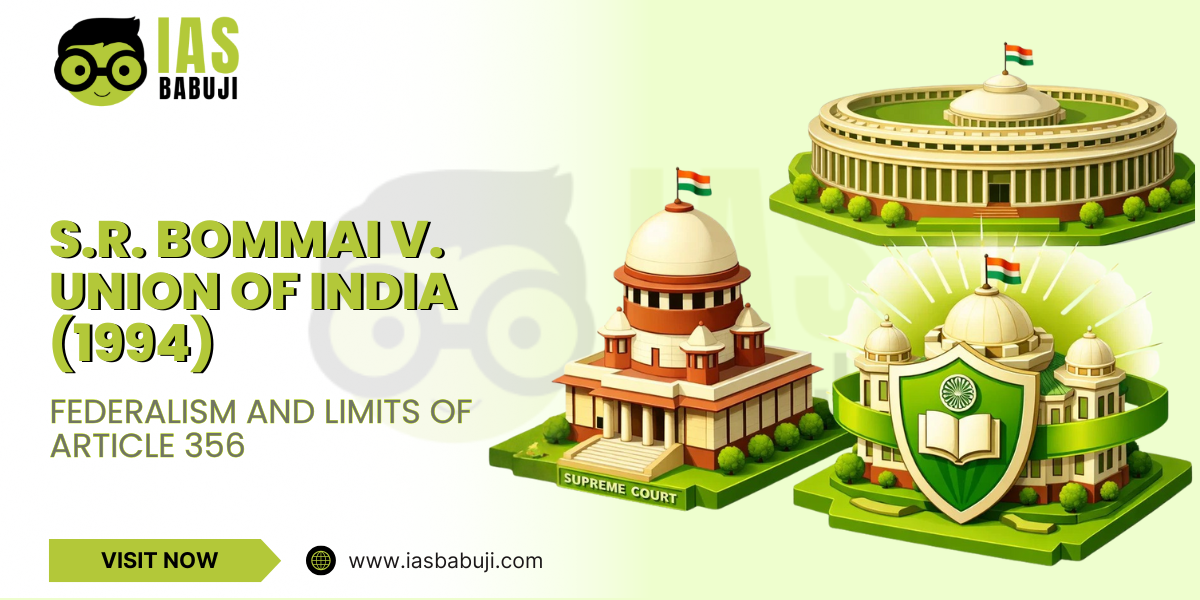
Feature Image Prompt (3D Illustrator)

Prompt:
A 3D isometric illustration of the Supreme Court of India protecting a state assembly with a constitutional shield, Parliament in the background, clean academic style, white background, theme color #b3c839.


Next bolo:

Post Views: 35
Tags: Article 356 UPSCFederalism ConstitutionGS 2 PolityPresident’s Rule IndiaSR Bommai CaseSupreme Court Judgments UPSC
ShareSendTweet
Previous Post

Minerva Mills Case (1980)

Next Post

Vishaka vs State of Rajasthan (1997)

Related Posts

Can Economic Growth Alone Deliver Social Justice in India?
Economics

Can Economic Growth Alone Deliver Social Justice in India?

by editorialteam
Role of the Governor in India’s Federal Structure
GS II

Role of the Governor in India’s Federal Structure

by editorialteam
Border Infrastructure as a Strategic Asset
GS III

Border Infrastructure as a Strategic Asset

by editorialteam
Emotional Intelligence in Civil Services
Ethics

Emotional Intelligence in Civil Services

by editorialteam
India’s Indo-Pacific Maritime Strategy
GS II

India’s Indo-Pacific Maritime Strategy

by editorialteam
Next Post
Vishaka vs State of Rajasthan (1997)

Vishaka vs State of Rajasthan (1997)

Recent Posts

  • Can Economic Growth Alone Deliver Social Justice in India?
  • Role of the Governor in India’s Federal Structure
  • Border Infrastructure as a Strategic Asset
  • Emotional Intelligence in Civil Services
  • India’s Indo-Pacific Maritime Strategy
  • India–China Border Tensions 2026
  • Role of Empathy in Public Service Delivery

Browse by Category

  • 2019
  • Admit Card
  • Age Limit
  • Andhra Pradesh Public Service Commission (APPSC)
  • Assam Public Service Commission (APSC)
  • Bihar Public Service Commission (BPSC)
  • CAPF
  • CDS
  • Chhattisgarh Public Service Commission (CGPSC)
  • CMS
  • Cut Off Marks
  • Economics
  • Economics Books
  • Editorial Articles
  • Eligibility Criteria
  • EPFO
  • Essay Writing
  • Ethics
  • Ethics Books
  • Exam Pattern
  • Geography
  • Geography Books
  • GS II
  • GS III
  • Gujarat Public Service Commission (GPSC)
  • Haryana Public Service Commission (HPSC)
  • Himachal Pradesh Public Service Commission (HPPSC)
  • Hindi Medium
  • History
  • History Books
  • IAS
  • IAS & IPS Officers
  • IAS Exam (CSE)
  • IES
  • IFS
  • IFS
  • Indian Polity
  • Internal Security
  • International Relations
  • IPS
  • IRS
  • ISS
  • Jammu and Kashmir Public Service Commission (JKPSC)
  • Jharkhand Public Service Commission (JPSC)
  • Karnataka Public Service Commission (KPSC)
  • Kerala Public Service Commission (KPSC)
  • Kurukshetra Magazine
  • Madhya Pradesh Public Service Commission (MPPSC)
  • Maharashtra Public Service Commission (MPSC)
  • Mains General Studies
  • Mains Syllabus
  • Mathematics
  • NCERT Books
  • NDA
  • Notification
  • Odisha Public Service Commission (OPSC)
  • Offline Coaching
  • Online Application
  • Online Coaching
  • Optional Subjects
  • Prelims Books
  • Prelims Exam
  • Prelims General Studies
  • Prelims Syllabus
  • Press Information Bureau (PIB)
  • Public Administration
  • Punjab Public Service Commission (PPSC)
  • Rajasthan Public Service Commission (RPSC)
  • RSTV
  • SCRA
  • Sociology
  • State Public Service Commission
  • Tamil Nadu Public Service Commission (TNPSC)
  • The Hindu
  • The Indian Express
  • Uncategorized
  • UPSC Books
  • UPSC Coaching
  • UPSC CSE Subjects
  • UPSC Current Affairs
  • UPSC Exam Details
  • UPSC Exams
  • UPSC Interview Process
  • UPSC Posts
  • UPSC Question Papers
  • UPSC Strategy
  • UPSC Study Material
  • UPSC Syllabus
  • UPSC Test Series
  • UPSC Training
  • Uttar Pradesh Public Service Commission (UPPSC)
  • Uttarakhand Public Service Commission (UKPSC)
  • West Bengal Public Service Commission (WBPSC)
  • Yojana Magazine

Browse by Tags

Article 368 Explained basic structure doctrine British India Centre State Relations Current Affair Dam Economy Empathy in Governance Exam Topper Federalism in India Government Scheme Government Schemes GS 2 Judiciary GS 2 Polity GS 2 Polity Notes History IAS IAS Officer IAS Officer Power IFS Officer Inclusive Growth Indian Constitution Indian Economy Inflation in India Informative Content IPS Officer judicial review India Kesavananda Bharati Case Macroeconomics Political Leader PSC Rajasthan Public Service Commission RBI Revolution Supreme Court Judgments UPSC UPSC CAPF Exam UPSC CDS Exam UPSC Coaching UPSC GS III Economy UPSC GS IV UPSC History Books UPSC Polity Notes UPSC Preparation UPSC Question Paper War
  • Home
  • Exam Details
  • Strategy
  • Books
  • Current Affairs
  • Contact Us
Contact us at [email protected]

© 2021 IAS BABU JI - One-Stop Solution for UPSC Exam Aspirants

No Result
View All Result
  • Home
  • Exam Details
  • Strategy
  • Books
  • Current Affairs
  • Contact Us

© 2021 IAS BABU JI - One-Stop Solution for UPSC Exam Aspirants

Are you sure want to unlock this post?
Unlock left : 0
Are you sure want to cancel subscription?