
Justice K.S. Puttaswamy (Retd.) v. Union of India (2017): Right to Privacy as a Fundamental Right
Introduction
The Justice K.S. Puttaswamy (Retd.) v. Union of India (2017) case is a constitutional milestone in which the Supreme Court unanimously declared the Right to Privacy as a Fundamental Right under Part III of the Constitution. The judgment marked a decisive shift in India’s rights jurisprudence by recognising privacy as intrinsic to life, liberty, dignity, and autonomy.
For UPSC aspirants, this case is indispensable for understanding Fundamental Rights, constitutional morality, technology and rights, and judicial review in the digital age.
Background of the Case
- The case arose in the context of the Aadhaar biometric identification scheme
- Retired Justice K.S. Puttaswamy challenged the mandatory linking of Aadhaar with welfare schemes
- The Union Government argued that the Constitution did not explicitly guarantee a right to privacy
- Conflicting earlier judgments made it necessary to settle the issue conclusively
Constitutional Provisions Involved
- Article 14 – Equality before the law
- Article 19 – Freedoms under Part III
- Article 21 – Right to life and personal liberty
Key Issues Before the Supreme Court
- Is the Right to Privacy a Fundamental Right under the Constitution?
- Does privacy form an essential part of liberty and dignity?
- Can the State limit privacy, and if yes, under what conditions?
Supreme Court Judgment (2017)
A nine-judge Constitution Bench unanimously held that the Right to Privacy is a Fundamental Right protected under Article 21 and other freedoms in Part III.
Key Principles Laid Down
1. Privacy as an Inherent Right
- Privacy is intrinsic to life and personal liberty
- It is not an elite or class-based concept
2. Overruling of Earlier Judgments
- M.P. Sharma (1954) and Kharak Singh (1963) were overruled to the extent they denied privacy as a Fundamental Right
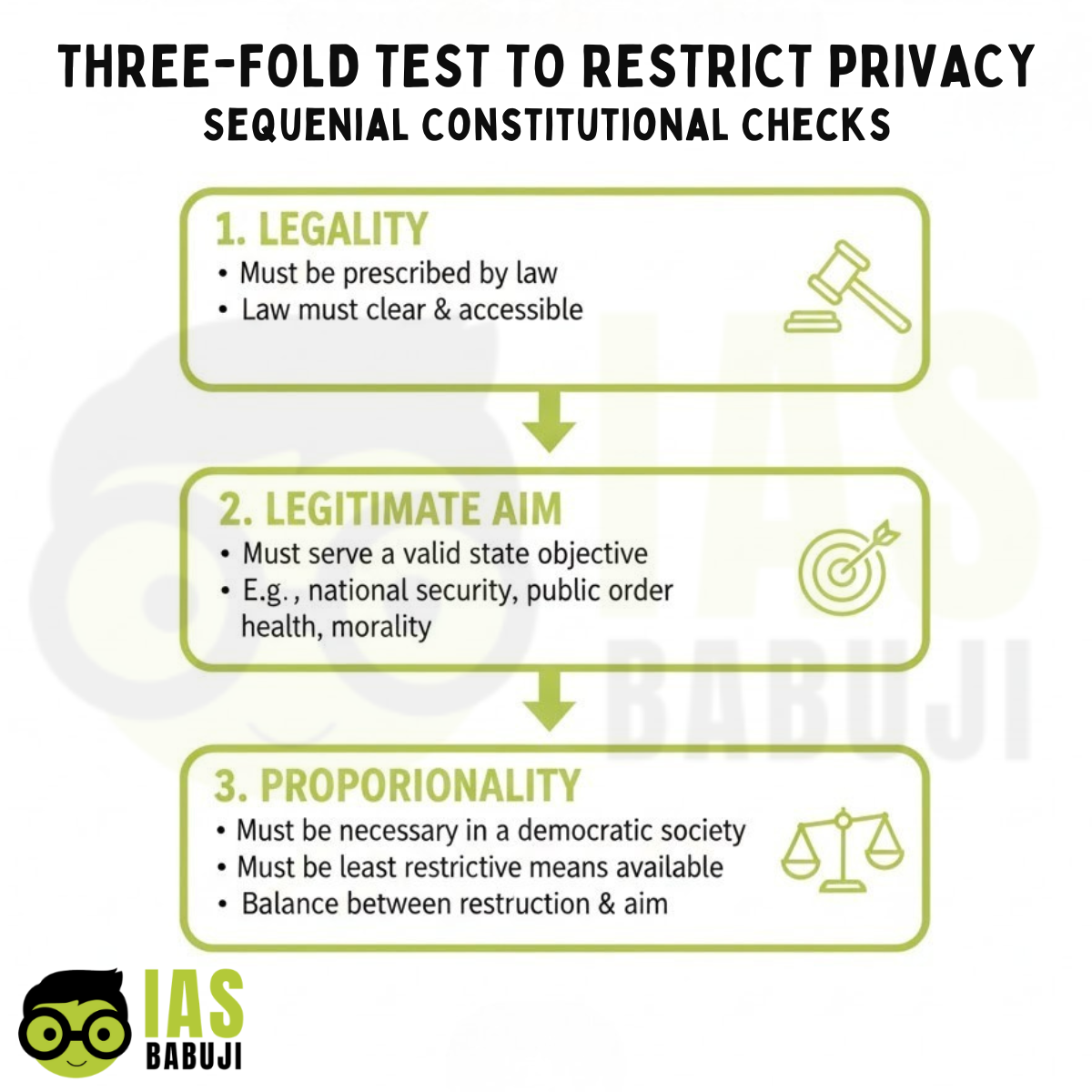
3. Test for Limiting Privacy
The Court laid down a three-fold test for State action restricting privacy:
- Existence of law
- Legitimate state aim
- Proportionality and necessity
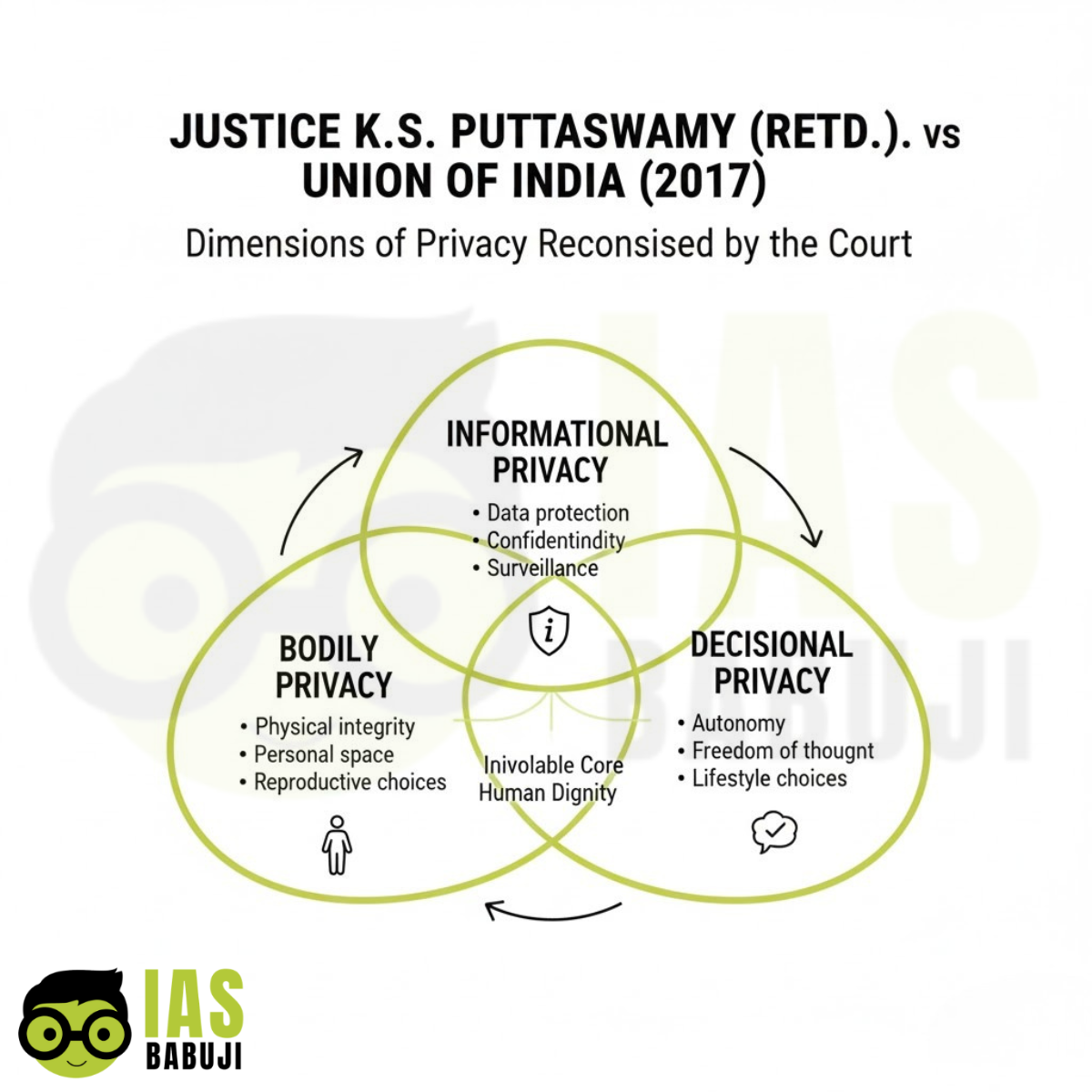
Dimensions of Privacy Recognised
The judgment recognised multiple facets of privacy:
- Bodily privacy
- Informational privacy
- Decisional autonomy
This expanded the understanding of individual freedom in modern governance.
Privacy and Technology
The Court acknowledged challenges posed by:
- Big data
- Surveillance
- Digital profiling
It emphasised the need for robust data protection laws.
Significance of the Judgment
1. Expansion of Fundamental Rights
- Privacy became a core constitutional value
- Strengthened dignity-based interpretation of Article 21
2. Impact on Governance and Policy
- Influenced the Aadhaar verdict (2018)
- Laid the foundation for data protection frameworks
3. Reinforcement of Constitutional Morality
- Balanced individual liberty with State interests
Impact on the Indian Legal System
- Recognition of informational self-determination
- Strengthened judicial scrutiny of surveillance laws
- Influenced cases on LGBTQ+ rights, reproductive autonomy, and free choice
Criticism of the Judgment
- Concerns over national security implications
- Ambiguity in balancing privacy with public interest
- Implementation challenges without a comprehensive data law
Despite concerns, the judgment is considered transformative.
UPSC Prelims and Mains Relevance
Prelims Focus
- Year – 2017
- Nine-judge bench
- Right to Privacy under Article 21
Mains (GS-II and GS-IV)
- Digital rights and governance
- Surveillance and civil liberties
- Ethical dimensions of privacy
Essay
- Technology vs individual freedom
- Dignity and autonomy
Conclusion
The Puttaswamy judgment represents a paradigm shift in Indian constitutional law by firmly placing individual autonomy and dignity at the centre of fundamental rights protection. By recognising privacy as intrinsic to life and liberty, the Supreme Court adapted constitutional interpretation to the realities of a digital and data-driven society. The ruling also established clear constitutional safeguards by prescribing a proportionality-based test for State intrusion into private life. For UPSC aspirants, this case illustrates how constitutional values evolve to address contemporary challenges without losing their normative core. Its long-term significance lies in shaping future debates on surveillance, data protection, and technological governance while reaffirming the primacy of human dignity in democratic systems.
FAQs on Justice K.S. Puttaswamy (Retd.) vs Union of India (2017)
Q1. Why is the Puttaswamy case important for UPSC?
It declared the Right to Privacy as a Fundamental Right.
Q2. Which earlier cases were overruled?
M.P. Sharma (1954) and Kharak Singh (1963), to the extent they denied privacy.
Q3. What test was laid down to restrict privacy?
Legality, legitimate aim, and proportionality.
Q4. Which article primarily protects privacy?
Article 21.