• Home
  • Exam Details
  • Strategy
  • Books
  • Current Affairs
  • Contact Us
IAS Babu Ji
Advertise With Us!
  • Home
  • Exam Details
  • Strategy
  • Books
  • Current Affairs
  • State PSC Exams
  • About Us
No Result
View All Result
  • Home
  • Exam Details
  • Strategy
  • Books
  • Current Affairs
  • State PSC Exams
  • About Us
No Result
View All Result
IAS Babu Ji
No Result
View All Result
Home UPSC Study Material Indian Polity

Navtej Singh Johar vs Union of India (2018)

by editorialteam
in Indian Polity, UPSC Study Material
Reading Time: 4 mins read
0
Navtej Singh Johar vs Union of India (2018)

Navtej Singh Johar vs Union of India (2018)

Share on FacebookShare on WhatsAppShare on Twitter

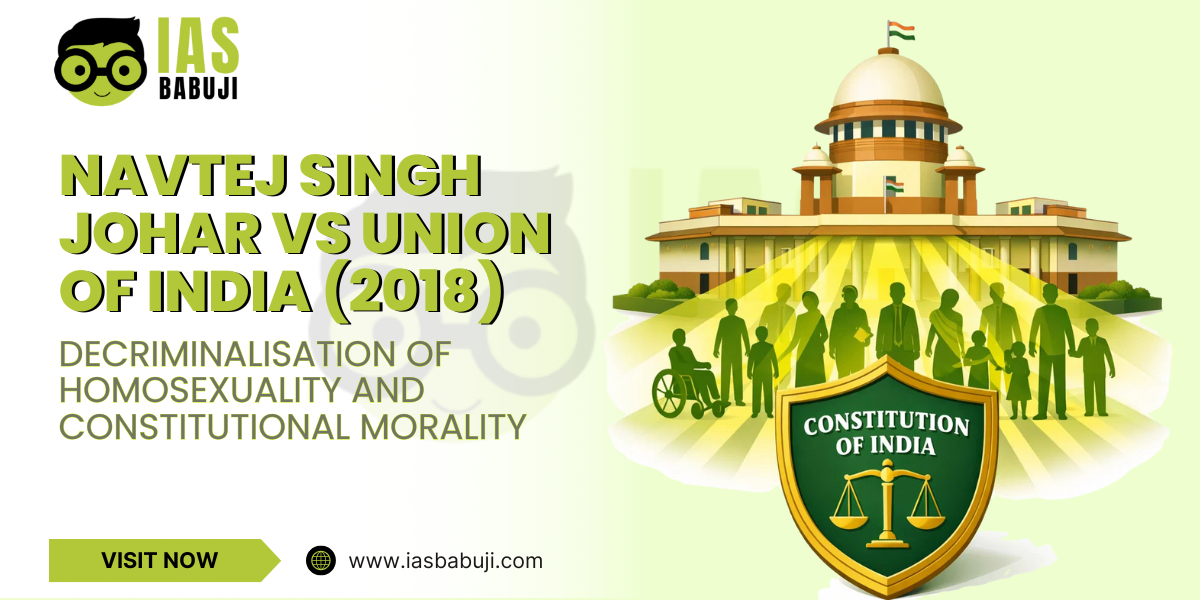
Navtej Singh Johar vs Union of India (2018): Decriminalisation of Homosexuality and Constitutional Morality

Introduction

The Navtej Singh Johar v. Union of India (2018) judgment is a historic Supreme Court decision that partially struck down Section 377 of the Indian Penal Code, decriminalising consensual sexual acts between adults. The ruling marked a decisive affirmation of individual dignity, equality, and constitutional morality over social prejudice.

For UPSC aspirants, this case is essential to understand Fundamental Rights, evolving interpretation of Article 21, constitutional morality, and minority rights.


Background of the Case

  • Section 377 of the IPC criminalised “carnal intercourse against the order of nature”
  • LGBTQ+ individuals faced discrimination, stigma, and criminal prosecution
  • Earlier judgment in Suresh Kumar Koushal v. Naz Foundation (2013) had upheld Section 377
  • Petitioners, including Navtej Singh Johar challenged the constitutional validity of Section 377

Constitutional Provisions Involved

  • Article 14 – Equality before law
  • Article 15 – Prohibition of discrimination
  • Article 19 – Freedom of expression
  • Article 21 – Right to life and personal liberty

Key Issues Before the Supreme Court

  1. Does Section 377 violate the right to equality and dignity?
  2. Can majoritarian morality override individual freedoms?
  3. Is sexual orientation an essential aspect of personal liberty?

Supreme Court Judgment (2018)

A five-judge Constitution Bench unanimously held that Section 377 is unconstitutional to the extent it criminalises consensual sexual acts between adults.


Key Principles Laid Down

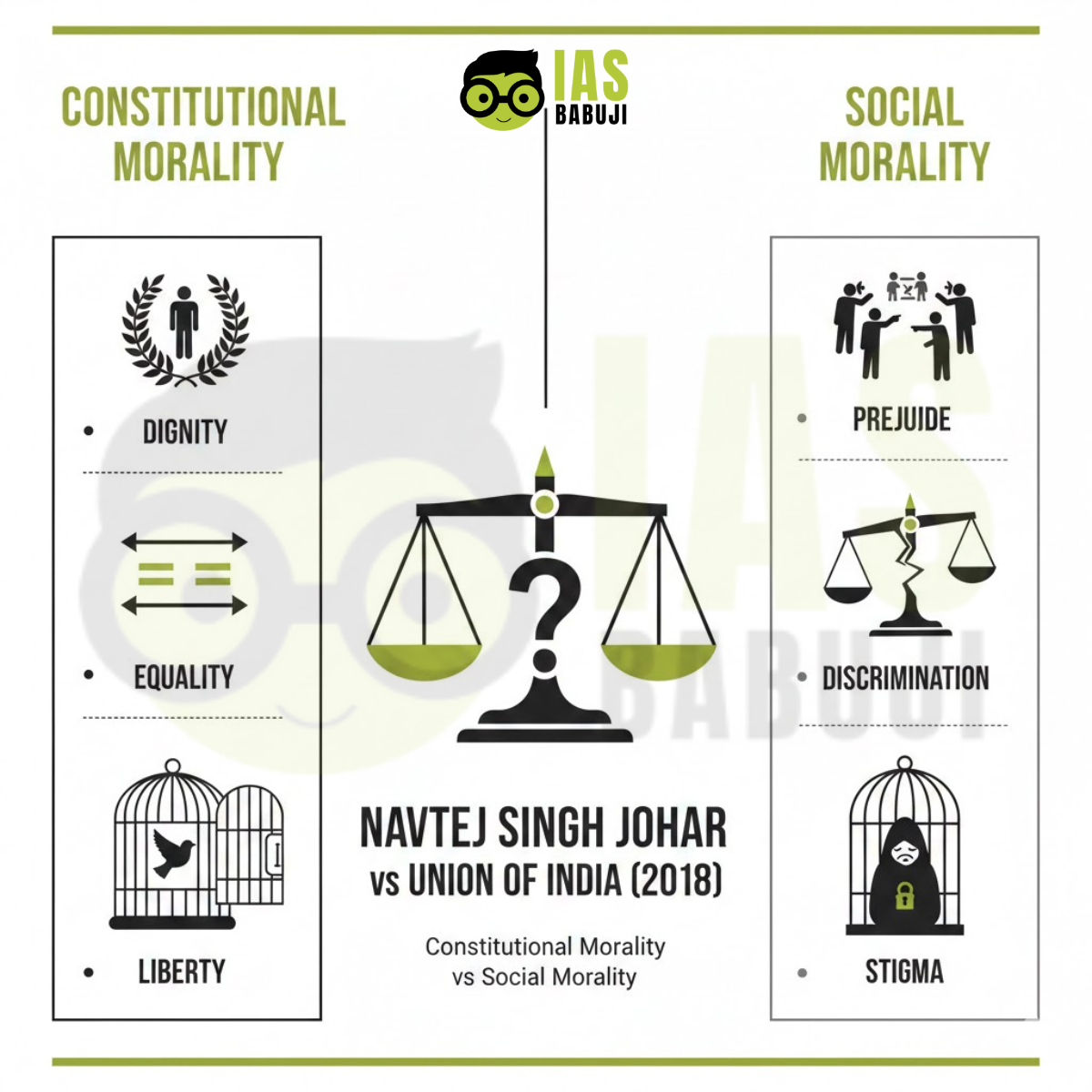
1. Constitutional Morality Over Social Morality

  • Fundamental Rights cannot be denied based on popular opinion
  • Constitutional values must guide governance

2. Sexual Orientation as an Inherent Attribute

  • Sexual orientation is a natural and intrinsic part of identity
  • Discrimination based on orientation violates equality

3. Dignity and Privacy

  • Criminalisation violates dignity under Article 21
  • The judgment built upon the Puttaswamy (2017) privacy ruling
Navtej Singh Johar vs Union of India (2018)
Constitutional Morality vs Social Morality

Role of Transformative Constitutionalism

The Court adopted a transformative approach:

  • The Constitution as a living document
  • Duty to protect marginalized communities
  • Emphasis on inclusiveness and pluralism

Significance of the Judgment

1. Expansion of Fundamental Rights

  • Strengthened right to dignity, autonomy, and choice

2. Protection of Minority Rights

  • Upheld the rights of a sexual minority against majoritarian bias

3. Global Human Rights Alignment

  • Brought India in line with international human rights norms


Impact on Indian Society and Law

  • Reduced criminal stigma against the LGBTQ+ community
  • Influenced policies on workplace inclusion and non-discrimination
  • Set precedent for rights-based interpretation in future cases

Criticism of the Judgment

  • Opposition based on cultural and religious grounds
  • Concerns about societal readiness
  • Demand for legislative clarity on related civil rights

Despite criticism, the ruling is widely regarded as progressive.


UPSC Prelims and Mains Relevance

Prelims Focus

  • Year – 2018
  • Section 377 IPC
  • Constitutional morality

Mains (GS-II and GS-IV)

  • Rights of marginalized groups
  • Role of the judiciary in social reform
  • Ethics of equality and dignity

Essay

  • Social justice and inclusivity
  • The Constitution as a transformative document
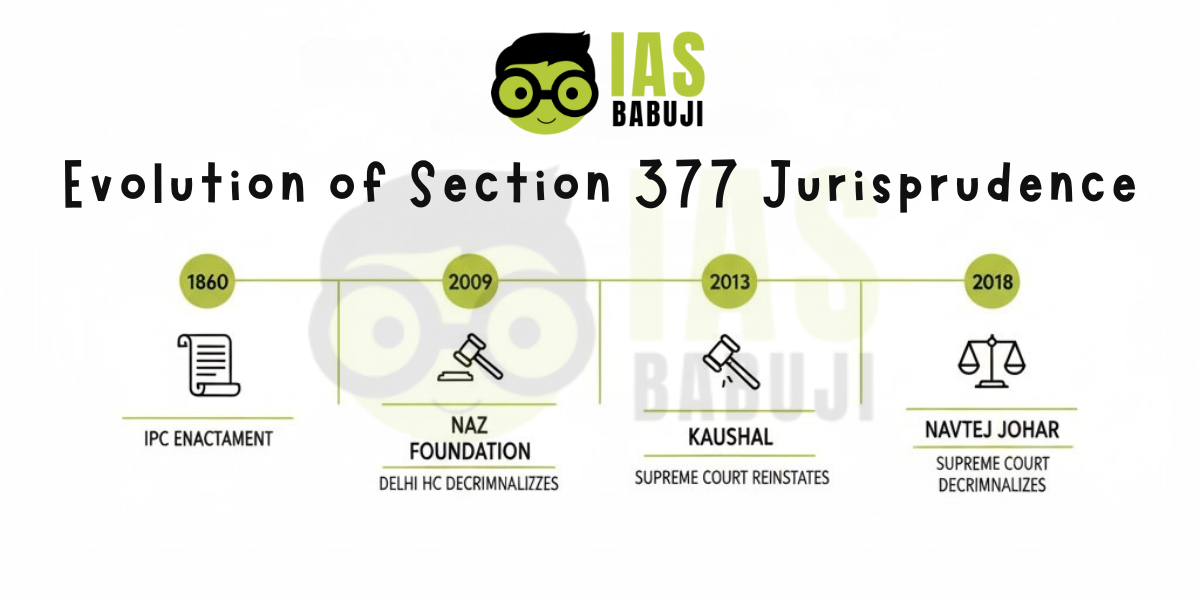
Evolution of Section 377 Jurisprudence

Conclusion

The Navtej Singh Johar judgment stands as a defining moment in India’s constitutional journey towards inclusivity and individual freedom. By decriminalising consensual same-sex relations, the Supreme Court dismantled a colonial-era law that violated dignity, equality, and personal liberty. The ruling reaffirmed that constitutional morality, not social prejudice, must guide the interpretation of Fundamental Rights. For UPSC aspirants, this case exemplifies the judiciary’s role in protecting minority rights and advancing transformative constitutionalism. Its long-term significance lies in fostering a rights-based framework where diversity is respected and individual identity is protected under the Constitution, reinforcing India’s commitment to justice, liberty, and equality.


FAQs on Navtej Singh Johar vs Union of India (2018)

Q1. Why is the Navtej Singh Johar case important for UPSC?
It decriminalised homosexuality and reinforced constitutional morality.

Q2. Which provision was partially struck down?
Section 377 of the IPC.

Q3. Which earlier judgment was overruled?
Suresh Kumar Koushal v. Naz Foundation (2013).

Q4. Which constitutional value was emphasized?
Dignity and equality under Articles 14 and 21.

Post Views: 25
Tags: Constitutional Morality IndiaGS 2 PolityLGBTQ Rights IndiaNavtej Singh Johar Case UPSCSection 377 JudgmentSupreme Court Judgments UPSC
ShareSendTweet
Previous Post

Justice K.S. Puttaswamy (Retd.) vs Union of India (2017)

Next Post

Shayara Bano vs Union of India (2017)

Related Posts

Can Economic Growth Alone Deliver Social Justice in India?
Economics

Can Economic Growth Alone Deliver Social Justice in India?

by editorialteam
Role of the Governor in India’s Federal Structure
GS II

Role of the Governor in India’s Federal Structure

by editorialteam
Border Infrastructure as a Strategic Asset
GS III

Border Infrastructure as a Strategic Asset

by editorialteam
Emotional Intelligence in Civil Services
Ethics

Emotional Intelligence in Civil Services

by editorialteam
India’s Indo-Pacific Maritime Strategy
GS II

India’s Indo-Pacific Maritime Strategy

by editorialteam
Next Post
Shayara Bano vs Union of India (2017)

Shayara Bano vs Union of India (2017)

Recent Posts

  • Can Economic Growth Alone Deliver Social Justice in India?
  • Role of the Governor in India’s Federal Structure
  • Border Infrastructure as a Strategic Asset
  • Emotional Intelligence in Civil Services
  • India’s Indo-Pacific Maritime Strategy
  • India–China Border Tensions 2026
  • Role of Empathy in Public Service Delivery

Browse by Category

  • 2019
  • Admit Card
  • Age Limit
  • Andhra Pradesh Public Service Commission (APPSC)
  • Assam Public Service Commission (APSC)
  • Bihar Public Service Commission (BPSC)
  • CAPF
  • CDS
  • Chhattisgarh Public Service Commission (CGPSC)
  • CMS
  • Cut Off Marks
  • Economics
  • Economics Books
  • Editorial Articles
  • Eligibility Criteria
  • EPFO
  • Essay Writing
  • Ethics
  • Ethics Books
  • Exam Pattern
  • Geography
  • Geography Books
  • GS II
  • GS III
  • Gujarat Public Service Commission (GPSC)
  • Haryana Public Service Commission (HPSC)
  • Himachal Pradesh Public Service Commission (HPPSC)
  • Hindi Medium
  • History
  • History Books
  • IAS
  • IAS & IPS Officers
  • IAS Exam (CSE)
  • IES
  • IFS
  • IFS
  • Indian Polity
  • Internal Security
  • International Relations
  • IPS
  • IRS
  • ISS
  • Jammu and Kashmir Public Service Commission (JKPSC)
  • Jharkhand Public Service Commission (JPSC)
  • Karnataka Public Service Commission (KPSC)
  • Kerala Public Service Commission (KPSC)
  • Kurukshetra Magazine
  • Madhya Pradesh Public Service Commission (MPPSC)
  • Maharashtra Public Service Commission (MPSC)
  • Mains General Studies
  • Mains Syllabus
  • Mathematics
  • NCERT Books
  • NDA
  • Notification
  • Odisha Public Service Commission (OPSC)
  • Offline Coaching
  • Online Application
  • Online Coaching
  • Optional Subjects
  • Prelims Books
  • Prelims Exam
  • Prelims General Studies
  • Prelims Syllabus
  • Press Information Bureau (PIB)
  • Public Administration
  • Punjab Public Service Commission (PPSC)
  • Rajasthan Public Service Commission (RPSC)
  • RSTV
  • SCRA
  • Sociology
  • State Public Service Commission
  • Tamil Nadu Public Service Commission (TNPSC)
  • The Hindu
  • The Indian Express
  • Uncategorized
  • UPSC Books
  • UPSC Coaching
  • UPSC CSE Subjects
  • UPSC Current Affairs
  • UPSC Exam Details
  • UPSC Exams
  • UPSC Interview Process
  • UPSC Posts
  • UPSC Question Papers
  • UPSC Strategy
  • UPSC Study Material
  • UPSC Syllabus
  • UPSC Test Series
  • UPSC Training
  • Uttar Pradesh Public Service Commission (UPPSC)
  • Uttarakhand Public Service Commission (UKPSC)
  • West Bengal Public Service Commission (WBPSC)
  • Yojana Magazine

Browse by Tags

Article 368 Explained basic structure doctrine British India Centre State Relations Current Affair Dam Economy Empathy in Governance Exam Topper Federalism in India Government Scheme Government Schemes GS 2 Judiciary GS 2 Polity GS 2 Polity Notes History IAS IAS Officer IAS Officer Power IFS Officer Inclusive Growth Indian Constitution Indian Economy Inflation in India Informative Content IPS Officer judicial review India Kesavananda Bharati Case Macroeconomics Political Leader PSC Rajasthan Public Service Commission RBI Revolution Supreme Court Judgments UPSC UPSC CAPF Exam UPSC CDS Exam UPSC Coaching UPSC GS III Economy UPSC GS IV UPSC History Books UPSC Polity Notes UPSC Preparation UPSC Question Paper War
  • Home
  • Exam Details
  • Strategy
  • Books
  • Current Affairs
  • Contact Us
Contact us at [email protected]

© 2021 IAS BABU JI - One-Stop Solution for UPSC Exam Aspirants

No Result
View All Result
  • Home
  • Exam Details
  • Strategy
  • Books
  • Current Affairs
  • Contact Us

© 2021 IAS BABU JI - One-Stop Solution for UPSC Exam Aspirants

Are you sure want to unlock this post?
Unlock left : 0
Are you sure want to cancel subscription?