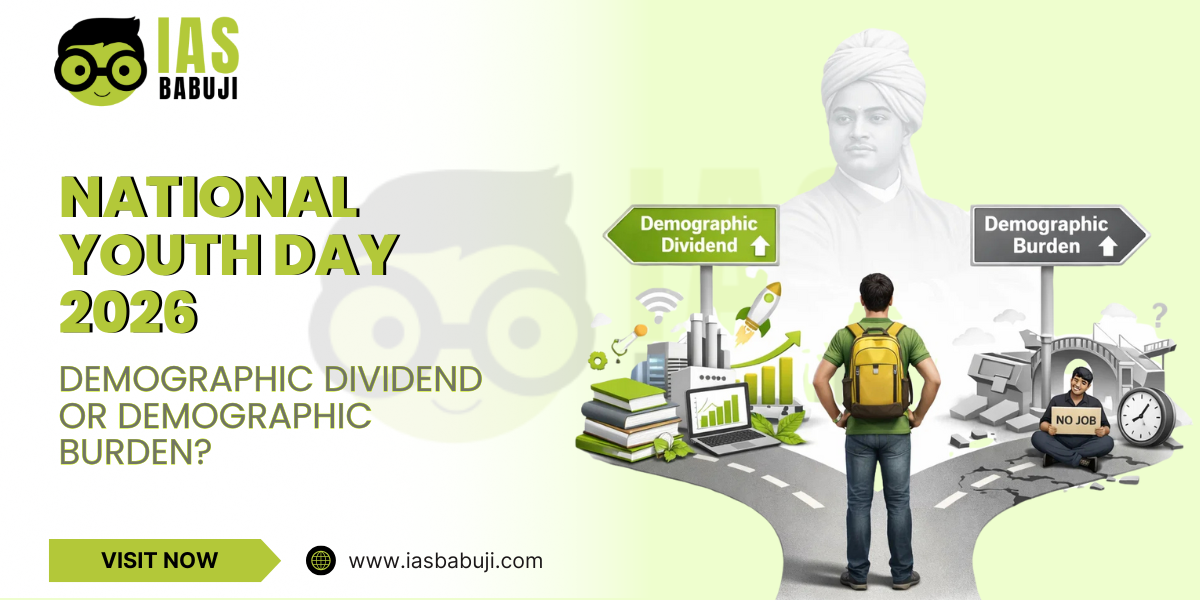
National Youth Day 2026: Demographic Dividend or Demographic Burden?
Introduction
Every year, 12 January is observed as National Youth Day to commemorate the birth anniversary of Swami Vivekananda, who believed that the future of India lies in the character, strength, and capability of its youth. In 2026, this observance gains special significance as India stands at a critical demographic juncture. With the largest youth population in the world, India is often described as a country poised to reap a demographic dividend. However, rising unemployment, skill mismatch, and declining labour force participation raise an uncomfortable question: Is India moving towards a demographic dividend or drifting into a demographic burden?
This debate is central to India’s economic, social, and governance challenges and is highly relevant for UPSC aspirants.
Understanding Demographic Dividend
Demographic dividend refers to the economic growth potential that arises when the working-age population (15–64 years) becomes larger than the dependent population.
Key features:
- High proportion of youth and working-age population
- Lower dependency ratio
- Opportunity for higher savings, productivity, and growth
However, the demographic dividend is not automatic. It depends on education, skills, employment opportunities, and governance capacity.
India’s Demographic Profile: The Youth Bulge
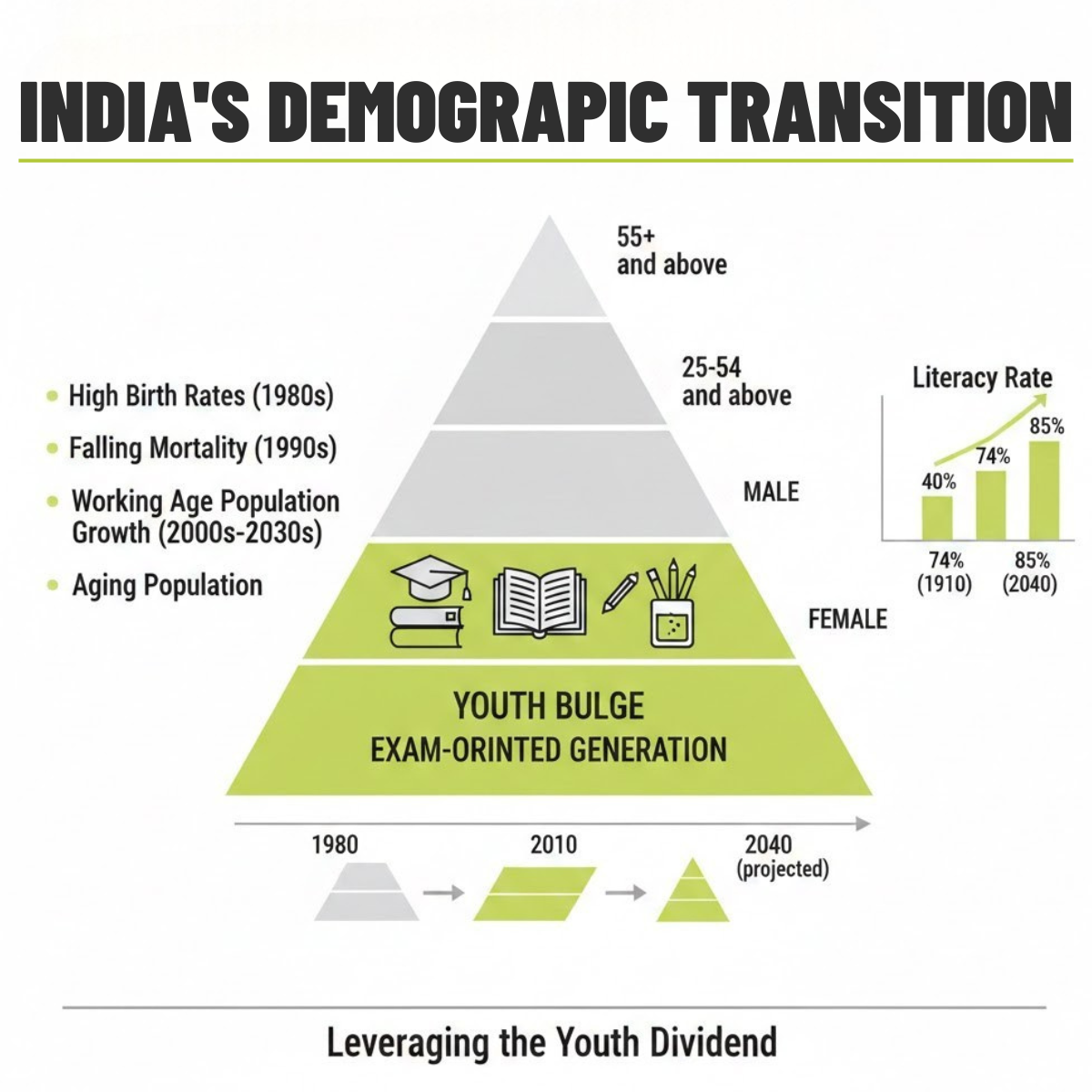
India is currently experiencing a youth bulge, with more than half of its population below 30 years of age.
Salient trends:
- Median age is significantly lower than developed economies
- Rising working-age population till mid-2030s
- Potential to support growth, innovation, and global labour markets
This phase is time-bound. If opportunities are missed, the dividend can quickly turn into a burden.
Why Youth is India’s Greatest Opportunity
Economic Growth Potential
- A large workforce can boost production and consumption
- Increased tax base and domestic demand
- Support for long-term economic expansion
Innovation and Entrepreneurship
- Youth-driven startups and digital adoption
- Strong presence in technology and services
- Startup ecosystem creating new job models
Global Workforce Advantage
- Ageing populations in developed countries
- India’s youth can meet global skill demand
Signs of a Demographic Burden Emerging
Unemployment and Underemployment
- Rising youth unemployment rates
- Educated unemployment is becoming common
- Growth is not translating into adequate jobs
Skill Mismatch
- The education system is misaligned with industry needs
- Shortage of job-ready skills
- Overemphasis on degrees over employability
Informal and Precarious Employment
- Dominance of the informal sector
- Gig and contract jobs without social security
- Poor job quality and income instability
Low Female Labour Force Participation
- One of the lowest participation rates globally
- Social norms, safety, and care burden issues
- Loss of productive potential
Education–Employment Disconnect
India’s education system faces structural challenges:
-
Rote learning over critical thinking
-
Limited vocational and technical training
-
Weak industry–academia linkage
As a result, many youth remain educated but unemployable, undermining the demographic advantage.
Governance and Policy Challenges
Harnessing youth potential requires strong governance.
Key challenges:
- Fragmented skill development ecosystem
- Uneven quality of training institutions
- Limited monitoring of outcomes
- Regional and rural–urban disparities
Without effective governance, demographic advantage cannot be converted into economic gains.
Ethical Dimension of the Youth Question
From an ethics perspective, demographic management is a moral responsibility of the State.
Ethical concerns include:
- Right to livelihood and dignity
- Inter-generational justice
- Social stability and inclusion
Failure to provide opportunities to youth can lead to alienation, frustration, and erosion of democratic values.
Government Initiatives for Youth Empowerment
India has launched multiple initiatives to leverage its youth population:
- Skill India Mission
- PM Kaushal Vikas Yojana
- Startup India and Stand-Up India
- National Education Policy reforms
- Digital skilling and entrepreneurship support
While intent is strong, outcomes depend on implementation quality and scale.
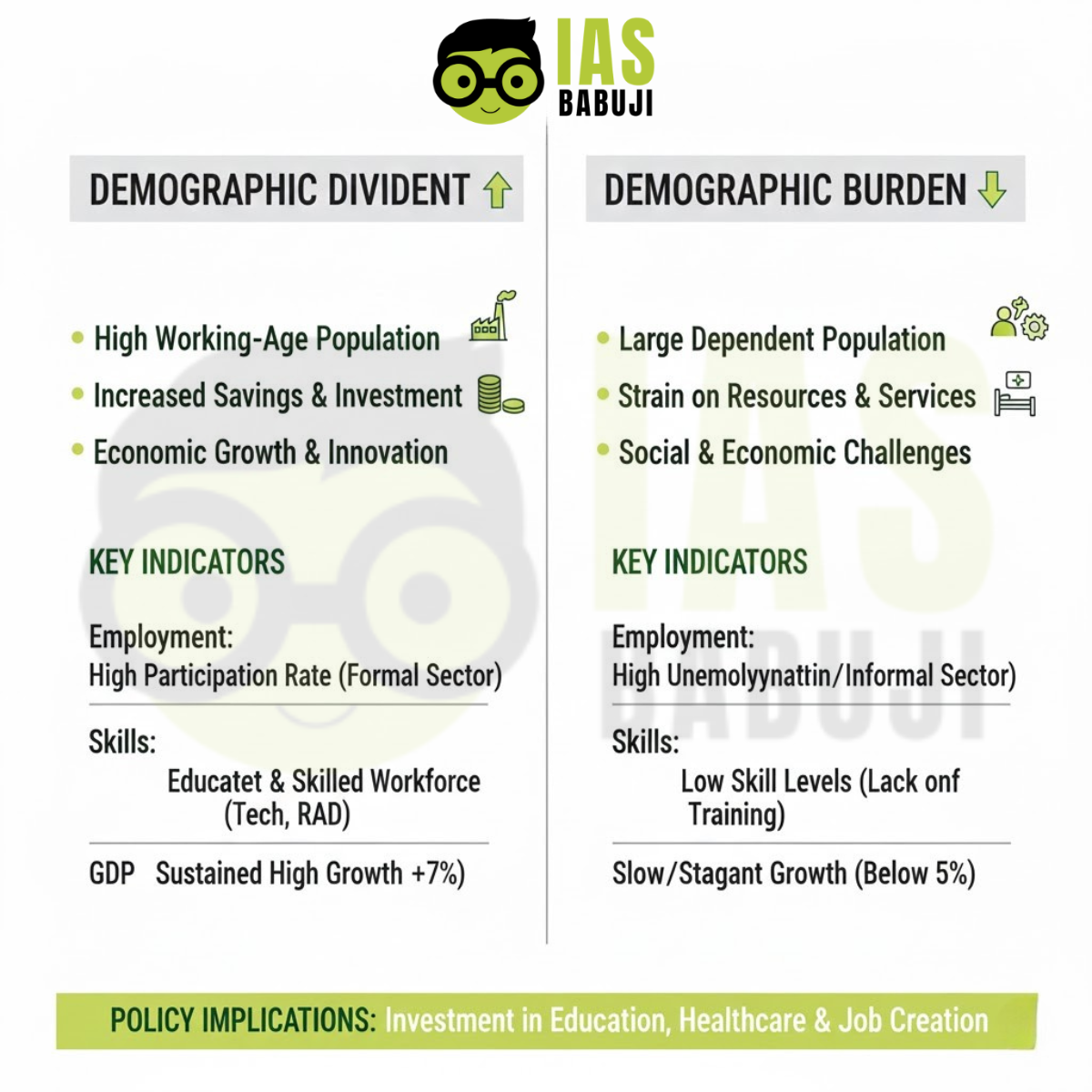
Demographic Dividend or Demographic Burden?
India’s youth advantage stands at a crossroads.
- If education, skills, jobs, and inclusion improve, youth can drive growth
- If unemployment, informality, and exclusion persist, youth pressure may become a burden
The outcome depends on policy choices made today, not in the distant future.
Way Forward
Key steps to harness demographic dividend:
- Align education with labour market needs
- Promote labour-intensive manufacturing and MSMEs
- Expand vocational and technical training
- Increase female workforce participation
- Strengthen social security for young workers
Youth empowerment must be treated as a national development strategy, not just a social objective.
Conclusion
On National Youth Day 2026, India must reflect deeply on the direction of its demographic transition. A large youth population offers an unprecedented opportunity to accelerate economic growth, innovation, and global competitiveness. However, this potential can only be realised if young people are equipped with relevant skills, meaningful employment, and social security. Persistent unemployment, skill mismatch, and informalisation threaten to turn the demographic dividend into a demographic burden. The challenge before India is not merely to educate its youth, but to make them employable, productive, and empowered. Harnessing the demographic dividend requires coordinated efforts in education reform, job creation, and ethical governance. The choices made today will determine whether India’s youth becomes the foundation of national progress or a missed opportunity in history.
FAQs
What is demographic dividend?
It is the economic growth potential arising from a higher proportion of working-age population.
Why is National Youth Day important for UPSC?
It links society, economy, governance, and ethics, making it relevant for GS I, GS III, and Essay.
What can turn a demographic dividend into a burden?
Unemployment, poor education quality, skill mismatch, and weak governance.