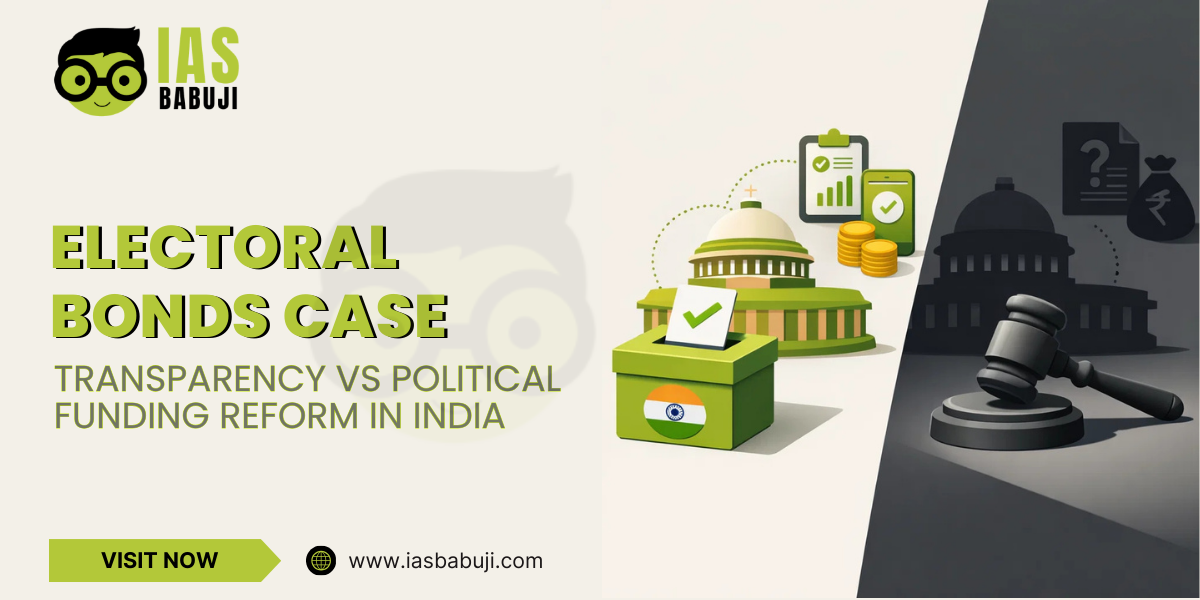
Electoral Bonds Case: Transparency vs Political Funding Reform in India
Introduction
Free and fair elections are the cornerstone of a democratic system. In India, political funding has long been a contentious issue due to concerns about black money, lack of transparency, and corporate influence. To address these issues, the Government of India introduced the Electoral Bonds Scheme in 2018 as a mechanism to reform political funding.
However, the scheme soon became controversial, leading to legal challenges. In February 2024, the Electoral Bonds Case marked a historic turning point when the Supreme Court struck down the scheme as unconstitutional. The judgment reignited debates around transparency, accountability, and the role of money in elections.
Background of the Electoral Bonds Scheme
The Electoral Bonds Scheme was introduced through the Finance Act, 2017 and implemented in 2018.
Key Features:
- Electoral bonds were bearer instruments similar to promissory notes
- Issued only by State Bank of India
- Available in denominations ranging from ₹1,000 to ₹1 crore
- Could be purchased by individuals or companies
- Donors remained anonymous to the public
- Only political parties registered under the Representation of the People Act, 1951 and securing at least 1% votes were eligible to receive donations
Objective:
- Cleanse political funding by promoting banking channel donations
- Reduce the use of black money in elections
- Ensure transparency in funding (as claimed by the government)
Issues with Political Funding in India
Before analyzing the judgment, it is important to understand the broader concerns:
1. Lack of Transparency
Political parties were not required to disclose the identity of donors under the scheme.
2. Corporate Influence
Amendments removed the cap on corporate donations, allowing unlimited funding.
3. Opaque Electoral Financing
The public had no way to know which party received funding from which entity.
4. Risk of Crony Capitalism
Possibility of quid pro quo arrangements between corporates and ruling parties.
Supreme Court Judgment (2024)
In February 2024, a Constitution Bench of the Supreme Court delivered a landmark judgment striking down the Electoral Bonds Scheme.
Key Observations:
1. Violation of Right to Information
The Court held that voters have a right to know about political funding under Article 19(1)(a).
2. Anonymity Undermines Transparency
The scheme’s anonymity provisions were found to be unconstitutional.
3. Corporate Funding Concerns
The removal of limits on corporate donations was considered problematic, as it could lead to undue corporate influence.
4. Arbitrary Policy Design
The scheme was criticized for being disproportionate and lacking safeguards.
5. Directions Issued by Court
- The Electoral Bonds Scheme was declared unconstitutional
- State Bank of India was directed to stop issuing bonds
- Details of political donations were to be disclosed to the Election Commission of India and made public
Arguments in Favour of Electoral Bonds
Despite the judgment, the scheme had several supporters.
1. Shift to Formal Economy
Encouraged donations through banking channels instead of cash.
2. Protection of Donor Privacy
Prevented political victimization of donors.
3. Reduced Black Money
Aimed to curb illegal funding in elections.
4. Ease of Political Donations
Simplified the process of contributing to political parties.
Criticism of the Scheme
1. Lack of Transparency
The anonymity provision made the system opaque.
2. Advantage to Ruling Party
Critics argued that the ruling party could access donor information indirectly via banking channels.
3. Unlimited Corporate Donations
Removal of donation caps increased risks of corporate capture of politics.
4. Weak Oversight
Limited role of regulatory bodies reduced accountability.
Impact of the Judgment
The Supreme Court verdict has significant implications:
1. Strengthening Democratic Accountability
Enhances transparency in political funding.
2. Reinforcing Voter Rights
Affirms citizens’ right to informed electoral choices.
3. Policy Re-evaluation
Forces the government to redesign political funding mechanisms.
4. Increased Scrutiny of Political Finance
Opens debate on alternative funding models.
Role of the Election Commission of India
The Election Commission of India plays a crucial role in ensuring free and fair elections.
Challenges Faced:
- Limited regulatory powers over political funding
- Dependence on legislative framework
- Difficulty in ensuring transparency
Need for Strengthening:
- Greater autonomy
- Enhanced monitoring powers
- Mandatory disclosure norms
Way Forward
1. Transparent Political Funding System
Mandatory disclosure of all donations above a certain threshold.
2. State Funding of Elections (Debated)
Partial state funding to reduce dependency on private donations.
3. Strengthening Legal Framework
Revisiting laws like the Representation of the People Act, 1951.
4. Digital Transparency Mechanisms
Real-time disclosure of political donations.
5. Institutional Reforms
Empowering the Election Commission with greater oversight authority.
Conclusion
The Electoral Bonds Scheme was introduced to reform political funding, but its design raised serious concerns about transparency and accountability. The Supreme Court’s 2024 judgment marks a significant step toward strengthening democratic principles by upholding the right to information and electoral transparency.
In the future, India must strike a balance between donor privacy and public accountability to ensure a fair, transparent, and credible electoral system.
FAQs for UPSC Preparation
1. What were Electoral Bonds?
Electoral bonds were financial instruments used to donate money to political parties anonymously through banking channels.
2. Why was the Electoral Bonds Scheme struck down?
It was struck down for violating the right to information under Article 19(1)(a) and undermining transparency in political funding.
3. Which bank issued Electoral Bonds?
Only the State Bank of India was authorized to issue them.
4. What is the role of the Election Commission in political funding?
It regulates elections and monitors political parties but has limited powers over funding transparency.
5. What is the main issue with anonymous political donations?
They reduce transparency and may lead to corruption and undue influence.
6. What reforms are suggested after the judgment?
Transparent funding systems, stronger laws, digital disclosures, and possible state funding of elections.