• Home
  • Exam Details
  • Strategy
  • Books
  • Current Affairs
  • Contact Us
IAS Babu Ji
Advertise With Us!
  • Home
  • Exam Details
  • Strategy
  • Books
  • Current Affairs
  • State PSC Exams
  • About Us
No Result
View All Result
  • Home
  • Exam Details
  • Strategy
  • Books
  • Current Affairs
  • State PSC Exams
  • About Us
No Result
View All Result
IAS Babu Ji
No Result
View All Result
Home UPSC Study Material GS II

Reforming the Rajya Sabha

by editorialteam
in GS II
Reading Time: 6 mins read
0
Reforming the Rajya Sabha

Reforming the Rajya Sabha

Share on FacebookShare on WhatsAppShare on Twitter

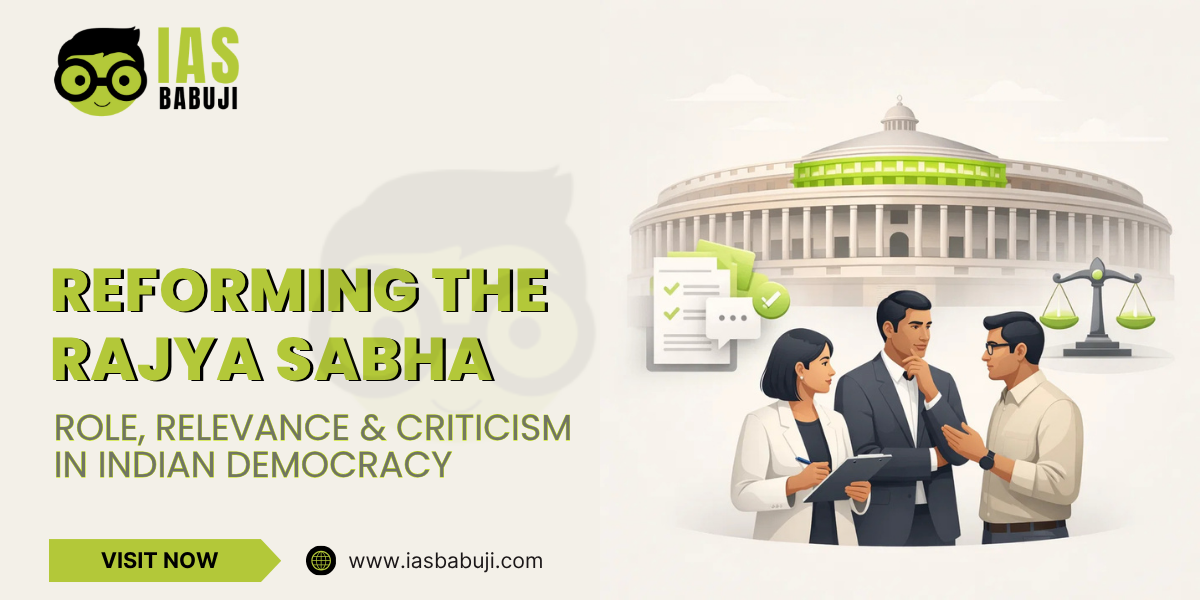
Reforming the Rajya Sabha: Role, Relevance & Criticism in Indian Democracy

Introduction

India follows a bicameral parliamentary system, consisting of the Lok Sabha (House of the People) and the Rajya Sabha (Council of States). The Rajya Sabha plays a vital role in ensuring federal balance, reviewing legislation, and representing the interests of states.

However, over the years, debates have emerged regarding its relevance, effectiveness, and need for reforms. Questions have been raised about whether the Rajya Sabha is fulfilling its intended role or merely acting as a delaying chamber.


Constitutional Position of Rajya Sabha

The Rajya Sabha derives its authority from the Constitution.

Key Provisions:

  • Article 80 – Defines composition and representation
  • Article 83 – Rajya Sabha is a permanent body
  • Article 249 – Special powers in national interest
  • Article 312 – Creation of All India Services

Unlike Lok Sabha, the Rajya Sabha cannot be dissolved, ensuring continuity in governance.


Composition and Election

  • Maximum strength: 250 members
  • 238 members elected by states and Union Territories
  • 12 nominated members by the President (experts in arts, science, literature, etc.)

Members are elected through proportional representation by single transferable vote.


Role and Functions of Rajya Sabha

1. Federal Representation

Represents the interests of states in the Union Parliament.

2. Legislative Role

  • Reviews and debates bills passed by Lok Sabha
  • Can suggest amendments

3. Revisory Chamber

Acts as a check against hasty legislation.

4. Special Powers

Under Article 249, it can allow Parliament to legislate on State List subjects.

5. Continuity in Governance

Being a permanent body, it ensures stability even when Lok Sabha is dissolved.


Importance of the Rajya Sabha

1. Protects Federal Structure

Ensures that states have a voice in national law-making.

2. Improves Legislative Quality

Provides a second level of scrutiny.

3. Includes Experts

Nominated members bring expertise into Parliament.

4. Prevents Majoritarianism

Acts as a check on the dominance of the Lok Sabha.


Criticism of the Rajya Sabha

Despite its importance, several criticisms have been raised.

1. Weak Federal Representation

Members are elected by state legislatures, not directly by people.

2. Political Tool

Used by political parties to accommodate leaders who lose Lok Sabha elections.

3. Obstruction of Legislation

Sometimes delays important bills for political reasons.

4. Limited Powers

Cannot introduce or amend Money Bills effectively.

5. Questionable Relevance

Critics argue that it duplicates the functions of Lok Sabha.


Key Issues and Challenges

1. Misuse of Money Bill Provision

Bypassing Rajya Sabha through Money Bills has raised concerns.

2. Party Dominance

Members often follow party lines instead of representing state interests.

3. Declining Debate Quality

Frequent disruptions affect its effectiveness.

4. Lack of Accountability

Indirect election reduces accountability to citizens.


Arguments in Favour of Reforms

1. Strengthening Federalism

Ensure better representation of states.

2. Improving Legislative Efficiency

Reduce delays while maintaining scrutiny.

3. Enhancing Accountability

Make members more answerable.

4. Reviving Deliberative Role

Encourage meaningful debates.


Suggested Reforms

1. Reform Election Process

Introduce partial direct elections or improve transparency.

2. Limit Party Control

Encourage independent thinking among members.

3. Strengthen Powers

Ensure greater role in financial legislation.

4. Regulate Money Bill Usage

Strict interpretation to prevent misuse.

5. Improve Functioning

  • Reduce disruptions
  • Increase sitting days
  • Promote the committee system

Role of Rajya Sabha in Modern Democracy

The Rajya Sabha continues to play an important role in:

  • Maintaining checks and balances
  • Ensuring continuity
  • Representing diverse interests
  • Strengthening parliamentary democracy

Way Forward

  • Balance between efficiency and deliberation
  • Institutional reforms without weakening federalism
  • Encourage constructive debate and cooperation

A reformed Rajya Sabha can act as a true chamber of reflection in India’s democracy.


Conclusion

The Rajya Sabha remains a crucial pillar of India’s parliamentary system. While it faces criticism regarding its relevance and functioning, its role in ensuring federal balance and legislative scrutiny cannot be ignored.

Reforms should aim to strengthen—not weaken—the institution, making it more transparent, accountable, and effective in fulfilling its constitutional mandate.


FAQs for UPSC Preparation

1. What is the Rajya Sabha?

It is the Upper House of Parliament representing the states.

2. Is the Rajya Sabha a permanent body?

Yes, it cannot be dissolved.

3. What is the maximum strength of the Rajya Sabha?

250 members.

4. What is its role in legislation?

It reviews, debates, and suggests amendments to bills.

5. Why is the Rajya Sabha criticized?

Due to limited powers, indirect elections, and political misuse.

6. What reforms are suggested?

Election reforms, strengthening powers, and improving functioning.

Post Views: 0
ShareSendTweet
Previous Post

Judicial Activism in India

Related Posts

Judicial Activism in India
GS II

Judicial Activism in India

by editorialteam
Electoral Bonds Case
GS II

Electoral Bonds Case

by editorialteam
Civil Services Reforms in India
GS II

Civil Services Reforms in India

by editorialteam
India–EU Free Trade Agreement Finalised 2026
Essay Writing

India–EU Free Trade Agreement Finalised 2026

by editorialteam
Role of the Governor in India’s Federal Structure
GS II

Role of the Governor in India’s Federal Structure

by editorialteam

Recent Posts

  • Reforming the Rajya Sabha
  • Judicial Activism in India
  • Electoral Bonds Case
  • Civil Services Reforms in India
  • Anti-Defection Law in India
  • Invasive Alien Species (IAS)
  • 5G/6G and Satellite Internet

Browse by Category

  • 2019
  • Admit Card
  • Age Limit
  • Andhra Pradesh Public Service Commission (APPSC)
  • Assam Public Service Commission (APSC)
  • Bihar Public Service Commission (BPSC)
  • CAPF
  • CDS
  • Chhattisgarh Public Service Commission (CGPSC)
  • CMS
  • Cut Off Marks
  • Economics
  • Economics
  • Economics Books
  • Editorial Articles
  • Eligibility Criteria
  • Environment & Ecology
  • EPFO
  • Essay Writing
  • Ethics
  • Ethics Books
  • Exam Pattern
  • Geography
  • Geography Books
  • GS II
  • GS III
  • Gujarat Public Service Commission (GPSC)
  • Haryana Public Service Commission (HPSC)
  • Himachal Pradesh Public Service Commission (HPPSC)
  • Hindi Medium
  • History
  • History
  • History Books
  • IAS
  • IAS & IPS Officers
  • IAS Exam (CSE)
  • IES
  • IFS
  • IFS
  • Indian Polity
  • Internal Security
  • International Relations
  • IPS
  • IRS
  • ISS
  • Jammu and Kashmir Public Service Commission (JKPSC)
  • Jharkhand Public Service Commission (JPSC)
  • Karnataka Public Service Commission (KPSC)
  • Kerala Public Service Commission (KPSC)
  • Kurukshetra Magazine
  • Madhya Pradesh Public Service Commission (MPPSC)
  • Maharashtra Public Service Commission (MPSC)
  • Mains General Studies
  • Mains Syllabus
  • Mathematics
  • NCERT Books
  • NDA
  • Notification
  • Odisha Public Service Commission (OPSC)
  • Offline Coaching
  • Online Application
  • Online Coaching
  • Optional Subjects
  • Prelims Books
  • Prelims Exam
  • Prelims General Studies
  • Prelims Syllabus
  • Press Information Bureau (PIB)
  • Public Administration
  • Punjab Public Service Commission (PPSC)
  • Rajasthan Public Service Commission (RPSC)
  • RSTV
  • Science & Technology
  • SCRA
  • Sociology
  • State Public Service Commission
  • Tamil Nadu Public Service Commission (TNPSC)
  • The Hindu
  • The Indian Express
  • Uncategorized
  • UPSC Books
  • UPSC Coaching
  • UPSC CSE Subjects
  • UPSC Current Affairs
  • UPSC Exam Details
  • UPSC Exams
  • UPSC Interview Process
  • UPSC Posts
  • UPSC Question Papers
  • UPSC Strategy
  • UPSC Study Material
  • UPSC Syllabus
  • UPSC Test Series
  • UPSC Training
  • Uttar Pradesh Public Service Commission (UPPSC)
  • Uttarakhand Public Service Commission (UKPSC)
  • West Bengal Public Service Commission (WBPSC)
  • Yojana Magazine

Browse by Tags

administrative reforms india basic structure doctrine British India Centre State Relations Current Affair Dam Economy Exam Topper Government Scheme Government Schemes GS 2 Polity GS 2 Polity Notes GS II polity History IAS IAS Officer IAS Officer Power IFS Officer Inclusive Growth Indian Constitution Indian Economy Inflation in India Informative Content IPS Officer judicial review India Kesavananda Bharati Case Macroeconomics mission karmayogi net zero 2070 India PSC public administration india RBI Supreme Court Judgments UPSC UPSC Calendar UPSC CAPF Exam UPSC CDS Exam UPSC Coaching UPSC Current Affairs upsc gs2 governance UPSC GS III Economy UPSC polity current affairs UPSC Polity Notes UPSC Preparation UPSC Question Paper War
  • Home
  • Exam Details
  • Strategy
  • Books
  • Current Affairs
  • Contact Us
Contact us at [email protected]

© 2021 IAS BABU JI - One-Stop Solution for UPSC Exam Aspirants

No Result
View All Result
  • Home
  • Exam Details
  • Strategy
  • Books
  • Current Affairs
  • Contact Us

© 2021 IAS BABU JI - One-Stop Solution for UPSC Exam Aspirants

Are you sure want to unlock this post?
Unlock left : 0
Are you sure want to cancel subscription?