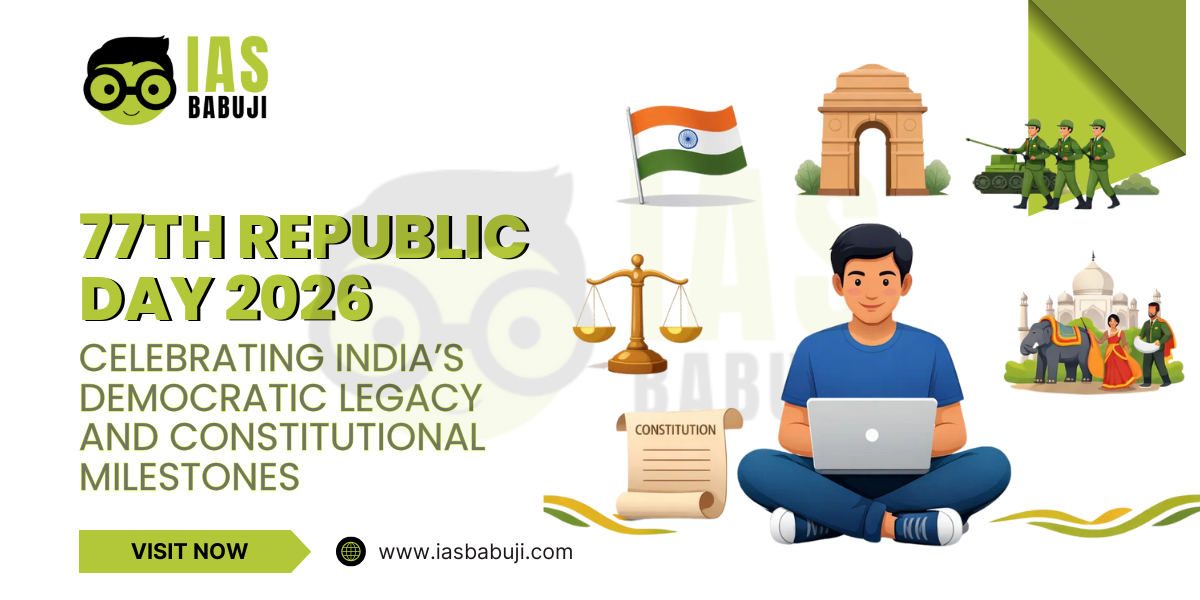
77th Republic Day 2026: Celebrating India’s Democratic Legacy and Constitutional Milestones
Introduction
Every year, on 26th January, India commemorates Republic Day, a day of immense historical, political, and cultural significance. In 1950, the Constitution of India came into force, establishing India as a sovereign, socialist, secular, and democratic republic. This day symbolizes the transition of India from a British Dominion to a fully functioning republic, with its own framework of laws, governance, and citizen rights.
In 2026, India celebrates its 77th Republic Day, offering an opportunity to reflect on the nation’s democratic journey, constitutional values, defense capabilities, and socio-economic progress. For UPSC and other competitive exam aspirants, understanding the nuances of Republic Day is crucial, as it connects history, polity, governance, culture, and current affairs—all integral parts of the syllabus.
Historical Background of Republic Day
Republic Day finds its roots in India’s struggle for complete independence. Though India gained independence on 15 August 1947, it remained a dominion under the British Crown, with limited sovereignty. To assert full self-governance and legal independence, the Constituent Assembly of India, led by Dr. B.R. Ambedkar, drafted a comprehensive Constitution.
The date 26 January 1950 was chosen deliberately to honor the Purna Swaraj (Complete Independence) Declaration of 1930, which emphasized India’s commitment to self-rule and national sovereignty. On this day, the Constitution came into effect, making India a republic governed by laws of its own making, rather than colonial statutes.
The Constitution laid down fundamental principles of justice, liberty, equality, and fraternity, and established key democratic institutions such as the Parliament, Judiciary, and Executive, along with provisions for fundamental rights, directive principles of state policy, and duties of citizens.
Significance of Republic Day
Republic Day is more than a ceremonial occasion; it serves as a reminder of India’s constitutional ideals and democratic foundations. Its significance can be examined through multiple dimensions:
- Democracy and Governance: Republic Day celebrates India’s status as a sovereign, democratic republic, where the power of governance ultimately rests with the people. It is a day to acknowledge the functioning of elected representatives, independent judiciary, and accountable institutions.
- Constitutional Values: The day underscores India’s commitment to justice (social, economic, and political), liberty (of thought, expression, and belief), equality (before law), and fraternity among its citizens, forming the backbone of the Indian republic.
- National Integration: Through the cultural tableaux and parade displays, Republic Day highlights India’s diverse cultures, traditions, and languages, promoting a sense of unity in diversity. It reminds citizens that despite regional, linguistic, and religious differences, India’s constitutional framework binds the nation together.
- Defense and Strategic Preparedness: The Republic Day Parade showcases India’s military strength, defense innovations, and strategic capabilities, emphasizing the importance of a secure and technologically advanced nation.
- Socio-Cultural Pride: The event celebrates achievements in arts, culture, and education, reflecting the nation’s progress in various spheres and inspiring citizens to contribute to nation-building.
For aspirants preparing for UPSC and other competitive exams, understanding these layers of significance helps connect historical events with contemporary governance, policy initiatives, and defense strategies, which are frequently asked in exams.
77th Republic Day 2026: Celebrations and Highlights
The 77th Republic Day celebrations in 2026 were marked by grandeur, innovation, and inclusivity, reflecting India’s evolving socio-political and technological landscape:
- Presidential Address and Ceremonial Functions: The President of India, as the constitutional head, presided over the formalities at Rajpath, New Delhi, with the Prime Minister, Vice President, Cabinet Ministers, and Chief Justice of India in attendance. The event reinforced India’s constitutional framework and democratic ethos.
- Military Parade and Defense Showcase: The parade featured the Indian Army, Navy, and Air Force, along with paramilitary forces, highlighting India’s indigenous defense production, advanced weaponry, and strategic preparedness. New innovations in aerospace, missile defense, and surveillance technologies were showcased, reflecting India’s self-reliance in defense and futuristic capabilities.
- Cultural Tableaux: States and Union Territories presented cultural tableaux, emphasizing folk traditions, festivals, local achievements, and social initiatives. This segment of the parade illustrated India’s diverse heritage and regional pride, fostering awareness of the country’s cultural richness.
- Recognition of Achievers: On this day, Padma Awards—including Padma Vibhushan, Padma Bhushan, and Padma Shri—were conferred to individuals excelling in arts, science, public service, sports, and social work, highlighting merit, innovation, and contribution to national development.
- Special Initiatives: The 2026 celebrations emphasized technology, sustainability, and inclusive growth, showcasing government initiatives in renewable energy, digital governance, and social welfare schemes. This demonstrates how Republic Day serves as a platform for reflecting contemporary policy priorities alongside traditional values.
Constitutional and Polity Relevance for UPSC
Republic Day is closely linked to Indian Polity and Governance, making it highly relevant for UPSC aspirants:
- Historical Perspective: Questions on the Constituent Assembly, adoption of the Constitution, Purna Swaraj, and framing of fundamental rights often appear in exams.
- Role of Constitutional Authorities: The President, Prime Minister, Parliament, and Judiciary—central to Republic Day functions—form an important focus area for polity questions.
- Fundamental Rights and Duties: Understanding these constitutional provisions is essential for analyzing citizen-state relations and governance policies.
- Defense and Strategic Studies: Displays of modern weaponry, indigenous technology, and military capabilities provide insights into India’s strategic posture and self-reliance, relevant for GS Paper III.
- Socio-Economic and Cultural Policies: Cultural tableaux and awards reflect developmental priorities, social initiatives, and national integration, connecting history, culture, and current affairs.
Republic Day and Citizen Awareness
Republic Day also serves as a reminder for citizens to uphold democratic values, civic duties, and ethical governance principles. Activities such as flag hoisting, participation in local events, and engagement with social initiatives encourage civic responsibility and national pride. For aspirants, this understanding deepens the connection between constitutional provisions and real-world governance.
Contemporary Reflections: India in 2026
In 2026, Republic Day goes beyond historical commemoration to reflect India’s current achievements and future aspirations:
- Technological Advancements: Highlighting India’s progress in AI, space missions, renewable energy, and defense innovation.
- Inclusive Governance: Showcasing policies that promote social welfare, education, and empowerment of marginalized communities.
- Global Engagement: Celebrating India’s role in international forums, climate diplomacy, and strategic partnerships to reinforce its global influence.
This dynamic reflection of India’s growth demonstrates how constitutional ideals guide contemporary policy and governance.
Conclusion
The 77th Republic Day 2026 is a tribute to India’s democratic journey, constitutional foresight, and national achievements. It encapsulates the essence of sovereignty, unity, and progress, reminding citizens and aspirants alike of their rights, duties, and role in nation-building.
For UPSC, MPSC, SSC, and banking exam aspirants, understanding Republic Day helps connect historical context, constitutional provisions, governance structures, and current affairs, forming a strong base for both prelims and mains preparation.
By reflecting on Republic Day, aspirants gain insights into India’s past struggles, present accomplishments, and future aspirations, enriching both their exam preparation and civic consciousness.
FAQs
Q1: Why is 26th January celebrated as Republic Day?
A1: Because on 26 January 1950, India’s Constitution came into effect, making India a sovereign republic.
Q2: Who presides over the Republic Day celebrations?
A2: The President of India, as the constitutional head, presides over the official ceremonies.
Q3: How is Republic Day relevant for UPSC exams?
A3: It covers History, Polity, Governance, Culture, and Current Affairs, linking constitutional knowledge with contemporary developments.
Q4: What is the significance of the Republic Day Parade?
A4: The parade highlights India’s defense strength, cultural diversity, and technological achievements, reflecting national pride.
Q5: Which awards are presented on Republic Day?
A5: Padma Awards—Padma Vibhushan, Padma Bhushan, and Padma Shri—honor outstanding contributions in arts, science, public service, and social work.