
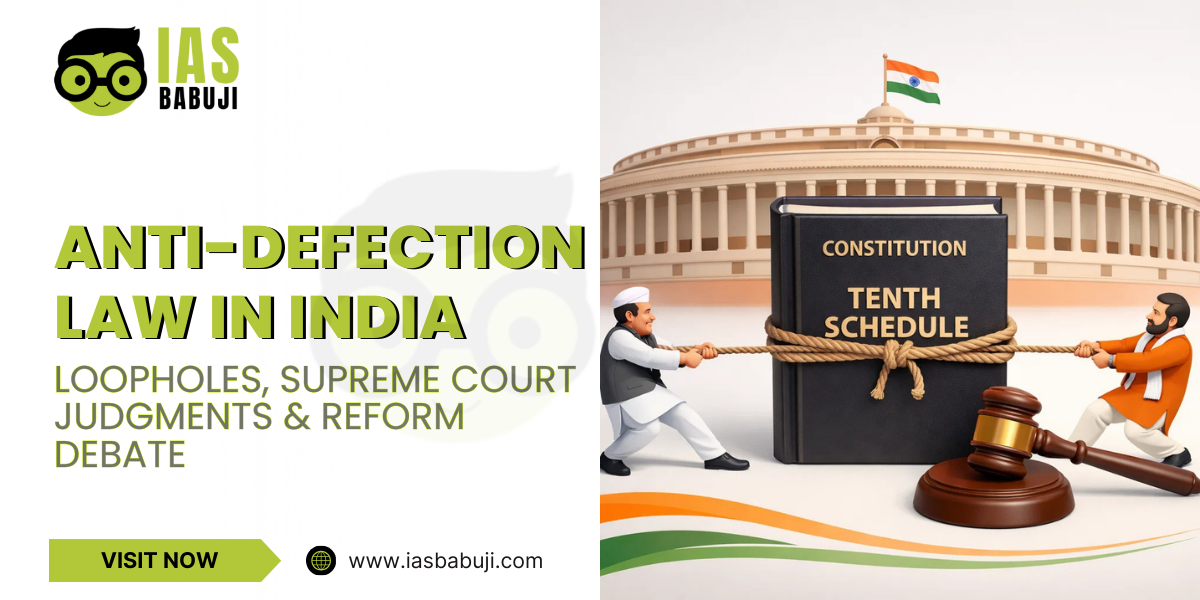
Anti-Defection Law: Loopholes, Supreme Court Judgments & Reform Debate
Focus: 10th Schedule, Speaker’s role, constitutional concerns
Paper: GS 2 – Polity & Governance
Introduction
Political defections have historically destabilised governments in India. The phrase “Aaya Ram, Gaya Ram” became symbolic of frequent party-switching by legislators in the 1960s and 70s. To curb this political instability, the Anti-Defection Law was introduced through the 52nd Constitutional Amendment Act, 1985, inserting the Tenth Schedule into the Constitution.
While the law aimed to promote stability and party discipline, over time it has generated serious constitutional debates concerning:
- Role and neutrality of the Speaker
- Judicial review
- Merger loopholes
- Impact on parliamentary democracy
For UPSC, this topic is extremely important for both Prelims (factual) and Mains (critical analysis).
1. Background of Anti-Defection Law
Before 1985:
- Frequent defections weakened state governments.
- Horse-trading and political instability were common.
- Coalition politics intensified the problem.
The 52nd Constitutional Amendment Act (1985) inserted the Tenth Schedule, providing grounds for disqualification.
Later, the 91st Constitutional Amendment Act (2003) strengthened the law by removing the provision that allowed “split” by one-third members.
2. What is the Tenth Schedule?
The Tenth Schedule lays down:
- Grounds for disqualification
- Authority to decide disqualification
- Exceptions to disqualification
- Bar on judicial interference (initially)
It applies to:
- Members of Parliament
- Members of State Legislatures
3. Grounds for Disqualification under Tenth Schedule
A legislator can be disqualified if:
1) Voluntarily giving up membership of the party
Not limited to formal resignation. Even conduct indicating leaving the party can qualify.
2) Voting or abstaining against party whip
If a member votes:
- Against party direction
- Without prior permission
They may be disqualified.
3) Independent Member
If an independent member joins a political party after election → disqualified.
4) Nominated Member
If joins a party after six months of nomination → disqualified.
4. Exceptions: When Disqualification Does Not Apply
1) Merger Provision
If:
-
Two-thirds of members of a legislative party agree to merge with another party
Then disqualification does not apply.
This “2/3rd merger rule” has become a major loophole in recent years.
5. Role of the Speaker: Constitutional Controversy
Under the Tenth Schedule:
- The Speaker (or Chairman in Rajya Sabha) decides disqualification cases.
- Their decision was originally final.
Key Constitutional Concern:
Speaker belongs to a political party. Can they act impartially?
This has led to serious criticism:
- Delayed decisions to favour ruling party
- Quick decisions to destabilise opposition
- Strategic resignation and re-election tactics
6. Important Supreme Court Judgments
1. Kihoto Hollohan v. Zachillhu (1992)
Landmark judgment.
Supreme Court held:
- The anti-defection law is constitutionally valid.
- The speaker’s decision is subject to judicial review.
- Courts can intervene after a decision is made.
Significance:
Balanced parliamentary autonomy with judicial oversight.
2. Nabam Rebia v. Deputy Speaker (2016)
Court held:
-
The speaker cannot decide on disqualification petitions if notice for their removal is pending.
This created procedural complications in several state crises.
3. Keisham Meghachandra Singh v. Speaker, Manipur (2020)
Supreme Court recommended:
- Disqualification decisions should be made within 3 months.
- Suggested the possibility of an independent tribunal instead of the Speaker.
This judgment revived the reform debate.
4. Recent Political Crises (Maharashtra, Karnataka, etc.)
In several state crises:
- MLAs resigned before disqualification.
- Delays in decision altered government formation.
- Courts had to intervene repeatedly.
These events exposed systemic weaknesses.
7. Major Loopholes in Anti-Defection Law
1) Speaker Bias
Since the Speaker is a political figure, neutrality is questioned.
2) Delay in Decisions
No fixed constitutional time limit (though SC recommended 3 months).
Delay can:
- Help the ruling party survive
- Help defectors resign and contest again
3) Merger Clause Abuse
The two-thirds rule has enabled:
-
Mass defectUUipulation
4) Restriction on Legislative Freedom
Whip applies broadly.
Criticism:
- MPs/MLAs cannot vote based on conscience.
- Reduces Parliament to a rubber stamp.
- Weakens deliberative democracy.
8. Reform Debate: What Needs to Change?
1) Independent Tribunal
Suggestion:
- Transfer power from the Speaker to an independent body.
- Possibly the Election Commission or a retired judges panel.
2) Time-bound Decision
Make a 3-month timeline mandatory.
3) Restrict Whip Scope
Whip should apply only to:
- No-confidence motions
- Money bills
- Confidence votes
Not on every ordinary legislation.
4) Remove Merger Loophole
Either:
-
Abolish the merger exception
OR -
Make conditions stricter
9. Arguments in Favour of Anti-Defection Law
- Ensures political stability.
- Prevents horse-trading.
- Maintains party discipline.
- Protects voter mandate.
10. Arguments Against the Law
- Undermines freedom of speech of legislators.
- Strengthens party high command culture.
- Reduces accountability to the constituency.
- Encourages mass engineered defections.
11. UPSC Prelims Quick Facts
- Introduced: 52nd Constitutional Amendment Act, 1985
- Amended: 91st Constitutional Amendment Act, 2003
- Located in: Tenth Schedule
- Deciding authority: Speaker/Chairman
- Judicial review allowed? Yes (post Kihoto Hollohan case)
12. Conclusion
The Anti-Defection Law was enacted to bring stability to India’s parliamentary democracy. However, over time, it has created a tension between:
- Stability vs democratic freedom
- Party discipline vs legislative independence
- Political neutrality vs institutional bias
Reforms are necessary to ensure that the law strengthens democracy rather than weakening it.
A balanced approach must:
- Preserve government stability
- Protect legislative autonomy
- Ensure institutional neutrality
Only then can the Anti-Defection Law fulfil its constitutional purpose.
FAQs
Q1. Which amendment introduced the Anti-Defection Law?
The 52nd Constitutional Amendment Act, 1985.
Q2. Where is the Anti-Defection Law located?
In the Tenth Schedule of the Constitution.
Q3. Who decides disqualification?
Speaker (Lok Sabha/State Assembly) or Chairman (Rajya Sabha).
Q4. Is the Speaker’s decision final?
No. It is subject to judicial review.
Q5. What is the merger rule?
If two-thirds of members merge with another party, they avoid disqualification.