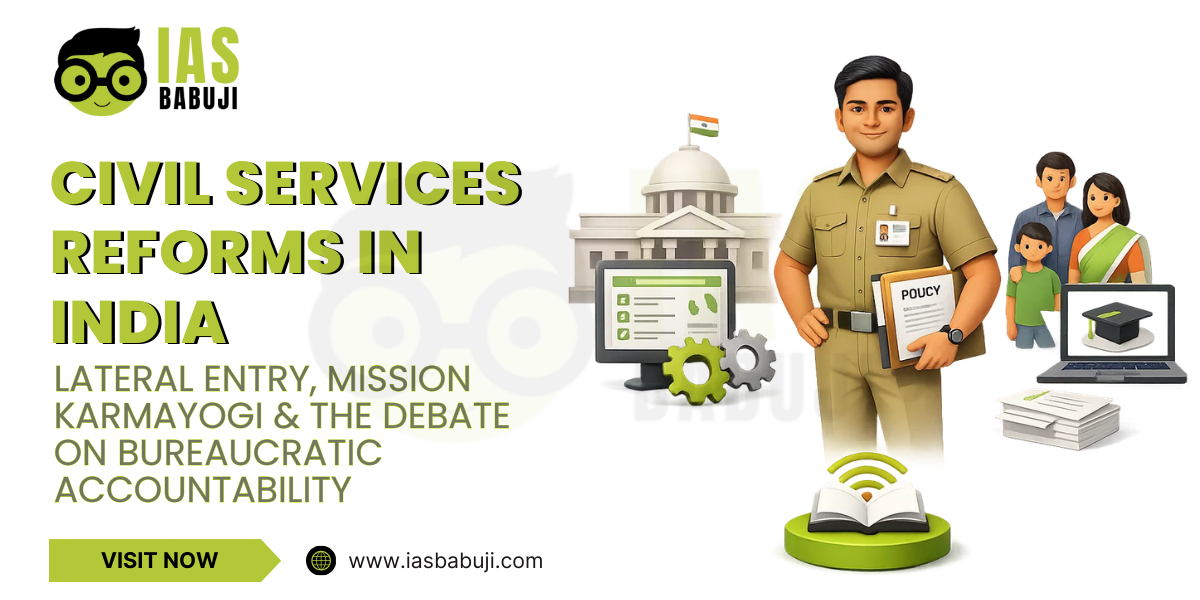
Civil Services Reforms in India: Lateral Entry, Mission Karmayogi & the Debate on Bureaucratic Accountability
Introduction
The civil services form the backbone of India’s administrative system. They play a crucial role in implementing government policies, maintaining law and order, delivering public services, and ensuring continuity in governance. The constitutional framework under Articles 309–323 of the Constitution of India provides the legal basis for recruitment and service conditions of civil servants.
Since independence, India has relied on an elite administrative system led by services such as the Indian Administrative Service (IAS), Indian Police Service (IPS), and Indian Foreign Service (IFS). However, rapid socio-economic transformation, technological advancements, and rising public expectations have highlighted the need for continuous reforms in the civil services.
In recent years, initiatives like lateral entry into bureaucracy, Mission Karmayogi, and proposals for performance-based evaluation have sparked an important debate on improving efficiency, accountability, and expertise within India’s administrative machinery.
Need for Civil Services Reforms in India
Several structural and functional challenges have created the need for reforms in India’s civil services.
1. Increasing Complexity of Governance
Modern governance involves complex issues such as climate change, digital economy, cybersecurity, artificial intelligence, and global trade. Traditional bureaucratic structures may lack the specialized expertise required to address these challenges.
2. Slow Decision-Making
The administrative system is often criticized for excessive procedural delays, red tape, and hierarchical decision-making processes.
3. Accountability Deficit
Civil servants exercise significant authority in policymaking and implementation, but mechanisms for performance evaluation and accountability have often been considered weak.
4. Skill Gap in Specialized Areas
Many policy domains require professionals with expertise in fields such as finance, data science, public health, infrastructure management, and energy policy.
5. Public Expectations for Efficient Governance
With rising awareness and digital transparency, citizens increasingly demand efficient public service delivery and responsive governance.
Major Reform Initiatives
The Government of India has initiated several reforms to modernize the bureaucracy. Some important initiatives include:
- Lateral entry into senior administrative positions
- Mission Karmayogi (Capacity building programme)
- Performance-based evaluation systems
- Digital governance and e-office systems
- Administrative reforms suggested by committees such as the Second Administrative Reforms Commission (ARC)
These reforms aim to build a competent, transparent, and citizen-centric civil service system.
Lateral Entry into Civil Services
Lateral entry refers to the recruitment of professionals from outside the traditional civil service system into senior government positions.
In 2018, the Government of India initiated lateral recruitment for Joint Secretary-level posts in various ministries.
Objectives of Lateral Entry
- Bringing specialized expertise into government
- Infusing fresh ideas and innovation in policymaking
- Improving efficiency and decision-making
- Reducing bureaucratic monopoly in administration
Potential Advantages
- Access to domain experts in sectors like energy, infrastructure, and finance
- Faster decision-making due to professional experience
- Exposure to global best practices
Concerns
However, lateral entry has also generated debate regarding:
- Transparency in selection processes
- Possible politicization of bureaucracy
- Impact on career progression of existing civil servants
Despite these concerns, proponents argue that a balanced approach combining career bureaucrats and domain specialists can strengthen governance.
Mission Karmayogi (National Programme for Civil Services Capacity Building)
Mission Karmayogi was launched in 2020 to transform the capacity-building ecosystem of India’s civil services.
The programme aims to shift the focus from rule-based administration to role-based administration.
Key Features of Mission Karmayogi
- iGOT Karmayogi Digital Platform
An online learning platform providing training modules for civil servants. - Competency-Based Human Resource Management
Officers are trained based on specific competencies required for their roles. - Continuous Learning Framework
Training is not limited to initial induction but continues throughout a civil servant’s career. - Institutional Mechanism
The programme includes a Public Human Resources Council, Capacity Building Commission, and a Special Purpose Vehicle.
Significance
Mission Karmayogi aims to create a future-ready, technology-enabled, and citizen-focused civil service system.
Performance-Based Evaluation and Accountability
Traditional evaluation of civil servants in India has largely relied on the Annual Confidential Report (ACR) system. Over time, this evolved into the Annual Performance Appraisal Report (APAR).
However, critics argue that these systems often fail to objectively assess performance.
Proposed Reforms
- Introduction of 360-degree feedback mechanisms
- Linking promotions with measurable outcomes
- Use of data-driven performance metrics
- Strengthening disciplinary mechanisms
These measures aim to promote meritocracy, transparency, and accountability within the bureaucracy.
Arguments in Favour of Civil Services Reforms
1. Improved Efficiency
Reforms can reduce bureaucratic delays and enhance service delivery.
2. Professional Expertise
Lateral entry enables government institutions to access domain specialists.
3. Better Policy Implementation
Modern training programmes like Mission Karmayogi enhance administrative competence.
4. Citizen-Centric Governance
Performance evaluation systems can improve accountability to citizens.
5. Global Competitiveness
Modernized bureaucracies help countries respond effectively to global economic and technological changes.
Criticism and Concerns
Despite their potential benefits, civil service reforms have also raised several concerns.
1. Politicization Risks
Lateral entry appointments may lead to political influence in bureaucratic appointments.
2. Impact on Bureaucratic Neutrality
Career civil servants traditionally maintain political neutrality. External entrants may alter this balance.
3. Institutional Resistance
Existing officers may resist reforms perceived as threats to their career progression.
4. Implementation Challenges
Large-scale training programmes and evaluation systems require strong institutional capacity.
5. Lack of Comprehensive Reform
Some experts argue that reforms should also address issues like frequent transfers, political interference, and administrative autonomy.
Role of Civil Services in Democratic Governance
Civil services are vital for maintaining the functioning of a democratic state.
They perform several key roles:
- Policy formulation and advice to political executives
- Implementation of laws and government programmes
- Maintenance of public order and regulatory functions
- Ensuring continuity in administration despite political changes
A professional and accountable civil service system helps maintain administrative stability, rule of law, and effective governance.
Way Forward and Key Recommendations
To ensure successful civil service reforms, several measures can be considered.
1. Transparent Lateral Entry Mechanisms
Recruitment processes should be transparent, merit-based, and free from political interference.
2. Strengthening Mission Karmayogi
Continuous capacity building and digital learning should be expanded across all levels of administration.
3. Institutionalized Performance Evaluation
Objective and measurable indicators should be used to assess bureaucratic performance.
4. Protecting Bureaucratic Neutrality
Institutional safeguards must ensure that civil servants remain politically neutral.
5. Encouraging Innovation and Technology
Adoption of digital governance tools can enhance efficiency and transparency.
6. Reducing Political Interference
Civil servants should be given adequate autonomy to perform their duties effectively.
Conclusion
Civil services remain a crucial pillar of India’s governance system. However, evolving administrative challenges require continuous reforms to ensure efficiency, expertise, and accountability.
Initiatives such as lateral entry, Mission Karmayogi, and performance-based evaluation systems represent important steps toward modernizing India’s bureaucracy. At the same time, these reforms must be implemented carefully to protect the principles of bureaucratic neutrality, transparency, and democratic accountability.
A balanced reform strategy combining professional expertise, institutional integrity, and citizen-centric governance can strengthen India’s administrative system and contribute to effective democratic governance.
FAQs for UPSC Preparation
1. What is lateral entry in civil services?
Lateral entry refers to the recruitment of professionals from outside the traditional civil services into senior government positions.
2. What is Mission Karmayogi?
Mission Karmayogi is a government programme launched in 2020 to enhance the capacity building and training of civil servants through a competency-based framework.
3. What is the purpose of performance-based evaluation in civil services?
It aims to improve accountability, transparency, and efficiency by linking promotions and career progression to measurable performance indicators.
4. Which constitutional provisions govern civil services in India?
Articles 309 to 323 of the Constitution deal with recruitment, service conditions, and public service commissions.
5. What are the main concerns regarding lateral entry?
Concerns include possible politicization, lack of transparency in recruitment, and impact on the career progression of existing civil servants.
6. Why are civil service reforms important?
They help modernize administration, improve service delivery, and ensure efficient governance in a rapidly changing socio-economic environment.