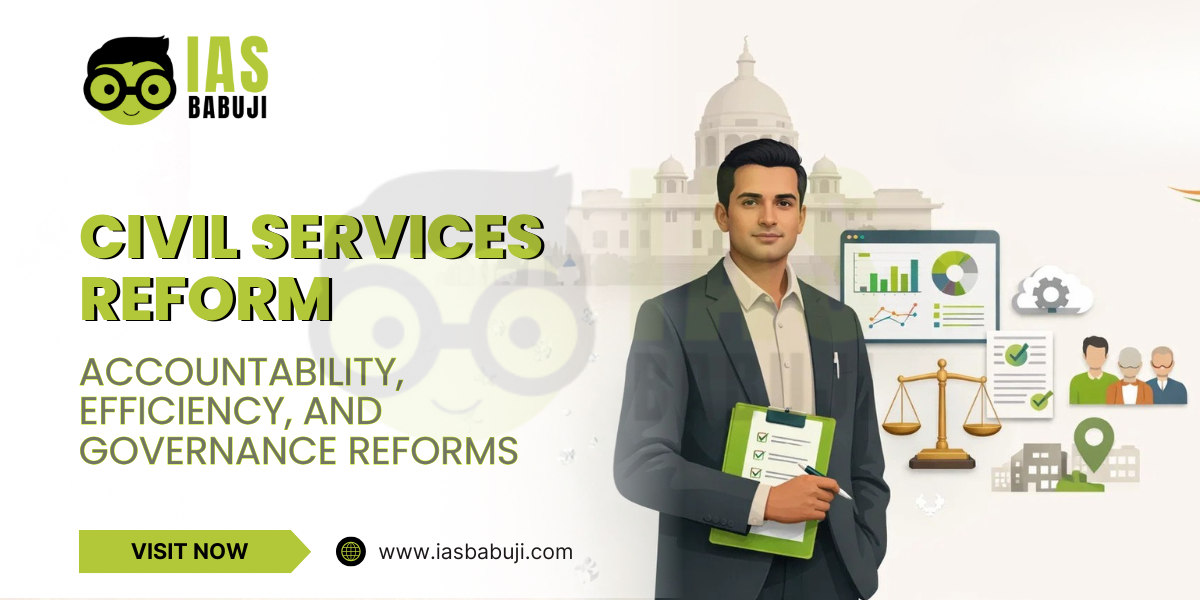
Civil Services Reform: Accountability, Efficiency, and Governance Reforms
GS II (Governance) | GS IV (Ethics) | Essay | UPSC-Oriented Analysis
Introduction
The Indian Civil Services form the backbone of the country’s administrative machinery. From policy formulation to implementation and public service delivery, civil servants play a critical role in governance. However, concerns regarding bureaucratic inefficiency, lack of accountability, political interference, procedural delays, and outcome-insensitive performance have intensified calls for civil services reform. In an era of rising citizen expectations, complex governance challenges, and technology-driven administration, India must reorient its civil services toward greater accountability, efficiency, transparency, and citizen-centricity.
Why Civil Services Reform Is Necessary
1. Rising Governance Complexity
Modern governance requires expertise in technology, economics, climate change, and global affairs. Traditional administrative structures often struggle to keep pace with emerging challenges.
2. Citizen Expectations and Service Delivery
Citizens increasingly demand faster, transparent, and accountable public services. Delays and red tape erode public trust in governance institutions.
3. Performance and Outcome Deficit
- Limited linkage between performance and career progression
- Focus on processes rather than measurable outcomes
- Weak performance evaluation mechanisms
4. Political Interference and Transfers
Frequent transfers and politicization of bureaucracy affect administrative neutrality, morale, and continuity in policymaking.
5. Corruption and Ethical Concerns
Lack of strong accountability frameworks can create opportunities for corruption, rent-seeking, and misuse of power.
Accountability in Civil Services
Meaning of Accountability
Accountability refers to the obligation of civil servants to justify decisions, accept responsibility, and be answerable to citizens, institutions, and constitutional authorities.
Key Dimensions of Accountability
- Political Accountability: Responsiveness to elected leadership while maintaining neutrality
- Legal Accountability: Compliance with laws, rules, and judicial oversight
- Administrative Accountability: Internal discipline, audits, and performance reviews
- Social Accountability: Public scrutiny, RTI, citizen feedback, and media oversight
- Ethical Accountability: Adherence to integrity, fairness, and probity
Efficiency in Civil Services
Efficiency means optimal use of resources to deliver timely, effective, and outcome-oriented public services.
Key Efficiency Challenges
- Procedural rigidity and outdated rules
- Excessive paperwork and slow decision-making
- Skill gaps in emerging sectors
- Limited innovation and risk aversion
- Poor coordination among departments
Major Reform Recommendations in India
1. Administrative Reforms Commission (ARC)
- Performance-based appraisal systems
- Lateral entry to bring specialized expertise
- Fixed tenure to ensure stability and professionalism
2. Second ARC (2005–2009)
- Citizen-centric administration
- Simplification of procedures
- Outcome-based evaluation of officers
- Code of Ethics for Civil Servants
3. Mission Karmayogi (National Programme for Civil Services Capacity Building)
- Continuous learning and skill upgradation
- Competency-based training
- Technology-driven HR management
4. Lateral Entry and Domain Specialization
- Bringing professionals from the private sector and academia
- Encouraging subject-matter expertise
Measures to Improve Accountability
Strengthening Performance Management
- Transparent, objective, and outcome-based performance indicators
- Linking promotions with service delivery outcomes
Ensuring Tenure Security
- Fixed tenure to prevent political pressure
- Independent Civil Services Boards for postings and transfers
Enhancing Transparency
- Effective implementation of RTI
- Open data platforms and citizen dashboards
Disciplinary Reforms
- Faster inquiry processes in corruption and misconduct cases
- Time-bound vigilance mechanisms
Measures to Improve Efficiency
Process and Procedural Reforms
- Simplification of rules
- Reducing file-based culture
- Adopting e-governance tools
Capacity Building
- Training in technology, data analytics, public finance, and behavioral governance
- Exposure to global best practices
Technology Integration
- Digital governance, AI, and automation
- Real-time monitoring of public programs
Promoting Innovation
- Encouraging experimentation and best practices
- Incentives for innovative public service delivery
Ethical Dimensions of Civil Services Reform
Civil servants must uphold values such as:
- Integrity
- Impartiality
- Commitment to public welfare
- Empathy toward marginalized groups
- Courage to resist political pressure
Reforms should strengthen ethical leadership, moral responsibility, and service-oriented governance.
Global Best Practices
- UK & Australia: Performance-linked evaluation systems
- Singapore: Merit-based promotions and high accountability standards
- France: Strong training institutions and domain specialization
India can adapt these lessons while respecting its democratic and constitutional framework.
Challenges in Implementing Reforms
- Resistance to change within bureaucracy
- Political reluctance to reduce control over postings
- Trade-off between neutrality and accountability
- Need to balance autonomy with oversight
Way Forward
Key Reform Priorities
- Strengthen meritocracy and professional autonomy
- Implement performance-linked incentives
- Expand Mission Karmayogi and competency mapping
- Encourage lateral entry and domain expertise
- Institutionalize ethical codes and accountability mechanisms
- Leverage technology for faster and transparent governance
- Promote citizen feedback and social audits
Conclusion
Civil services reform is essential for building a responsive, accountable, and efficient governance system in India. While civil servants remain indispensable to nation-building, their effectiveness depends on systemic improvements in training, evaluation, ethical conduct, and administrative autonomy. Reforms must strike a balance between political accountability and professional independence, ensuring that bureaucracy serves not power, but the people. A modern, transparent, and citizen-centric civil service is key to realizing India’s governance and development goals in the 21st century.