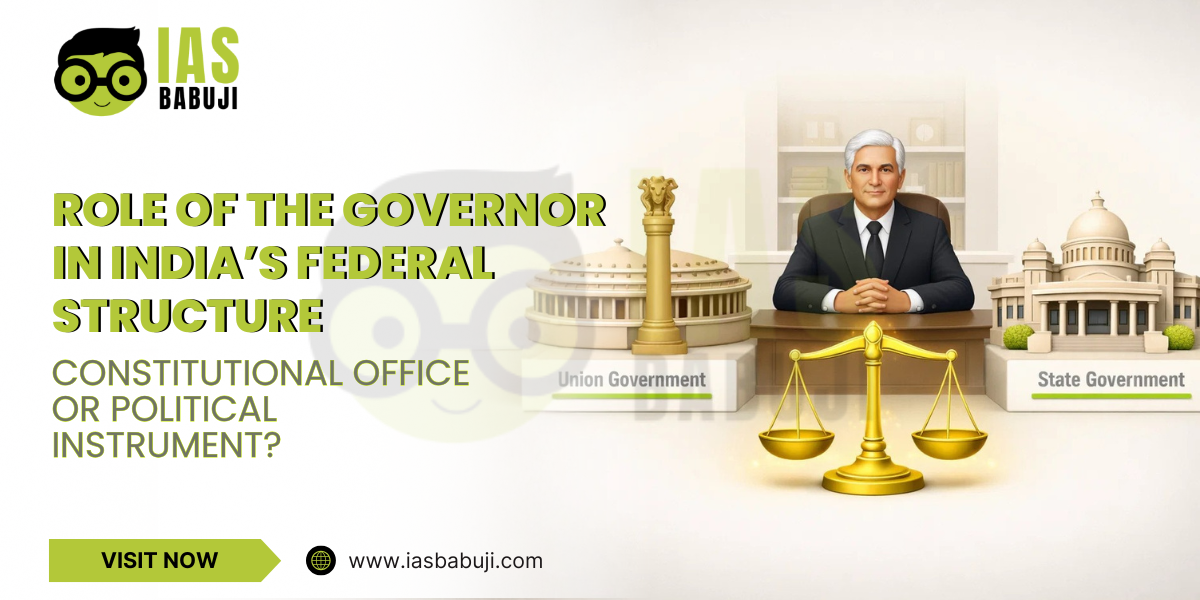
Role of the Governor in India’s Federal Structure: Constitutional Office or Political Instrument?
Introduction
India’s Constitution establishes a federal system with a strong unitary bias, where powers are divided between the Union and the States. Within this structure, the Governor occupies a unique and often controversial position. Appointed by the President and acting as the constitutional head of the State, the Governor is expected to function as a neutral link between the Centre and the State.
However, frequent instances of Centre–State conflicts, controversial use of discretionary powers, and repeated Supreme Court interventions have raised a critical question:
Is the Governor a constitutional office designed to protect federalism, or has it become a political instrument of the Union government?
This question holds immense relevance for GS II (Polity & Governance) and contemporary federal debates.
Constitutional Position of the Governor
Appointment and Tenure
- Article 155: The Governor is appointed by the President.
- Article 156: Holds office during the pleasure of the President.
- No fixed security of tenure; removal does not require explanation.
This method of appointment itself creates a perception that the Governor is aligned with the Union executive, unlike an elected constitutional authority.
Powers and Functions
The Governor performs:
- Executive functions: Appointing CM, Council of Ministers
- Legislative functions: Summoning, proroguing the legislature, reserving bills
- Financial functions: Recommending Money Bills
- Judicial functions: Granting pardons under Article 161
Most of these are exercised on the aid and advice of the Council of Ministers, except in certain discretionary situations.
Discretionary Powers: The Core of the Controversy
The Constitution does not clearly define the scope of discretionary powers, leading to wide interpretation.
Key discretionary areas include:
- Appointment of the Chief Minister in a hung assembly
- Ordering floor tests
- Reserving State Bills for the President’s consideration (Article 200)
- Reporting constitutional breakdown (Article 356)
It is the selective and partisan use of these powers that has triggered allegations of misuse.
Governor as a Constitutional Safeguard
Supporters argue that the Governor plays a vital role in:
- Ensuring constitutional governance in States
- Acting as a neutral umpire during political instability
- Protecting national interest and unity
In cases of fractured mandates, Governors can facilitate:
- Peaceful transition of power
- Stability through floor tests
- Avoidance of constitutional deadlock
The office, in theory, strengthens cooperative federalism.
Governor as a Political Instrument: Emerging Reality?
Patterns of Misuse
Several trends suggest political use of the office:
- Delays in inviting parties to form government
- Arbitrary reservation of bills passed by elected legislatures
- Public criticism of State governments
- Frequent reports recommending the President’s Rule
These actions often align with the interests of the ruling party at the Centre, undermining State autonomy.
Impact on Federalism
Such practices:
- Weaken State sovereignty
- Create trust deficits between the Centre and the States
- Undermine the spirit of constitutional morality
Supreme Court’s Interventions and Observations
The judiciary has repeatedly attempted to discipline the office of the Governor.
Key Judgments
S.R. Bommai v. Union of India (1994)
- Restricted arbitrary use of Article 356
- Emphasised the floor test as the correct method to test the majority
- Reinforced federalism as part of the basic structure
Rameshwar Prasad Case (2006)
- The governor’s subjective satisfaction cannot override constitutional norms
Nabam Rebia v. Deputy Speaker (2016)
- The Governor has no discretion in legislative matters beyond the Constitution
- Reaffirmed that the Governor is not a parallel authority
Recent Observations
The Court has cautioned Governors against:
- Acting as political agents
- Delaying assent to bills indefinitely
- Publicly criticising elected governments
Recommendations by Commissions
Sarkaria Commission (1988)
- A governor should be a non-political person
- Must act as a bridge, not a barrier
- Discretion to be used sparingly
Punchhi Commission (2010)
- Fixed tenure for Governors
- Removal only after consultation with the Chief Minister
- Clear guidelines for discretionary powers
Despite these recommendations, implementation remains weak.
Way Forward: Reclaiming Constitutional Neutrality
To restore the credibility of the office:
- Define discretionary powers clearly
- Ensure security of tenure
- Follow Supreme Court guidelines strictly
- Promote political consensus in appointments
- Institutionalise constitutional morality over political convenience
A Governor must be a constitutional conscience-keeper, not a political referee.
Conclusion
The office of the Governor lies at the heart of India’s federal experiment. While the Constitution envisages it as a neutral constitutional authority, political practice has often distorted this vision. Judicial interventions have provided corrective mechanisms, but sustainable reform requires political maturity and institutional restraint.
Ultimately, the Governor can either strengthen Indian federalism or strain it—the choice lies not in the Constitution, but in its implementation.
FAQs
Q1. Is the Governor an agent of the Centre?
No, constitutionally, the Governor is not an agent of the Centre but an independent constitutional authority. However, political practices have often blurred this distinction.
Q2. What are the discretionary powers of the Governor?
They include appointing a Chief Minister in a hung assembly, reserving bills, and recommending President’s Rule, but these must follow constitutional conventions.
Q3. Which case strengthened federalism against Governor misuse?
The S.R. Bommai case (1994) is the most significant judgment reinforcing federalism.
Q4. Can the Governor delay assent to State Bills indefinitely?
The Supreme Court has indicated that indefinite delay violates constitutional morality.
Q5. Why is this topic important for GS II?
It links polity, federalism, Centre–State relations, constitutional offices, and Supreme Court jurisprudence—core GS II themes.