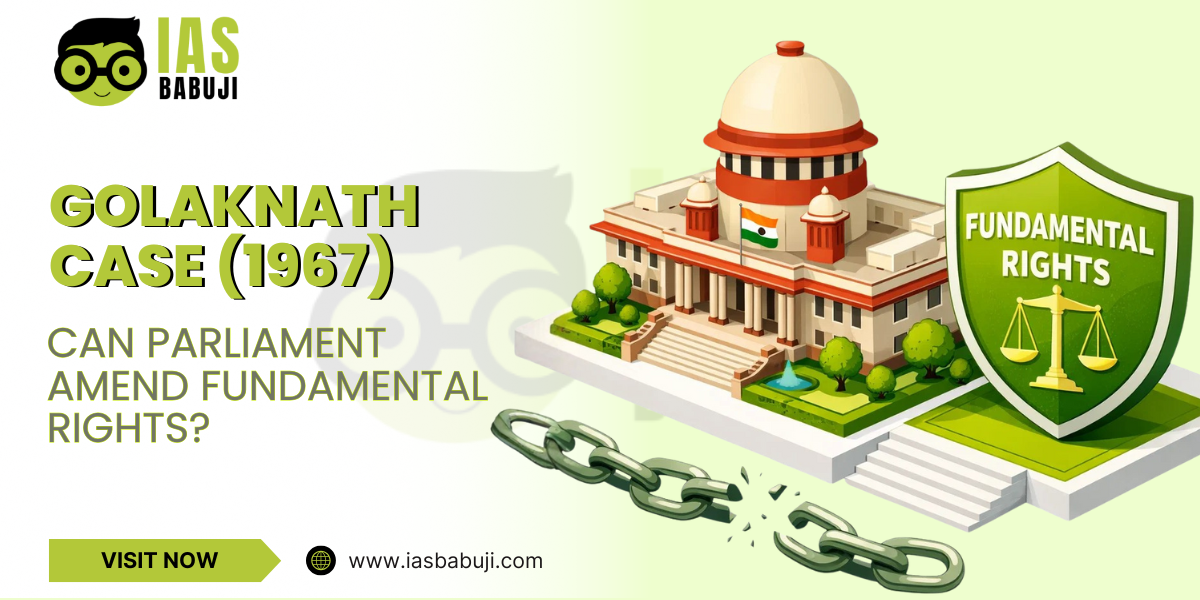
Golaknath Case (1967): Can Parliament Amend Fundamental Rights?
Introduction
The Golaknath v. State of Punjab (1967) case is a landmark Supreme Court judgment that placed strict limits on Parliament’s amending power. It marked a crucial phase in India’s constitutional evolution by asserting that Fundamental Rights are inviolable and cannot be amended by Parliament.
Although later modified by the Kesavananda Bharati Case (1973), the Golaknath judgment played a decisive role in strengthening the protection of Fundamental Rights and shaping future constitutional jurisprudence. For UPSC aspirants, this case is essential for understanding the judiciary–parliament conflict and the gradual development of the Basic Structure Doctrine.
Background of the Case
- The Golaknath family owned agricultural land in Punjab
- The Punjab government sought to acquire this land under land reform laws
- The petitioners challenged the constitutional validity of these laws
- They argued that constitutional amendments placing these laws in the Ninth Schedule violated their Fundamental Rights
The core issue was whether Parliament had the power to amend Fundamental Rights under the Constitution.
Constitutional Provisions Involved
- Article 13(2) → State shall not make laws violating Fundamental Rights
- Article 368 → Power of Parliament to amend the Constitution
- Articles 14, 19, 31 → Fundamental Rights affected by land reforms
Key Issues Before the Supreme Court
- Does Parliament have the power to amend Fundamental Rights?
- Does the term “law” under Article 13 include constitutional amendments?
- Can Fundamental Rights be curtailed in the name of socio-economic reforms?
Supreme Court Judgment (1967)
An 11-judge Constitution Bench delivered the judgment by a 6:5 majority.
Key Rulings
- Parliament cannot amend Fundamental Rights
- Constitutional amendments are included within the definition of “law” under Article 13
- Fundamental Rights are transcendental and immutable
- Article 368 only prescribes the procedure for amendment and does not confer unlimited power
Doctrine of Prospective Overruling
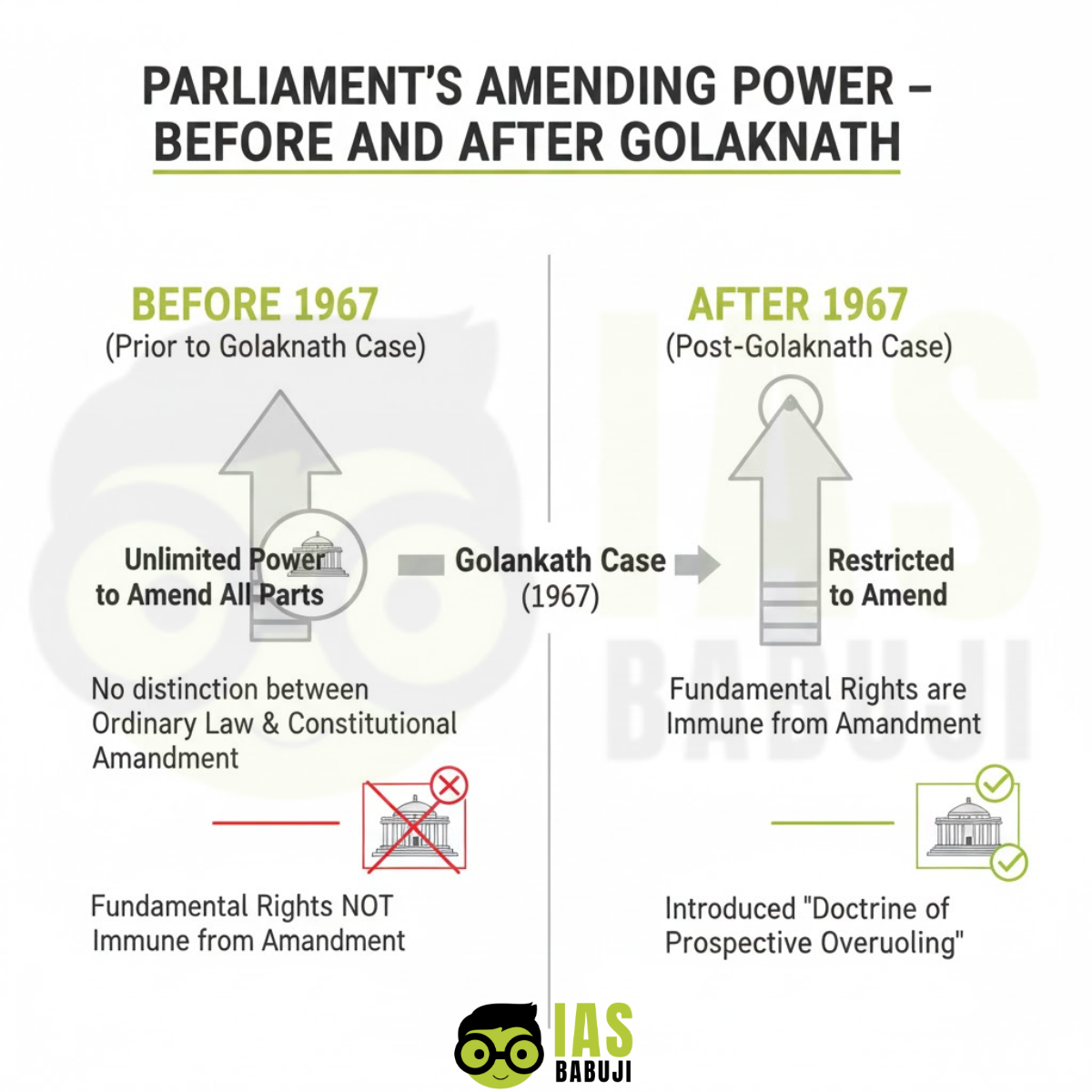
The Supreme Court applied the doctrine of prospective overruling for the first time in India.
- The judgment would apply only to future amendments
- Past constitutional amendments remained valid
- Ensured legal stability while protecting Fundamental Rights
Significance of the Judgment
1. Strengthening Fundamental Rights
- Asserted the supremacy of Fundamental Rights over parliamentary power
2. Judicial Activism
- Expanded the role of the judiciary in constitutional interpretation
3. Trigger for Constitutional Amendments
- Led to the 24th Constitutional Amendment Act, 1971, restoring Parliament’s amending power
- Set the stage for the Kesavananda Bharati Case (1973)
Impact on Later Developments
- Overruled partially by the Kesavananda Bharati Case
- Influenced the emergence of the Basic Structure Doctrine
- Reinforced judicial scrutiny of constitutional amendments
Criticism of the Judgment
- Accused of excessive judicial activism
- Restricted Parliament’s ability to implement social justice reforms
- Created a constitutional deadlock between the legislature and the judiciary
Despite criticism, the case remains a cornerstone in India’s constitutional history.
UPSC Prelims and Mains Relevance
Prelims Focus
- Year of judgment → 1967
- Majority verdict → 6:5
- Doctrine introduced → Prospective overruling
Mains (GS-II)
- Parliament vs Judiciary
- Scope of Article 368
- Protection of Fundamental Rights
Essay and Ethics
- Constitutional morality
- Limits of state power
- Rule of law
Previous Year Question (PYQ)
UPSC Mains 2020
“Parliament’s power to amend the Constitution is not absolute. Discuss.”
→ Golaknath Case provides strong constitutional backing.
Conclusion
The Golaknath judgment marked a significant assertion of judicial authority in safeguarding Fundamental Rights against unchecked parliamentary power. By holding that Fundamental Rights are beyond the reach of constitutional amendments, the Supreme Court elevated their status as permanent and inviolable guarantees. Although later modified by the Kesavananda Bharati case, Golaknath laid the intellectual foundation for limiting Parliament’s amending power and preserving constitutional values. For UPSC aspirants, this case is crucial for understanding the dynamic interaction between the judiciary and legislature, as well as the evolution of constitutional doctrines in India. Its relevance lies not only in its verdict but in how it shaped subsequent debates on constitutional supremacy, judicial review, and democratic governance.
FAQs on Golaknath Case (1967)
Q1. Why is the Golaknath Case important for UPSC?
It restricted Parliament’s power to amend Fundamental Rights.
Q2. Which doctrine was introduced in this case?
Doctrine of Prospective Overruling.
Q3. Which amendment overruled Golaknath Case?
24th Constitutional Amendment Act, 1971.
Q4. Which case finally settled the amendment issue?
Kesavananda Bharati Case (1973).
SEO Meta Description
SEO Tags (Comma-Separated)
Infographic Prompts (With Placement)
Infographic 1 – After Judgment Section
Title: Parliament’s Amending Power – Before and After Golaknath
Prompt:
A split comparison infographic showing Parliament’s unlimited amending power before 1967 versus restricted power after Golaknath judgment. Clean academic vector style, white background, accent color #b3c839.
Infographic 2 – Near Conclusion
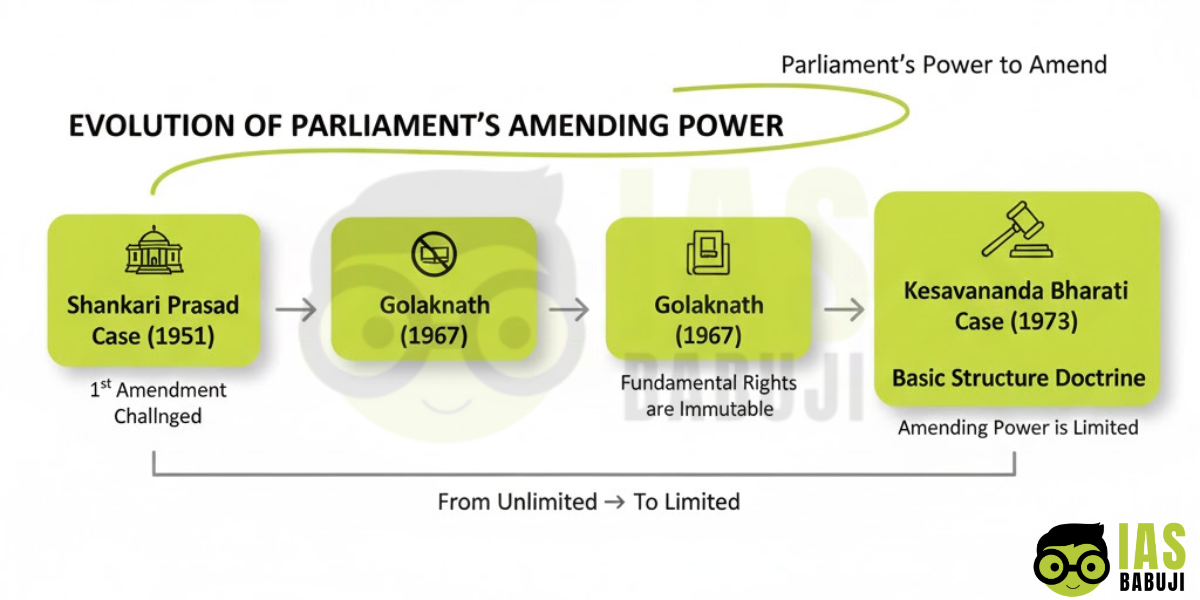
Title: Evolution of Amendment Power
Prompt:
A flowchart infographic showing Shankari Prasad → Golaknath → Kesavananda Bharati. Minimal icons, UPSC revision-friendly layout, color accent #b3c839.