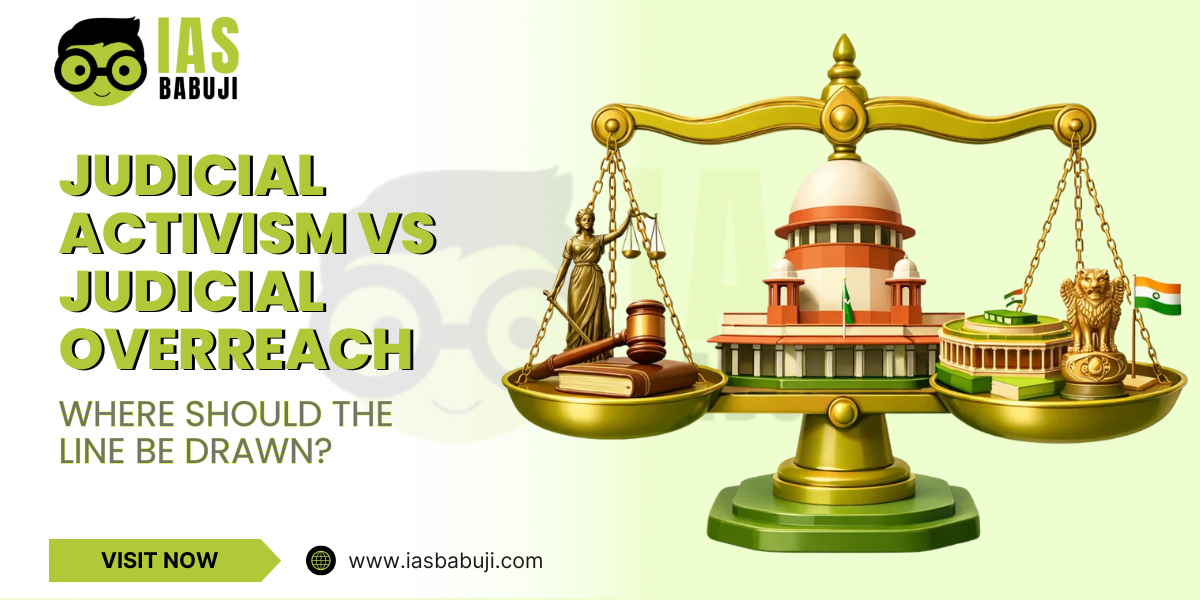
Judicial Activism vs Judicial Overreach: Where Should the Line Be Drawn?
Introduction
Judicial Activism and Judicial Overreach are among the most debated concepts in India’s constitutional discourse. While judicial activism has often been celebrated for protecting fundamental rights and strengthening constitutional values, judicial overreach raises concerns about the judiciary encroaching upon the domain of the legislature and executive. For a constitutional democracy like India, maintaining the delicate balance among the three organs of the State is crucial. This debate holds immense relevance for UPSC aspirants, particularly for GS Paper II, GS Paper IV, and essay writing.
Understanding Judicial Activism
Judicial activism refers to a proactive role played by the judiciary in interpreting the Constitution to protect rights, expand liberties, and ensure justice, especially when other organs fail in their constitutional duties.
Key features:
- Expansive interpretation of Fundamental Rights
- Use of Public Interest Litigation (PIL)
- Emphasis on constitutional morality and social justice
- Filling governance gaps in exceptional situations
Judicial activism has been instrumental in strengthening rights related to life, dignity, environment, gender justice, and transparency.
What is Judicial Overreach?
Judicial overreach occurs when courts cross constitutional boundaries and interfere excessively in the functioning of the legislature or executive, thereby disturbing the separation of powers.
Indicators of judicial overreach:
-
Directing policy formulation instead of interpretation
-
Monitoring executive actions beyond necessity
-
Issuing orders with administrative or legislative character
-
Lack of institutional accountability
Such actions may undermine democratic legitimacy and institutional balance.
Key Differences Between Judicial Activism and Judicial Overreach
- Nature
- Judicial Activism is corrective and rights-oriented
- Judicial Overreach is intrusive and authority-expanding
- Objective
- Activism aims to uphold constitutional values
- Overreach risks substituting judicial wisdom for democratic choice
- Constitutional Basis
- Activism operates within constitutional interpretation
- Overreach stretches constitutional limits
- Impact
- Activism strengthens democracy
- Overreach may weaken institutional trust
Why Judicial Activism Became Necessary in India
Several structural and governance challenges led to the rise of judicial activism in India:
- Executive inertia and policy paralysis
- Legislative delays in social reform
- Weak access to justice for marginalized groups
- Need to enforce Directive Principles indirectly
In such contexts, judicial intervention acted as a constitutional safeguard rather than a power grab.
Ethical Dimensions of the Debate
From an ethics perspective, judicial activism aligns with values such as justice, accountability, and compassion. However, judicial overreach raises ethical concerns related to:
- Abuse of discretionary power
- Lack of democratic mandate
- Accountability deficit
For GS-IV, this debate reflects the tension between ends-based ethics (justice outcomes) and process-based ethics (institutional propriety).
Where Should the Line Be Drawn?
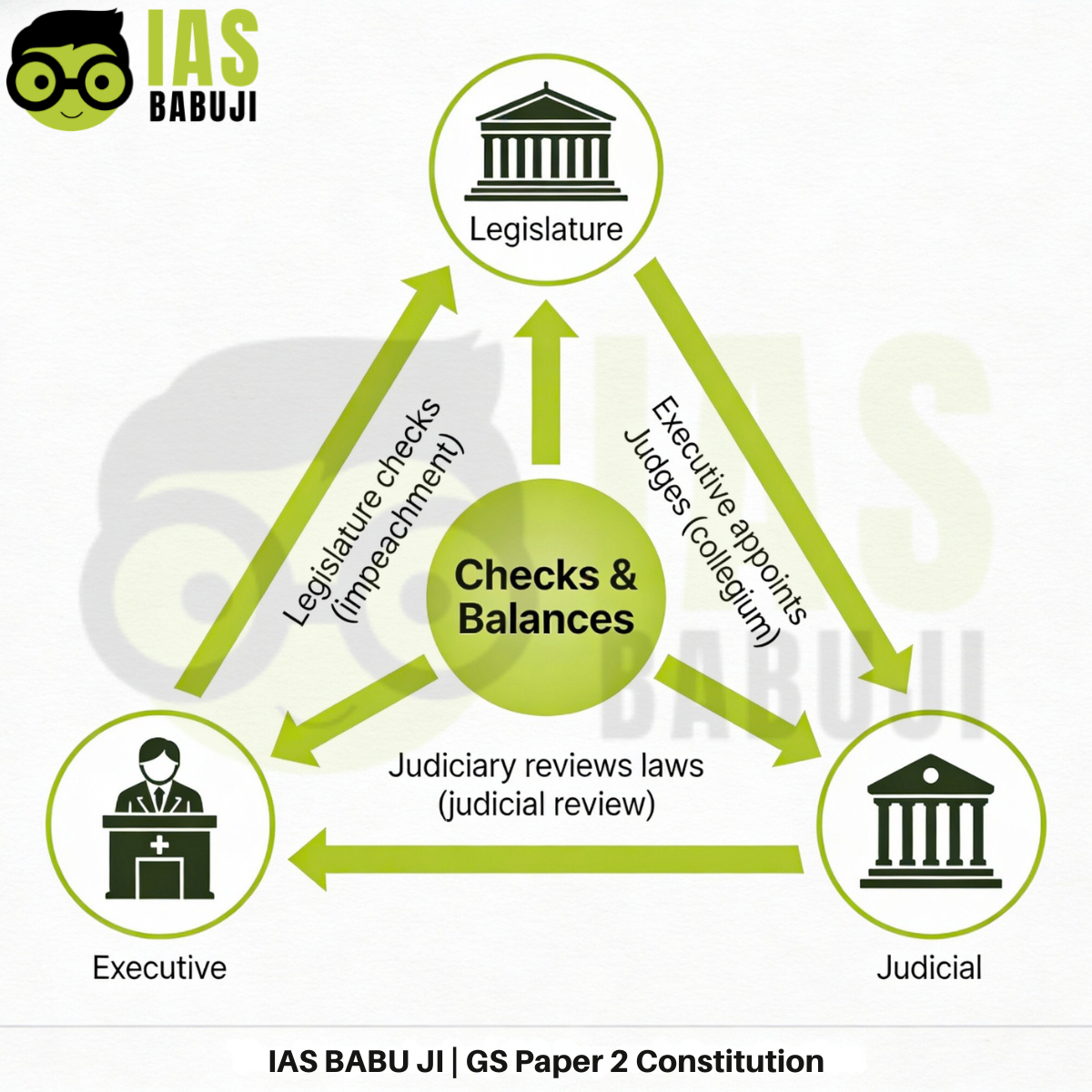
The line between activism and overreach should be guided by constitutional discipline.
Key principles to maintain balance:
- Respect for Separation of Powers
- Use of judicial restraint where policy expertise is required
- Intervention only when fundamental rights or a constitutional breakdown is evident
- Deference to democratic processes in routine governance
Judicial intervention should be a constitutional necessity, not a governance substitute.
Relevance for UPSC Mains and Essay
This topic is highly relevant for:
- GS-II: Polity, Judiciary, Constitutional Governance
- GS-IV: Ethics, Accountability, Institutional Integrity
- Essay: Democracy, Rule of Law, Constitutionalism
Well-structured answers linking constitutional values with ethical reasoning can fetch high marks.
Conclusion
Judicial activism has played a transformative role in deepening Indian democracy by protecting rights and reinforcing constitutional values. However, unchecked judicial overreach risks disturbing the balance of power and weakening democratic accountability. The challenge lies not in choosing between activism and restraint, but in harmonizing judicial responsibility with constitutional limits. A judiciary that intervenes when necessary, restrains when appropriate, and remains anchored to constitutional morality is essential for the long-term health of Indian democracy.
(Approx. 135 words)
FAQs
What is judicial activism in simple terms?
Judicial activism refers to proactive judicial interpretation to protect rights and uphold constitutional values, especially when other institutions fail.
Why is judicial overreach considered problematic?
Judicial overreach can undermine separation of powers by allowing courts to intrude into legislative or executive functions.
Is judicial activism necessary in a democracy?
Yes, but only in exceptional situations where constitutional rights or democratic principles are under serious threat.
Which UPSC papers cover this topic?
GS Paper II, GS Paper IV, and Essay Paper.
SEO Meta Data
Meta Title:
Judicial Activism vs Judicial Overreach in India | UPSC GS II & Ethics
Meta Description:
Tags (comma-separated)
Feature Image Prompt (3D Illustrator Style)
Prompt:
Infographic Prompts with Placement
Infographic 1: Judicial Activism vs Judicial Overreach (Comparison Table)
Prompt:
“Minimalist infographic comparing Judicial Activism and Judicial Overreach across parameters like purpose, constitutional role, impact, and risks, clean typography, UPSC exam-friendly design, color #b3c839”
Placement: After the section “Key Differences Between Judicial Activism and Judicial Overreach”
Infographic 2: Separation of Powers in India
Prompt:
“Flowchart-style infographic showing separation of powers between Legislature, Executive, and Judiciary with checks and balances, simple icons, academic tone, color theme #b3c839”
Placement: Before the section “Where Should the Line Be Drawn?”