Office of the Governor: Constitutional Powers, Discretion and Federal Debates
The Office of the Governor occupies a unique position in India’s constitutional framework. As the constitutional head of a State, the Governor is expected to act as a neutral link between the Union and the States. However, in recent years, the role of Governors has become a subject of intense debate due to allegations of political bias, misuse of discretionary powers, and strain on India’s federal structure.
For UPSC Prelims and Mains, questions on the Governor are important due to their linkage with constitutional provisions, federalism, Centre–State relations, and current affairs.
Constitutional Position of the Governor
The Governor is provided for under Part VI of the Indian Constitution, which deals with the States.
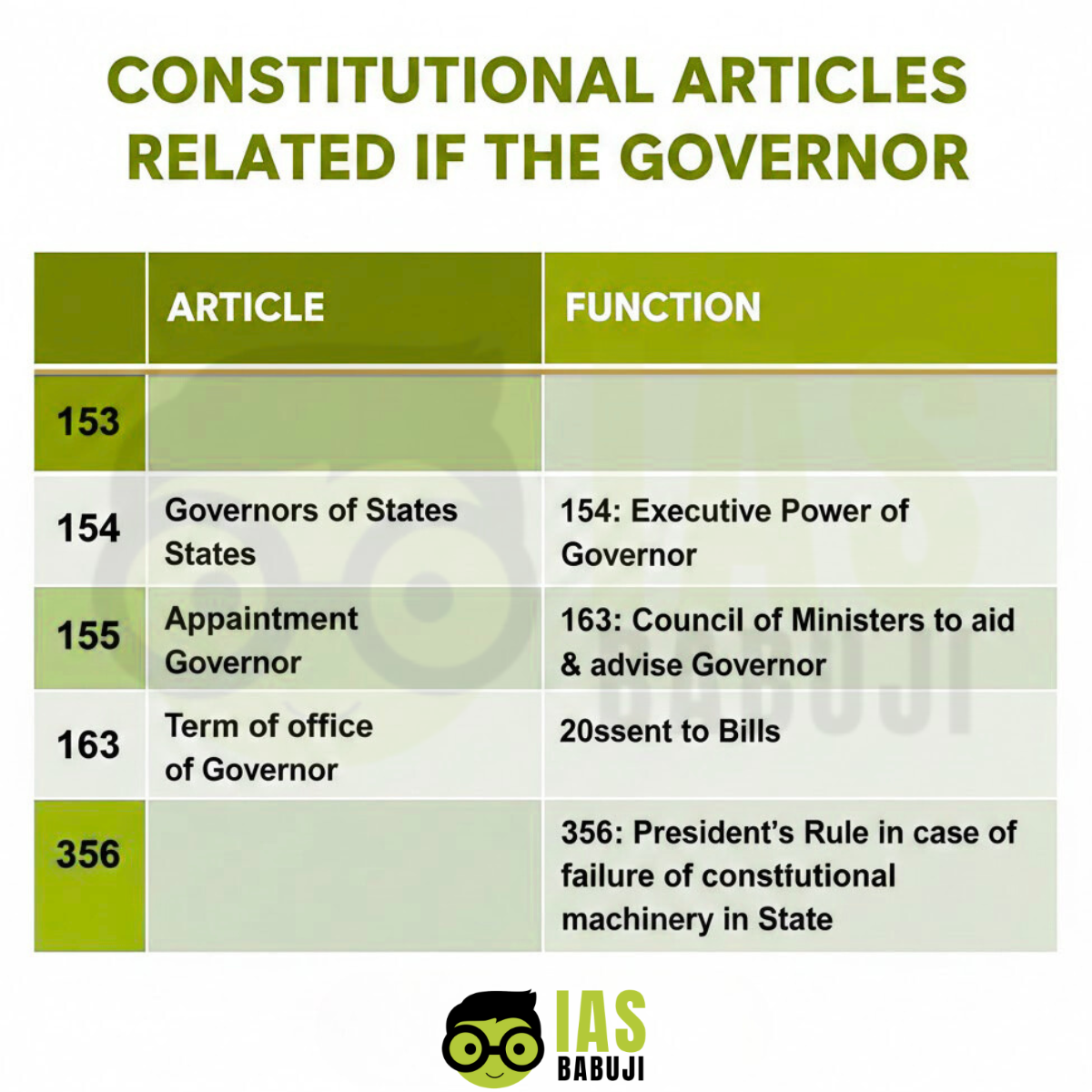
Key Constitutional Articles
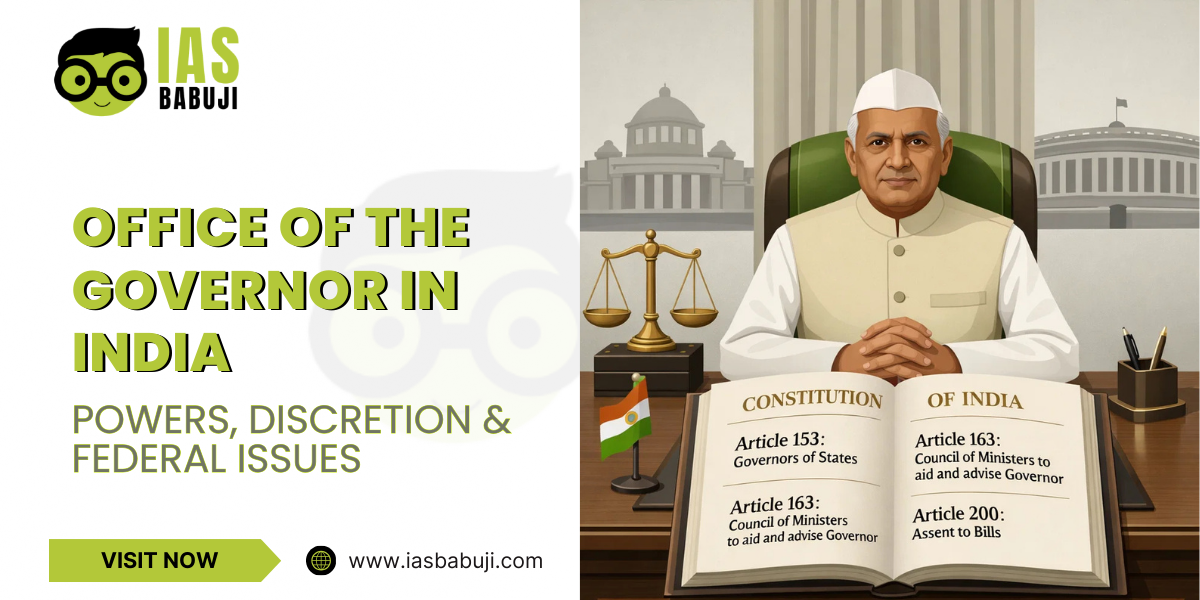
- Article 153: There shall be a Governor for each State
- Article 154: Executive power of the State vested in the Governor
- Article 155: Appointment of Governor by the President
- Article 156: Term of office (five years, pleasure of the President)
- Article 163: Council of Ministers to aid and advise the Governor
- Article 200: Assent to Bills
- Article 356: Failure of constitutional machinery in States
The Governor is not an elected authority, but a nominee of the President, which often places the office at the centre of federal controversies.
Powers and Functions of the Governor
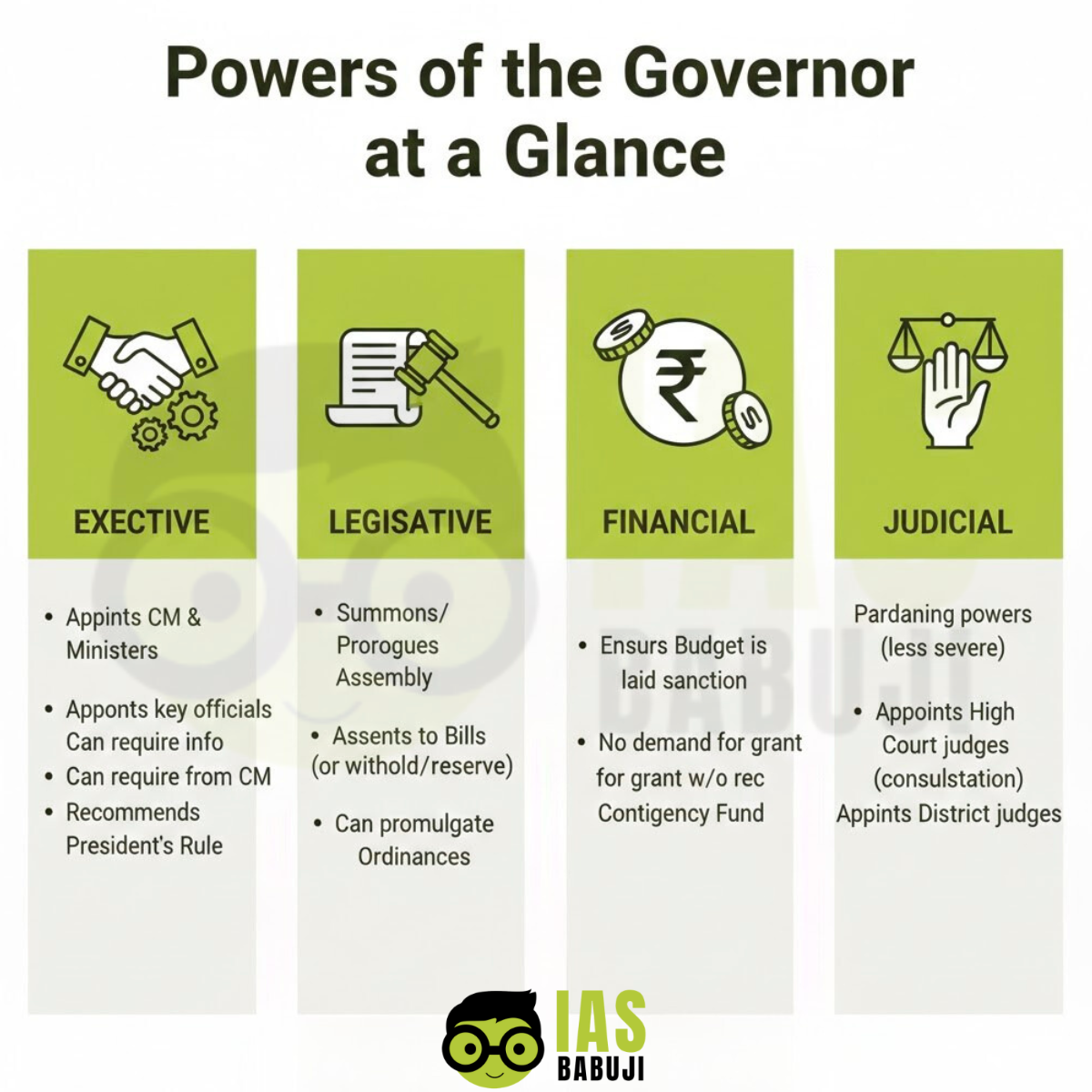
1. Executive Powers
- Appoints the Chief Minister and other Ministers
- Appoints Advocate General and State Election Commissioner
- Acts as the nominal executive head of the State
All executive actions are taken in the name of the Governor, but real power lies with the Council of Ministers.
2. Legislative Powers
- Summons, prorogues, and dissolves the State Legislature
- Addresses the first session of the Legislature
- Nominates members to the Legislative Council (where applicable)
- Gives assent to Bills passed by the State Legislature
Under Article 200, the Governor may:
- Give assent
- Withhold assent
- Return the Bill (except Money Bills)
- Reserve the Bill for the President’s consideration
3. Financial Powers
- Causes the State Budget to be laid before the Legislature
- Money Bills cannot be introduced without the Governor’s recommendation
4. Judicial Powers
- Appoints judges of subordinate courts
- Can grant pardons, reprieves, respites, or remissions under Article 161
Discretionary Powers of the Governor
The Governor’s discretionary powers are limited but crucial, and they form the core of most controversies.
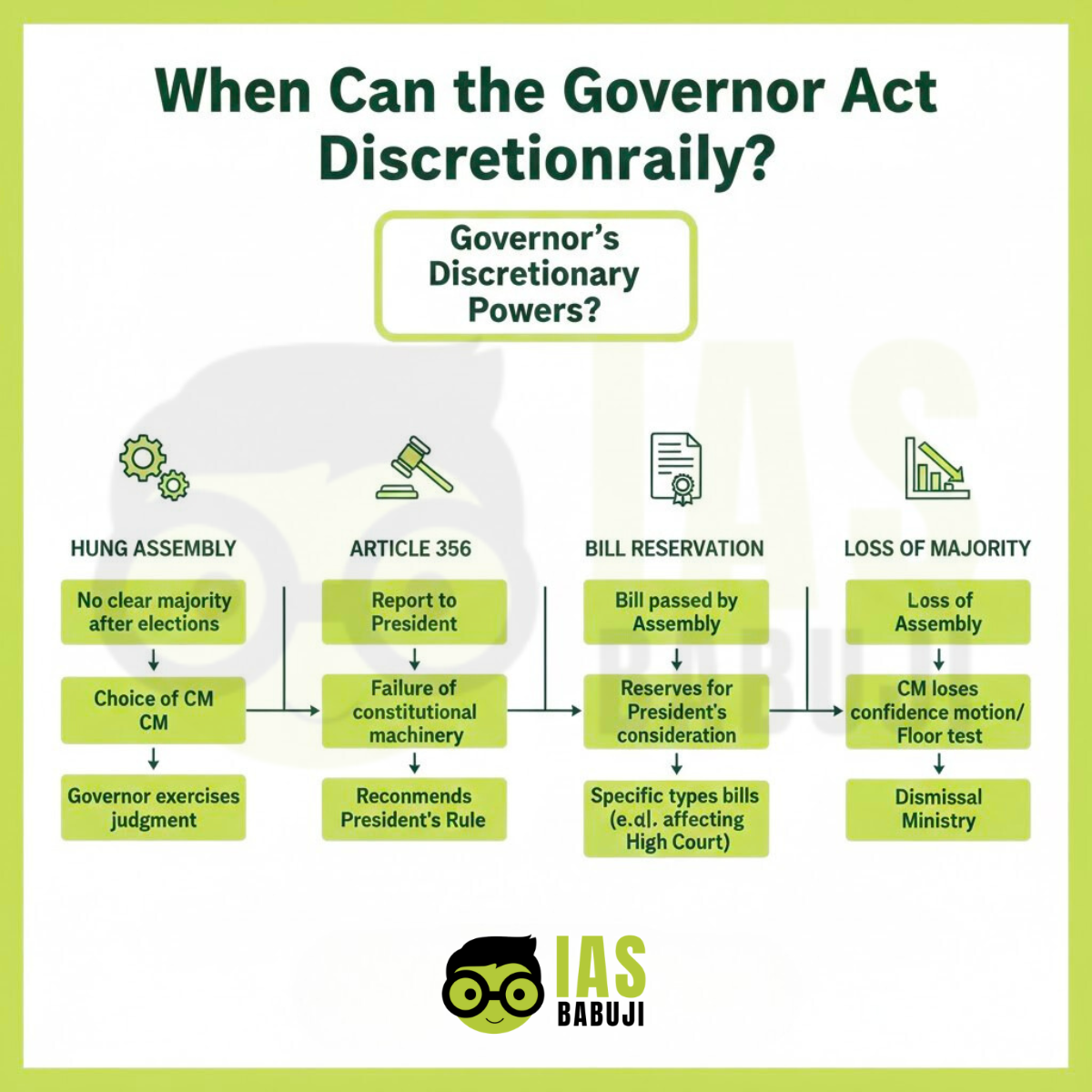
Situations Where the Governor Can Act Discretionarily
- Appointment of the Chief Minister in a hung Assembly
- Dismissal of a Ministry that has lost the majority
- Reservation of Bills for the President’s consideration
- Recommendation of President’s Rule (Article 356)
- Decisions relating to tribal areas in certain States
These powers are not explicitly listed, but have evolved through constitutional conventions and judicial interpretations.
Supreme Court on Discretionary Powers
- Shamsher Singh vs State of Punjab (1974)
The Governor must normally act on the aid and advice of the Council of Ministers. - S.R. Bommai Case (1994)
Use of Article 356 is subject to judicial review and must not be arbitrary. - Nabam Rebia Case (2016)
The Governor cannot interfere in legislative proceedings without aid and advice.
Office of the Governor and Federalism
India follows a quasi-federal system, where the Governor acts as:
- A constitutional head of the State
- A link between the Centre and the State
However, frequent conflicts arise due to:
- Central appointment of Governors
- Use of discretionary powers during political instability
- Delay in granting assent to State Bills
- Public criticism of elected State governments
These actions raise concerns about erosion of cooperative federalism.
Recent Debates and Controversies
In recent years, several issues have highlighted tensions around the Governor’s role:
- Delay in granting assent to State legislation
- Public statements by Governors on State policies
- Allegations of acting as an agent of the Centre
- Disputes over summoning or proroguing Assemblies
- Conflicts with elected Chief Ministers
Such developments have brought renewed focus on the neutrality and constitutional morality expected from the office.
Reform Suggestions and Expert Recommendations
Sarkaria Commission
- The governor should be a neutral and apolitical figure
- Use of discretionary powers should be minimal
Punchhi Commission
- Fixed tenure for Governors
- Clear guidelines for discretionary powers
- Strengthening federal trust
Way Forward
To preserve the sanctity of the Constitution:
- The governor must act as a constitutional statesman, not a political actor
- The centre must respect the spirit of federalism
- Judicial oversight should continue to act as a safeguard
- Constitutional conventions must be strengthened
The Office of the Governor should serve as a bridge, not a barrier, between the Union and the States.
Conclusion
The Office of the Governor is vital for maintaining constitutional balance in India. While the Constitution grants certain discretionary powers, their misuse threatens federal harmony. A careful balance between constitutional authority, judicial oversight, and political neutrality is essential to uphold democratic governance.
For UPSC aspirants, this topic is important not only from a constitutional perspective, but also in understanding the evolving nature of Indian federalism.
FAQs – Office of the Governor
Is the Governor a constitutional or real executive?
The Governor is the constitutional head; real executive power lies with the Council of Ministers.
Can the Governor act independently of the Council of Ministers?
Only in limited discretionary situations defined by constitutional practice and judicial interpretation.
Is the Governor answerable to the State Legislature?
No. The Governor is not responsible to the State Legislature.
Can the Governor be removed before completing the term?
Yes. The Governor holds office during the pleasure of the President.
Is the use of Article 356 absolute?
No. It is subject to judicial review as per the S.R. Bommai judgment.