
Vishaka vs State of Rajasthan (1997): Sexual Harassment, Fundamental Rights, and Judicial Law-Making
Introduction
The Vishaka v. State of Rajasthan (1997) judgment is a landmark decision in Indian constitutional jurisprudence that addressed the issue of sexual harassment at the workplace in the absence of specific legislation. By laying down the Vishaka Guidelines, the Supreme Court filled a legislative vacuum and expanded the scope of Fundamental Rights, particularly the right to life and dignity.
For UPSC aspirants, this case is crucial for understanding gender justice, judicial activism, international law influence, and constitutional interpretation.
Background of the Case
- Bhanwari Devi, a social worker in Rajasthan, was gang-raped while performing her official duties
- The incident highlighted systemic failure to protect women at the workplace
- Women’s rights organisations filed a Public Interest Litigation under the banner of Vishaka
- The case raised concerns regarding lack of legal safeguards against workplace harassment
Constitutional Provisions Involved
- Article 14 – Equality before the law
- Article 15 – Prohibition of discrimination
- Article 19(1)(g) – Right to practice any profession
- Article 21 – Right to life and personal liberty
International Law and Constitutional Interpretation
The Court relied on:
- Convention on the Elimination of All Forms of Discrimination Against Women (CEDAW)
- Article 51(c) – Respect for international law and treaty obligations
The Court held that international conventions consistent with fundamental rights can be used to interpret constitutional guarantees.
Key Issues Before the Supreme Court
- Can the judiciary frame guidelines in the absence of legislation?
- Does sexual harassment violate Fundamental Rights?
- Can international conventions be relied upon in constitutional interpretation?
Supreme Court Judgment (1997)
The Supreme Court acknowledged that sexual harassment at the workplace violates a woman’s right to equality, dignity, and freedom to work. In the absence of statutory law, the Court framed binding Vishaka Guidelines.
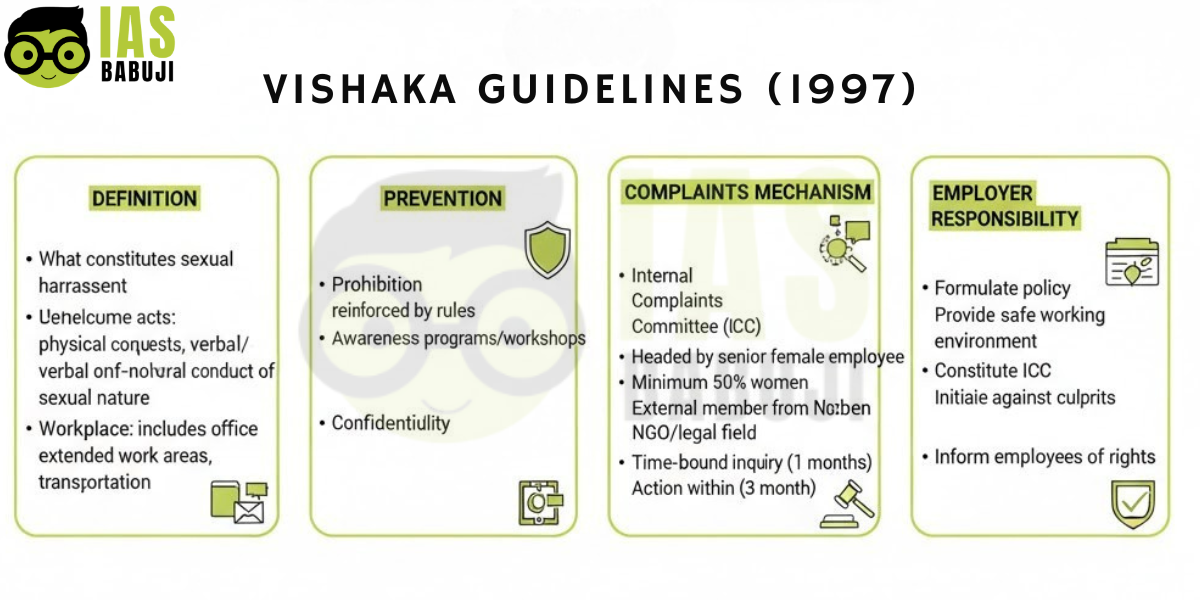
Vishaka Guidelines Explained
The guidelines were to operate as law until Parliament enacted appropriate legislation.
Core Components
- Definition of Sexual Harassment
- Physical contact and advances
- Demand or request for sexual favours
- Sexually coloured remarks
- Showing pornography
- Any unwelcome conduct of sexual nature
- Preventive Measures
- Mandatory prohibition of sexual harassment at workplaces
- Awareness and sensitisation programmes
- Complaints Mechanism
- Establishment of complaints committees
- Committee to be headed by a woman
- Inclusion of an external member to prevent bias
- Employer Responsibility
-
- Duty to ensure a safe working environment
- Disciplinary action against offenders
Significance of the Judgment
1. Judicial Law-Making
- The Court stepped in due to a legislative vacuum
- Reinforced the role of the judiciary as protector of Fundamental Rights
2. Advancement of Gender Justice
- Recognised workplace harassment as a constitutional violation
- Strengthened women’s right to dignity
3. Integration of International Law
- Gave domestic effect to CEDAW principles
Impact on the Indian Legal System
- Formation of internal complaints committees in institutions
- Laid the foundation for the Sexual Harassment of Women at Workplace Act, 2013
- Influenced gender-sensitive jurisprudence
Criticism of the Judgment
- Accusations of judicial overreach
- Lack of statutory enforcement initially
- Implementation challenges at the ground level
Despite criticism, the judgment is regarded as transformative.
UPSC Prelims and Mains Relevance
Prelims Focus
- Year – 1997
- Vishaka Guidelines
- Link with CEDAW
Mains (GS-II and GS-IV)
- Judicial activism
- Gender justice and constitutional morality
- Role of international law
Essay
- Women’s safety
- Dignity of labour
- Rights-based approach

Conclusion
The Vishaka judgment stands as a milestone in India’s journey towards gender justice and constitutional empowerment of women. By recognising sexual harassment as a violation of Fundamental Rights, the Supreme Court elevated workplace safety from a policy concern to a constitutional mandate. The Vishaka Guidelines demonstrated how judicial creativity can bridge legislative gaps while remaining anchored to constitutional values and international commitments. For UPSC aspirants, the case exemplifies the dynamic nature of the Constitution and the judiciary’s role in protecting dignity and equality. Its legacy continues through the Sexual Harassment of Women at Workplace Act, 2013, reflecting how judicial intervention can catalyse progressive legislative reform without undermining democratic principles.
FAQs on Vishaka vs State of Rajasthan (1997)
Q1. Why is the Vishaka case important for UPSC?
It laid down binding guidelines against workplace sexual harassment and expanded Fundamental Rights.
Q2. Which international convention influenced this case?
CEDAW.
Q3. Which article ensures a woman’s right to work with dignity?
Article 21 read with Articles 14 and 19(1)(g).
Q4. Which law replaced Vishaka Guidelines?
Sexual Harassment of Women at Workplace Act, 2013.
SEO Meta Description
SEO Tags (Comma-Separated)
Infographic Prompts (With Placement)
Infographic 1 – After Vishaka Guidelines Section
Title: Components of Vishaka Guidelines
Prompt:
Structured infographic showing definition, prevention, complaints mechanism, and employer responsibility. Clean academic layout, white background, accent color #b3c839.
Infographic 2 – Before Conclusion
Title: From Vishaka Guidelines to POSH Act 2013
Prompt:
Timeline infographic showing 1997 judgment leading to 2013 legislation. Minimal academic design, accent color #b3c839.
Feature Image Prompt (3D Illustrator)
Prompt: