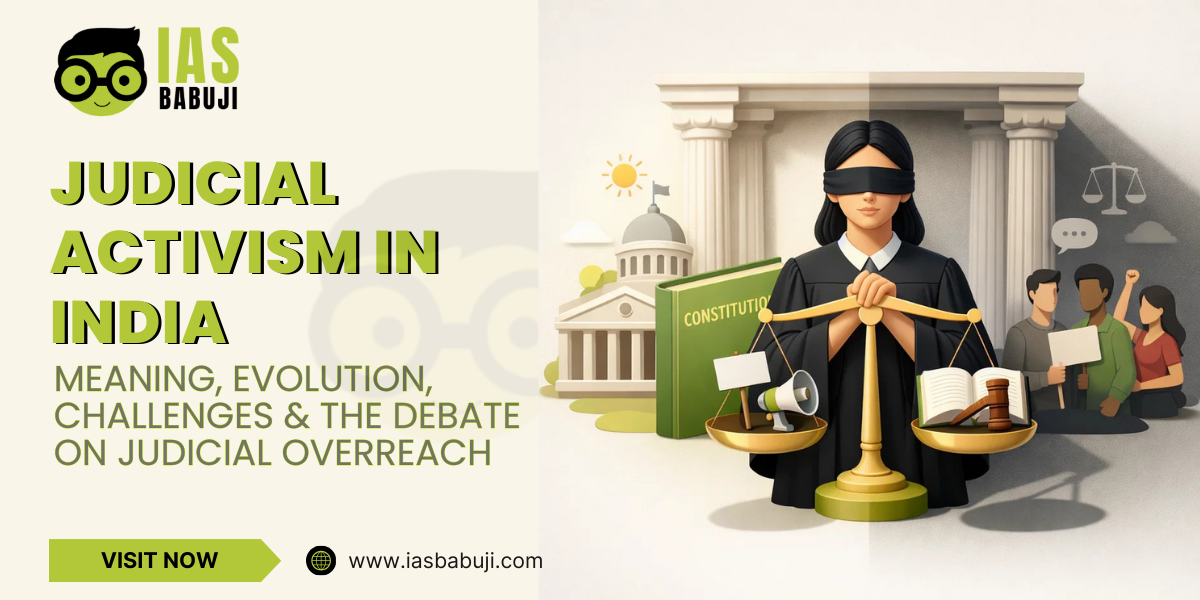
Judicial Activism in India: Meaning, Evolution, Challenges & the Debate on Judicial Overreach
Introduction
The Indian judiciary plays a crucial role in safeguarding the Constitution, protecting fundamental rights, and ensuring the rule of law. Over time, the judiciary has expanded its role beyond traditional interpretation of laws to actively intervene in matters of public interest. This proactive role is known as judicial activism.
Judicial activism has become a defining feature of Indian democracy, especially through instruments like Public Interest Litigation (PIL). While it has strengthened accountability and governance, it has also raised concerns regarding judicial overreach and the separation of powers.
Meaning of Judicial Activism
Judicial activism refers to the proactive role played by the judiciary in protecting rights, ensuring justice, and sometimes filling the gaps left by the executive and legislature.
It involves:
- Expanding the interpretation of laws and the Constitution
- Intervening in public policy issues
- Issuing directions to government authorities
In contrast, judicial restraint emphasizes minimal interference by courts in policy matters.
Constitutional Basis of Judicial Activism
Judicial activism in India is rooted in the Constitution.
Key Provisions:
- Article 32 – Empowers citizens to directly approach the Supreme Court
- Article 226 – Allows High Courts to issue writs
- Article 13 – Enables judicial review
- Doctrine of Basic Structure (evolved through case law)
These provisions provide the judiciary with wide powers to enforce rights and review government actions.
Evolution of Judicial Activism in India
Judicial activism in India evolved gradually:
1. Early Phase (1950s–1970s)
- The judiciary followed judicial restraint
- Focus on the strict interpretation of the Constitution
2. Post-Emergency Phase (1975–1980s)
- Expansion of judicial role after the Emergency in India
- Rise of PILs to protect citizens’ rights
3. PIL Era (1980s–2000s)
- The judiciary became more accessible
- Relaxation of locus standi (anyone could file a case for public interest)
4. Contemporary Phase
- Increased intervention in governance, environment, corruption, and policy matters
Key Tools of Judicial Activism
1. Public Interest Litigation (PIL)
Allows any citizen to approach courts for public causes such as environmental protection, human rights, etc.
2. Judicial Review
Power to review laws and executive actions for constitutional validity.
3. Continuing Mandamus
Courts monitor the implementation of their orders over time.
Landmark Cases of Judicial Activism
1. Kesavananda Bharati v. State of Kerala
-
Introduced the Basic Structure Doctrine
2. Maneka Gandhi v. Union of India
-
Expanded interpretation of Article 21 (Right to Life and Personal Liberty)
3. Vishaka v. State of Rajasthan
-
Guidelines on sexual harassment at workplace
4. MC Mehta Cases
-
Landmark environmental protection judgments
Importance of Judicial Activism
1. Protection of Fundamental Rights
Ensures that citizens’ rights are not violated by the state.
2. Filling Legislative Gaps
Courts step in when laws are absent or inadequate.
3. Promoting Good Governance
Improves the accountability of the executive.
4. Voice for the Marginalized
PILs provide access to justice for weaker sections.
Judicial Overreach: Meaning and Concerns
Judicial overreach refers to excessive interference by the judiciary in executive or legislative functions.
Key Concerns:
1. Violation of Separation of Powers
The Constitution divides powers among the legislature, executive, and judiciary.
2. Lack of Expertise
Courts may not have the technical expertise required for policymaking.
3. Democratic Legitimacy
Judges are not directly elected by the people.
4. Policy Paralysis
Frequent judicial intervention may slow down governance.
Judicial Activism vs Judicial Overreach
| Judicial Activism | Judicial Overreach |
|---|---|
| Protects rights | Interferes excessively |
| Based on constitutional values | May go beyond the mandate |
| Ensures accountability | Disrupts the separation of powers |
Arguments in Favour of Judicial Activism
1. Ensures Accountability
Acts as a check on the misuse of power.
2. Strengthens Democracy
Protects citizens from arbitrary actions.
3. Provides Timely Justice
Fills gaps when other organs fail.
Criticism of Judicial Activism
1. Undermines Institutional Balance
Can disturb the balance among the organs of government.
2. Judicial Overreach
Courts may exceed their jurisdiction.
3. Burden on the Judiciary
Increased PILs lead to a backlog of cases.
Role of Judiciary in a Democracy
The judiciary acts as:
- Guardian of the Constitution
- Protector of fundamental rights
- Interpreter of laws
- Check on executive and legislative excesses
A balanced judiciary ensures the rule of law and democratic stability.
Way Forward
1. Maintain Balance
Courts should exercise restraint while ensuring justice.
2. Strengthen Institutions
The executive and legislature should function effectively to reduce judicial intervention.
3. Clear Guidelines on PILs
Prevent misuse of PILs for personal or political gains.
4. Judicial Accountability
Ensure transparency in judicial functioning.
Conclusion
Judicial activism has played a transformative role in strengthening democracy and protecting rights in India. However, it must be exercised with caution to avoid judicial overreach.
A balanced approach—where the judiciary actively safeguards rights without encroaching upon other organs—will ensure the effective functioning of India’s democratic system.
FAQs for UPSC Preparation
1. What is judicial activism?
It is the proactive role of the judiciary in protecting rights and ensuring justice.
2. What is judicial overreach?
It refers to excessive judicial interference in executive or legislative functions.
3. What is PIL?
Public Interest Litigation allows citizens to approach courts for public causes.
4. Which case introduced the Basic Structure Doctrine?
Kesavananda Bharati case (1973).
5. Why is judicial activism important?
It protects fundamental rights and ensures accountability.
6. What is the difference between activism and restraint?
Activism involves intervention, while restraint emphasizes a limited judicial role.