Sangam Literature and Its Key Features (UPSC Prelims Notes)
(GS Paper 1 – Ancient India | Art & Culture | South Indian History)
Sangam Literature is one of the most scoring and repeatedly asked topics in UPSC Prelims under Ancient History and Indian Culture. It is the earliest and most authentic literary source for understanding the history, society, economy, and political life of ancient South India, especially the region known as Tamilakam.
Unlike many ancient sources that were written centuries later, Sangam poems reflect a more direct and contemporary picture of the period. UPSC often frames Sangam-related questions through matching, chronology, features, and elimination-based options, making it a must-cover topic for Prelims.
What is Sangam Literature?
Sangam Literature refers to a large body of early Tamil literary works composed by poets who were believed to have gathered in assemblies called “Sangams”.
The word Sangam literally means:
- Association
- Assembly
- Group of scholars/poets
The tradition says these literary assemblies were organised under royal patronage, mainly in the Pandya region.
Why is it important for UPSC?
Sangam Literature is important because it provides:
- A clear description of the Chera, Chola, and Pandya kingdoms
- Evidence of trade with the Romans
- A detailed view of Tamil society and culture
- A strong base for understanding early South Indian polity
Sangam Period: Timeline (UPSC Standard)
The Sangam Age is generally placed between:
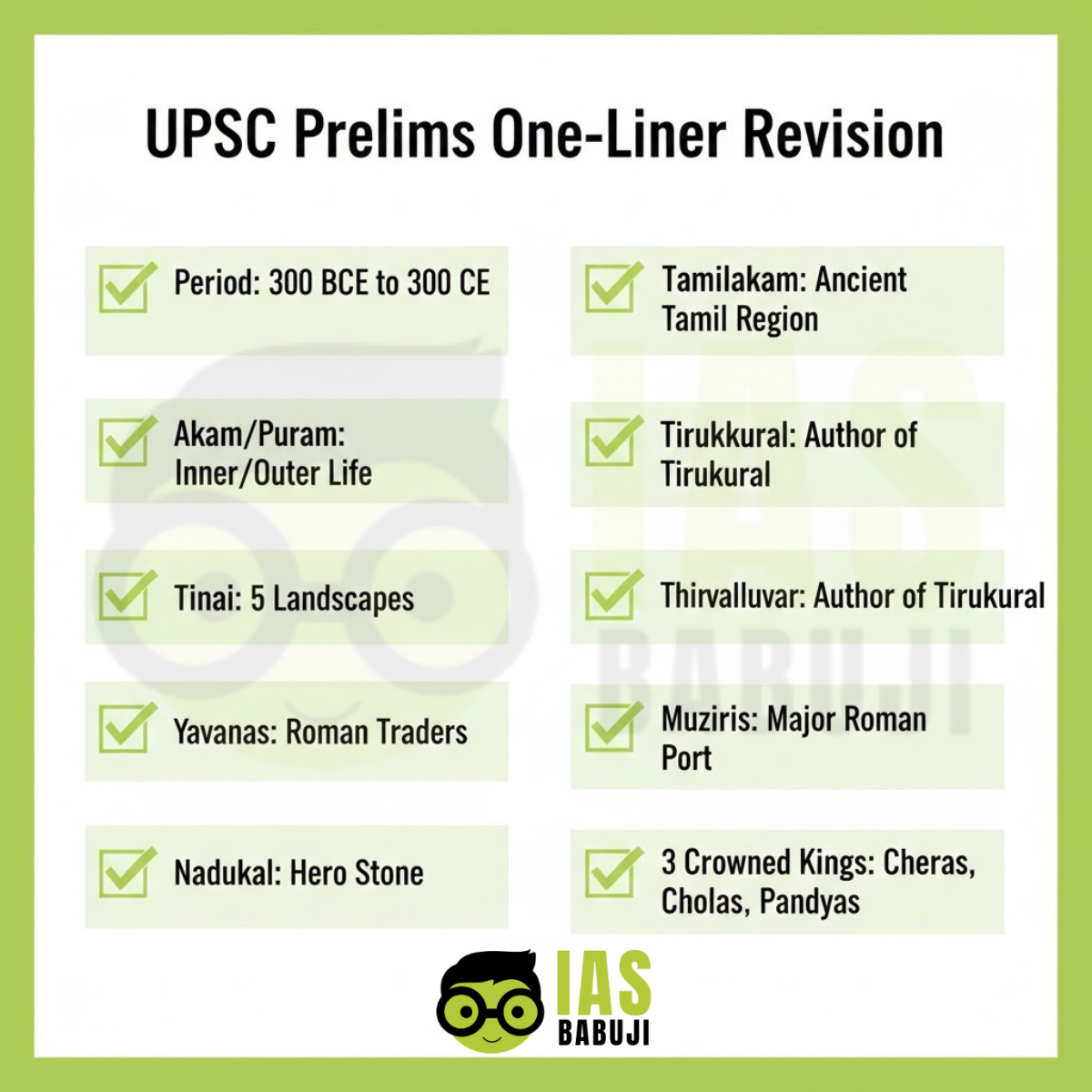
300 BCE to 300 CE (approx.)
Different books mention slightly different ranges, but UPSC questions usually accept this as the safest period.
The Region Described in Sangam Literature: Tamilakam
Sangam texts primarily describe Tamilakam, which included:
- Present-day Tamil Nadu
- Kerala
- Parts of Karnataka
- Parts of Andhra Pradesh
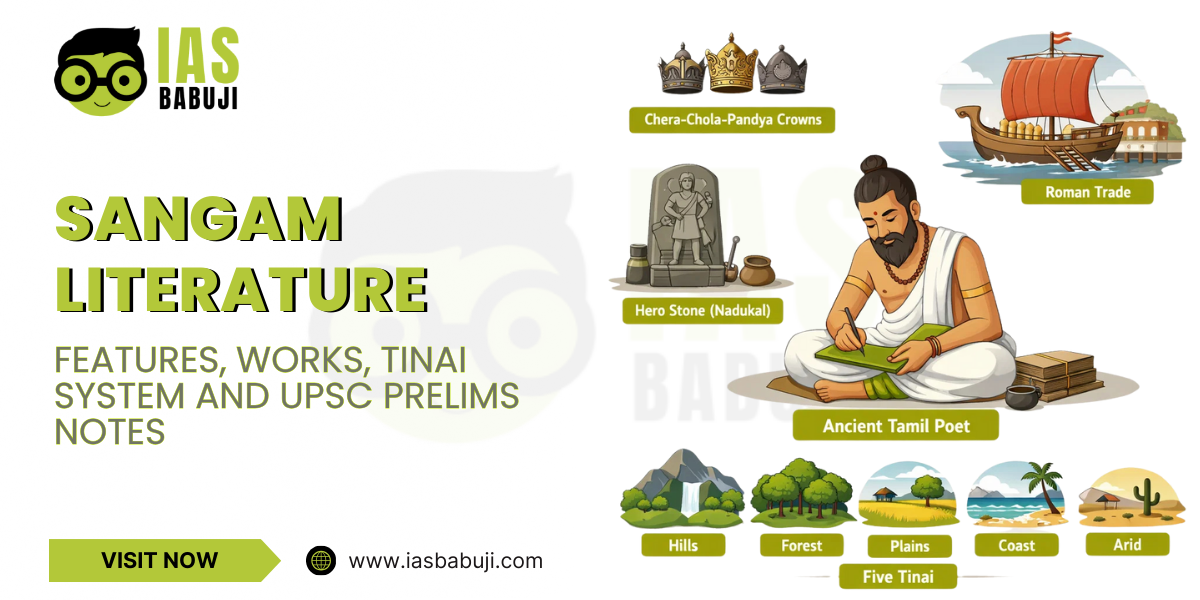
It also refers to the famous Three Crowned Kings:
- Chera
- Chola
- Pandya
These kingdoms form the backbone of early Tamil political history.
Main Classification: Akam and Puram (Very Important)
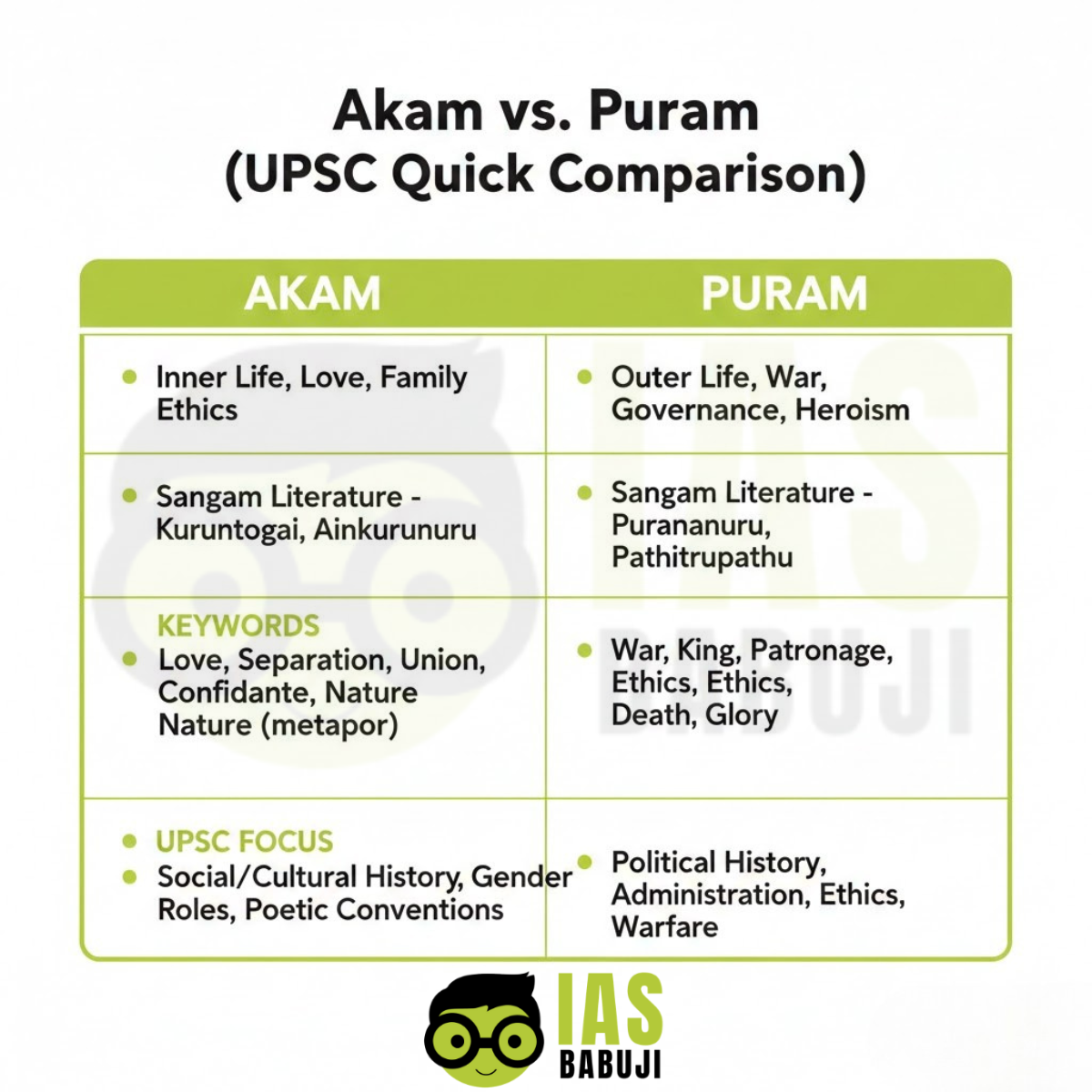
UPSC frequently asks about the classification of Sangam poems.
A) Akam (Inner World)
Akam poems focus on:
- Love
- Romance
- Emotional life
- Family relationships
- Personal feelings
Akam literature generally avoids naming kings directly, and instead focuses on private life.
B) Puram (Outer World)
Puram poems focus on:
- War and heroism
- Kings and battles
- Charity and public life
- Valour, honour, fame
- Social values and public duties
Puram poems provide important information about:
- Warfare practices
- Patronage
- Political structure
- Social hierarchy
Prelims trick:
Akam = Love | Puram = War
Major Sangam Literary Works (UPSC Must-Know)
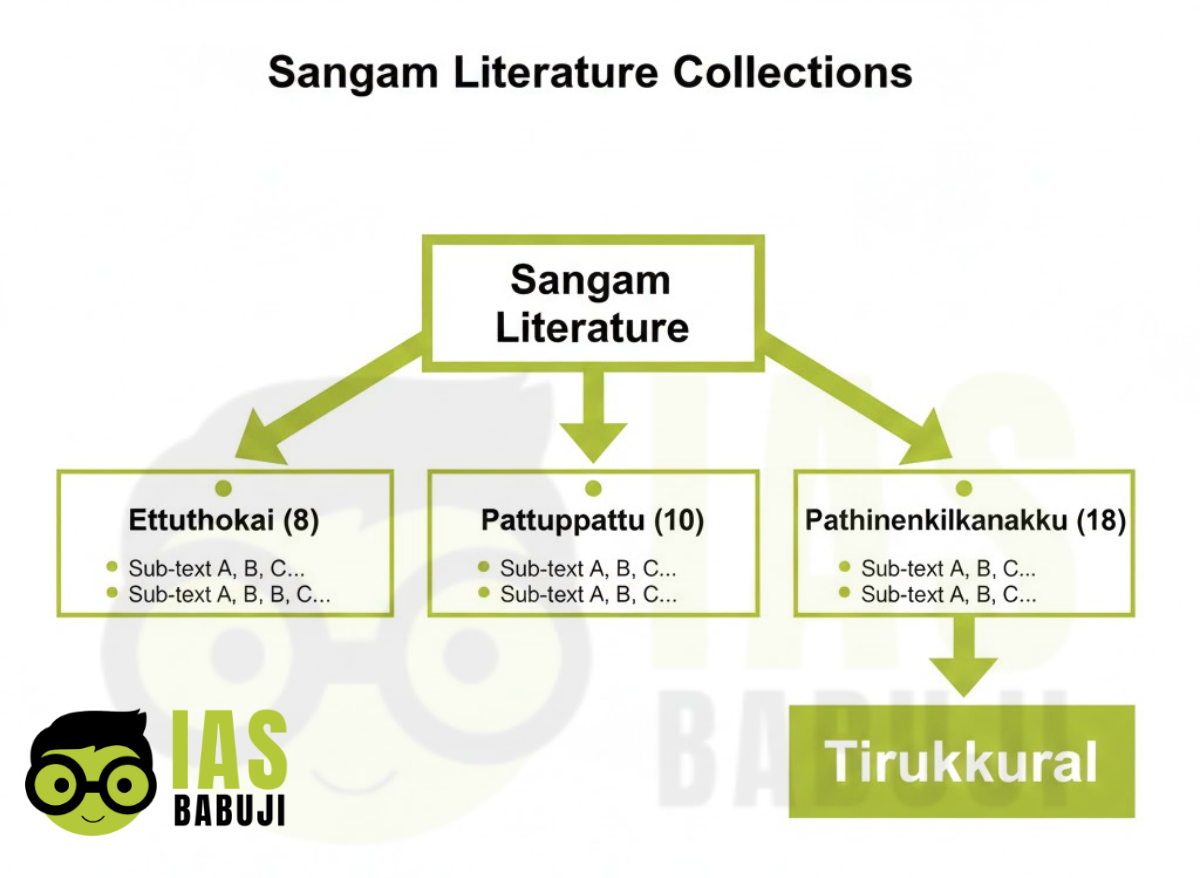
Sangam literature is broadly grouped into:
1) Ettuthokai (Eight Anthologies)
These are eight collections of poems.
They contain:
- Akam poems
- Puram poems
- Nature-based descriptions
- Social and political references
2) Pattuppattu (Ten Idylls)
These are ten long poems, often describing:
- Kings
- Cities
- Trade routes
- Festivals
- Ports and marketplaces
Pattuppattu is particularly useful for understanding:
- Urban life
- Economy and trade
- Cultural practices
3) Pathinenkilkanakku (Eighteen Minor Works)
These are considered later than the earlier Sangam collections.
They focus more on:
- Morality
- Ethics
- Good governance
- Social conduct
Tirukkural (Most Famous)
Among the minor works, the most famous is:
Tirukkural – written by Thiruvalluvar
It is a collection of couplets on:
- Aram (Virtue)
- Porul (Wealth/Polity)
- Inbam (Love)
Tirukkural is a high-value UPSC topic because it is linked with:
- Ethics
- Governance
- Indian cultural traditions
Key Features of Sangam Literature (UPSC Prelims Focus)
Sangam literature is not just poetry. It is a rich historical source that covers almost every dimension of life.
1) Political System and Kingship
Sangam texts describe a political structure where:
- Kings were central figures
- Warfare was common
- Royal patronage was important
Kings were praised for:
- Military victories
- Protection of subjects
- Charity and generosity
Sangam poems mention:
- Forts and armies
- Battle strategies
- Heroic ideals
2) The Three Crowned Kings
The most prominent rulers mentioned are:
- Chera – associated with western coast and trade
- Chola – associated with river plains and agriculture
- Pandya – associated with Madurai region
They are called the “three crowned kings” because they were the main dynasties of Tamilakam.
3) Social Life and Daily Culture
Sangam literature provides one of the most detailed pictures of early Indian society.
It describes:
- Farmers
- Fishermen
- Shepherds
- Traders
- Warriors
- Poets
- Craftsmen
It also indicates:
-
Existence of towns and cities
-
Marketplaces and trade centres
-
Social norms and community life
4) Status of Women
One notable feature is that women appear in Sangam literature in many roles:
- As heroines in Akam poems
- As poets and writers
- As participants in cultural life
Several Sangam poems are attributed to women poets, which is an important cultural point.
5) Economy and Trade (Very Important for Prelims)
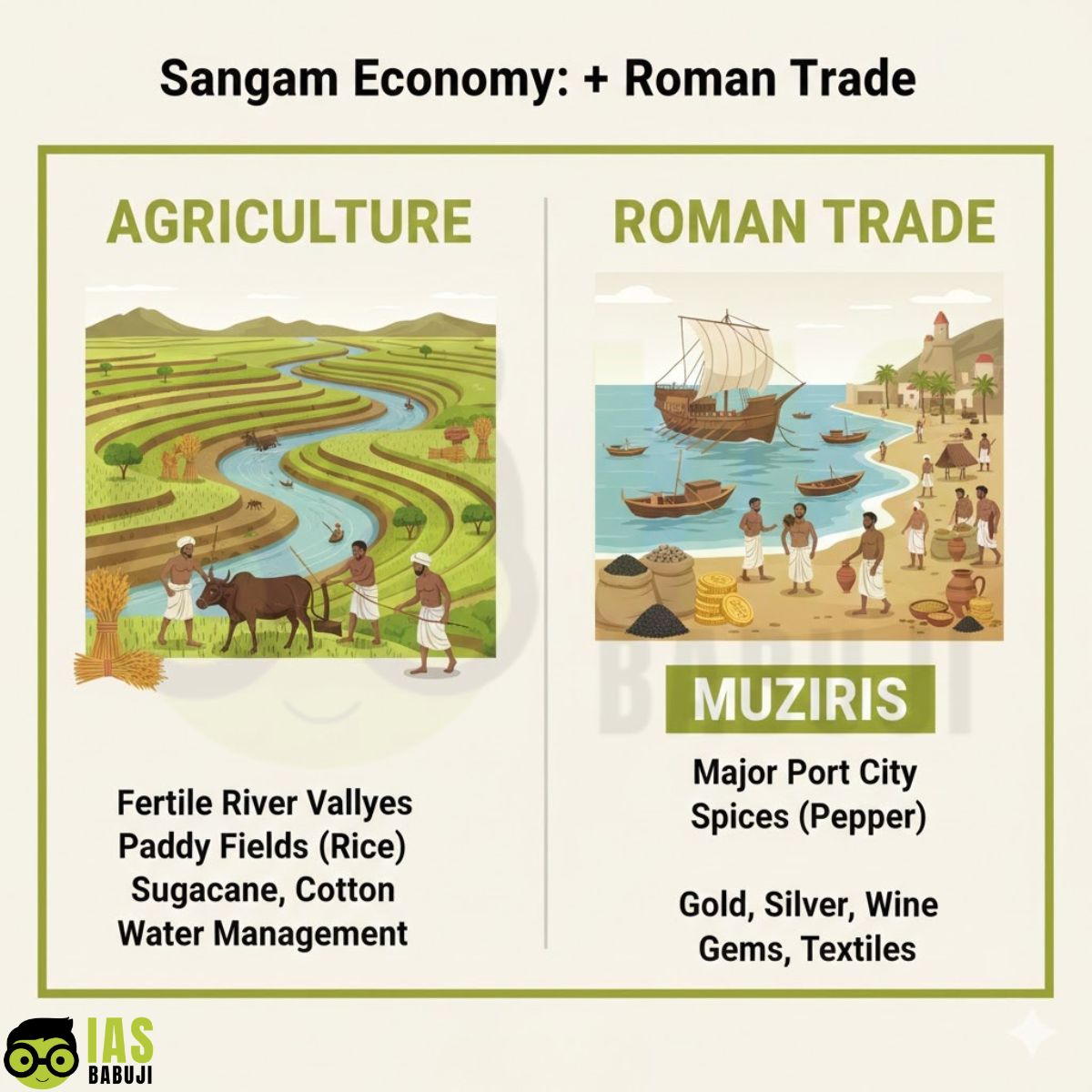
Sangam literature provides strong evidence of a flourishing economy.
A) Agriculture
Agriculture was a major economic base, especially in:
- River valleys
- Fertile plains
Crops mentioned include:
- Paddy
- Millets
- Sugarcane
B) Internal Trade
Trade existed between:
- Hills and plains
- Coastal and inland regions
- Villages and urban centres
C) Foreign Trade (Roman Trade)
This is one of the most asked features.
Sangam literature mentions:
- Yavanas (foreigners)
- Roman gold coins
- Overseas trade
The western coast had major ports, including the famous:
Muziris
Muziris is frequently associated with:
- Pepper trade
- Roman merchants
- International commerce
UPSC often asks about ports, products, and trade partners from this period.
6) Urbanisation and Port Culture
Sangam texts show that:
- Towns were growing
- Ports were thriving
- Markets were organised
Some poems describe:
- Busy streets
- Merchants and shops
- Warehouses
- Ships and harbours
This suggests early urbanisation in South India.
7) The Tinai System (Landscape Classification)
One of the most unique contributions of Sangam literature is its classification of life based on landscapes called Tinai.
Sangam literature divides the land into five ecological zones:
| Tinai (Landscape) | Region (Physiographic Zone) | Occupation (Economic Activity) | Key Cultural Theme (Poetic Mood) |
| Kurinji | Hilly/Mountainous | Hunting and Honey collection | Union of lovers (Secret meetings) |
| Mullai | Pastoral/Forest | Animal husbandry (Herding) | Waiting (Patiently awaiting the hero) |
| Marutham | Riverine/Agricultural | Agriculture (Plowing) | Infidelity (Quarrels between lovers) |
| Neithal | Coastal/Littoral | Fishing and Salt manufacturing | Lamenting (Anxiety over the hero’s return) |
| Palai | Arid/Desert | Highway robbery and Marauding | Separation (Long journey/Hardship) |
Key Takeaways for UPSC Prelims & Mains
- Eco-Centric Society: The Tinai system proves that Ancient Tamils had a deep understanding of biodiversity and ecological zones.
- The Deity Factor: Each Tinai was associated with a specific god (e.g., Murugan for Kurinji, Mayon for Mullai).
- Mains Context: You can use these Tinais to explain the Social Stratification and Economic Diversification of the Sangam Age.
8) Religion and Beliefs
Sangam religion was mainly:
- Nature-based
- Local deity worship
A very prominent deity was:
Murugan
Murugan is often described as:
- A Tamil deity
- Associated with hills and Kurinji region
Later Sangam works also show influence of:
- Jainism
- Buddhism
9) Warfare, Heroism and Nadukal
Sangam poems describe a society where:
- Battles were frequent
- Warriors were honoured
- Heroism was celebrated
A key cultural element was:
Nadukal (Hero Stones)
Nadukal were stones erected to honour warriors who died in battle.
UPSC sometimes asks this as a cultural marker of early Tamil society.
Sangam Literature as a Historical Source
Sangam literature is a major source for understanding early South India because:
- It is largely contemporary
- It contains the names of rulers and regions
- It describes trade and economy in detail
- It records cultural and social patterns
However, like any literary source, it also has limitations:
- It is poetic and sometimes exaggerated
- It focuses heavily on elite patrons (kings)
Still, it remains one of the most reliable sources for early Tamil history.
UPSC Prelims MCQ Logic (How Questions Are Framed)
UPSC typically tests Sangam literature through:
1) Akam vs Puram confusion
If the question has:
- Love/relationships → Akam
- War/kings → Puram
2) Tinai system matching
UPSC may ask:
- Which landscape is linked with agriculture/coast/hills etc.
3) Roman trade
If the question mentions:
- Yavanas
- Gold coins
- Ports
Then the Sangam trade is likely the answer.
4) Authors and works
Most common:
-
Tirukkural → Thiruvalluvar
Conclusion
Sangam literature is a high-scoring topic because it provides a complete picture of early South India. It is especially important for UPSC Prelims due to its factual richness and repeated appearance in MCQs.
Aspirants should revise the Sangam literature, focusing on:
- Akam vs Puram
- Major collections
- Tinai landscapes
- Roman trade and ports
- Chera–Chola–Pandya references
- Cultural features like Nadukal
FAQs (UPSC Prelims)
1. What is Sangam Literature?
Sangam literature is the earliest Tamil literary collection composed during the Sangam age, reflecting social, political, and economic life in ancient Tamilakam.
2. What is the time period of the Sangam literature?
It is generally dated to around 300 BCE to 300 CE.
3. What is the difference between Akam and Puram?
Akam deals with love and inner life, while Puram deals with war, kings, and public life.
4. What is the Tinai system in Sangam literature?
Tinai is the classification of land into five ecological zones: Kurinji, Mullai, Marutham, Neithal, and Palai.
5. Which is the most famous Sangam text?
Tirukkural, written by Thiruvalluvar, is the most famous.
6. What evidence of foreign trade is found in Sangam literature?
Sangam texts mention Yavanas and overseas trade, including Roman trade and ports like Muziris.