Is India’s Growth Jobless? Examining the Quality of Economic Growth
Introduction
Economic growth is often measured through rising GDP numbers, but growth without adequate employment generation raises serious concerns for a labour-abundant country like India. Over the years, India has recorded phases of high economic growth alongside persistent unemployment and underemployment. This paradox has given rise to the debate on “jobless growth”, questioning the quality, inclusiveness, and sustainability of India’s development trajectory. For UPSC aspirants, this topic is highly relevant for GS Paper III, Essay, and Ethics, as it links growth with social justice, demographic dividend, and governance outcomes.
What is Jobless Growth?
Jobless growth refers to a situation where economic output increases without a proportional rise in employment opportunities.
Key characteristics:
- Rising GDP with stagnant or slow employment growth
- Low employment elasticity of growth
- Shift towards capital-intensive production
- Informalisation and poor job quality
Understanding Employment Elasticity of Growth
Employment elasticity measures how much employment grows when the economy expands.
- High elasticity → growth generates more jobs
- Low elasticity → growth creates fewer jobs
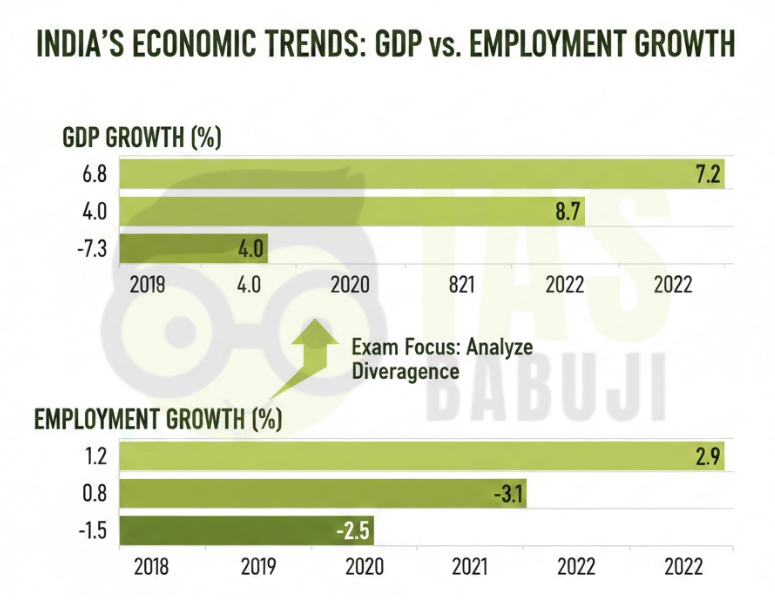
India’s employment elasticity has declined over time, indicating weakening job creation despite economic expansion.
Evidence of Jobless Growth in India
Structural Trends
- Decline in agricultural employment without adequate absorption in manufacturing
- Services sector growth concentrated in skill-intensive segments
- Manufacturing growth is increasingly capital-intensive
Labour Market Indicators
- High youth unemployment
- Rising informal and gig employment
- Low female labour force participation
Productivity vs Employment
- Output growth driven by productivity gains rather than labour absorption
Sectoral Analysis of Employment Growth
Agriculture
- Declining share in GDP
- Still employs a large workforce
- Disguised unemployment remains high
Manufacturing
- Expected to absorb surplus labour
- Automation and capital intensity limit job creation
- MSMEs generate jobs but face constraints
Services
- Major contributor to GDP growth
- High-end services generate fewer jobs
- Informal services dominate employment
Causes of Jobless Growth in India
Structural Transformation Challenges
- Slow transition from agriculture to industry
- Weak manufacturing base
Skill Mismatch
- Education is not aligned with market needs
- Shortage of industry-ready skills
Technology and Automation
- Increased use of capital and technology
- Labour displacement in traditional sectors
Informalisation of Employment
- Rise in contractual and gig work
- Lack of job security and social protection
Policy and Institutional Constraints
- Rigid labour laws in the past
- Ease of doing business gaps at the ground level
Quality of Employment: A Deeper Concern
Beyond job numbers, the quality of employment matters.
Indicators of poor job quality:
- Low wages
- Absence of social security
- Informal and precarious work
- Underemployment
Job-rich growth must ensure dignity, stability, and productivity.
Implications of Jobless Growth
Economic Implications
- Weak domestic demand
- Rising inequality
- Underutilisation of demographic dividend
Social Implications
- Youth frustration and social unrest
- Gender inequality in workforce participation
Governance and Ethical Dimensions
- Growth without inclusion undermines social justice
- Ethical responsibility of the State to create livelihoods
Government Initiatives to Address Employment Challenges
- Skill India and PM Kaushal Vikas Yojana
- Production Linked Incentive (PLI) schemes
- Focus on MSMEs and startups
- Labour code reforms
- Infrastructure-led growth strategy
While progress is visible, outcomes remain uneven.
Is India’s Growth Truly Jobless?
India’s growth is not entirely jobless, but it is job-poor and uneven.
- Jobs are being created, but not at the required scale
- Informality dominates employment
- Growth benefits are not equitably distributed
The challenge lies in improving the employment intensity and quality of growth.
Way Forward
- Strengthening manufacturing and MSMEs
- Promoting labour-intensive sectors
- Aligning education with industry needs
- Enhancing female labour participation
- Ensuring social security for informal workers
Inclusive growth must prioritise employment creation.
Conclusion
The debate on jobless growth highlights a fundamental concern about the quality and inclusiveness of India’s economic development. While GDP growth remains essential, it cannot be the sole measure of progress in a labour-surplus economy. India’s experience suggests that growth has not translated into adequate, secure, and productive employment for large sections of the population. Addressing this challenge requires a structural shift towards labour-intensive manufacturing, skill-oriented education, and a stronger MSME ecosystem. Equally important is improving job quality through formalisation and social protection. For India to fully realise its demographic dividend, economic growth must be both job-creating and inclusive, ensuring that development outcomes translate into meaningful livelihoods.
FAQs
What is jobless growth?
Jobless growth refers to economic growth without proportional employment generation.
Is jobless growth a problem for India?
Yes, because India has a large, young, and labour-abundant population.
Which sectors can generate maximum employment?
Manufacturing, MSMEs, construction, and labour-intensive services.
Which UPSC papers cover this topic?
GS Paper III and Essay.