Union Budget 2026-27: Detailed Analysis of Key Schemes, Fiscal Terms & Policy Priorities
GS Paper 3 – Indian Economy: Budget, Fiscal Policy, Development Initiatives
The Union Budget 2026-27 was presented in Parliament on 1 February 2026 by the Finance Minister. It lays out the government’s expenditure plans, revenue measures, tax proposals, and long-term priorities for the financial year beginning 1 April 2026. The overarching theme of the budget is growth with fiscal discipline, emphasising infrastructure-led expansion, manufacturing push, employment generation, structural reforms and sustainable development.
I. Macroeconomic and Fiscal Framework
1. Expenditure, Receipts and Growth
- Total expenditure for FY 2026-27 is estimated at ₹53.47 lakh crore, about 7.7% higher than the revised estimate of 2025-26.
- Receipts (excluding borrowings) are pegged at ₹36.51 lakh crore, showing a 7.2% growth over revised estimates.
- The government estimates a nominal GDP growth rate of ~10%, reflecting both real growth and inflation.
2. Deficits and Debt
- Fiscal deficit for 2026-27 is targeted at 4.3% of GDP, slightly lower than the revised estimate of 4.4% in 2025-26, indicating gradual fiscal consolidation.
- Revenue deficit is projected at 1.5% of GDP, matching the previous year’s revised estimate.
- Outstanding liabilities are estimated at about 55.6% of GDP, with the government aiming to reduce this to around 50% of GDP by March 2031.
II. Key Budgetary Allocations & Policy Focus
1. Capital Expenditure — Growth Engine
The budget makes infrastructure investment a central pillar of the economic strategy:
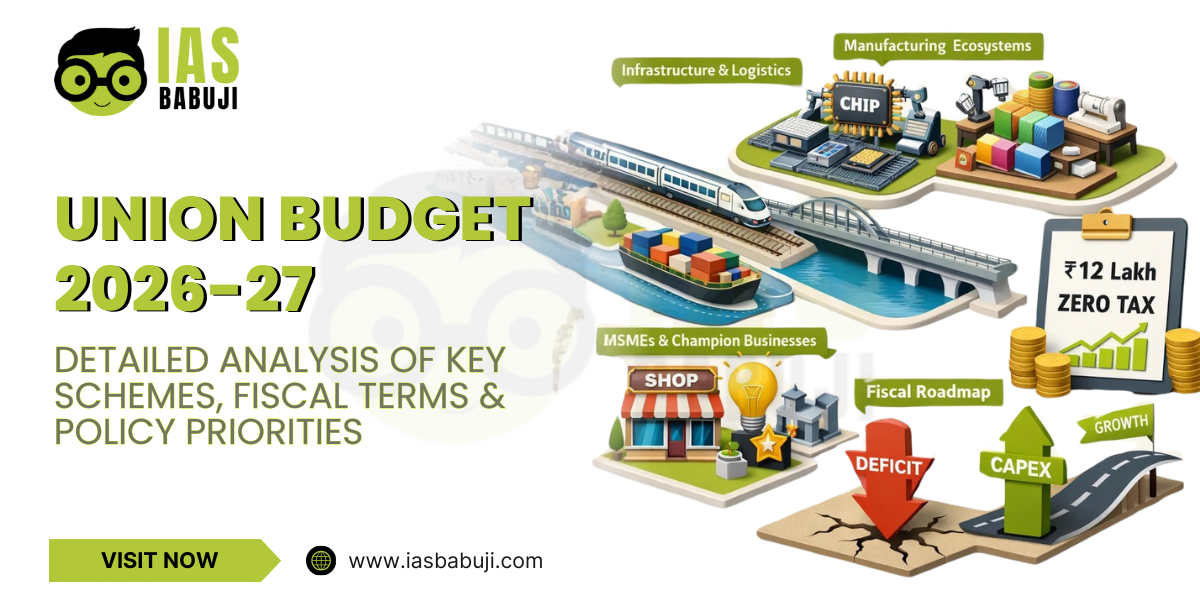
- Capital expenditure is increased to ₹12.2 lakh crore, one of the highest ever allocations to infrastructure.
- This supports long-term growth through improved connectivity, logistics, and asset creation.
Strategic investments include:
- Seven high-speed rail corridors to connect major urban and industrial hubs.
- Dedicated freight corridor (Dankuni–Surat) to improve freight movement efficiency.
- 20 new National Waterways to strengthen inland water transport.
- An Infrastructure Risk Guarantee Fund to crowd-in private investment by mitigating risks.
- City Economic Regions (CERs) — with ₹5,000 crore per region over five years — to foster integrated regional development.
2. Sector-Wise Focus and Major Schemes
A. Industry, Manufacturing & MSMEs
- Biopharma SHAKTI (₹10,000 crore) — A five-year programme to make India a global manufacturing hub for biologics and biosimilars.
- Electronics Component Manufacturing Scheme — Outlay raised to ₹40,000 crore to support domestic electronics component production.
- Semiconductor Mission 2.0 — continued focus on chip manufacturing and supply chain resilience.
- Chemical Parks and container manufacturing eco-system as part of cluster development policy.
- SME Growth Fund (₹10,000 crore) and top-ups to the Self-Reliant India Fund to develop “Champion SMEs”.
B. Textiles and Handloom
An Integrated Textile Programme comprising:
- National Fibre Scheme
- Textile Expansion and Employment Scheme
- National Handloom and Handicraft Programme
- Tex-Eco Initiative
- Samarth 2.0
This aims to strengthen India’s textile competitiveness, enhance employment, and support exports.
C. Energy, Minerals & Environment
- Establishment of Dedicated Rare Earth Corridors in mineral-rich states to support mining, processing and advanced manufacturing.
- Carbon capture, utilisation and storage (CCUS) allocations (~₹20,000 crore over five years) indicating emphasis on decarbonisation.
D. Education and Skills
- Five university townships to catalyse regional education-industry linkages and enhance skills development.
- Support to creative technologies and digital skill labs in schools and colleges.
E. Agriculture, Rural & Social Sector
- Extension of tax deductions for cooperatives engaged in supplying agricultural inputs (e.g., cattle feed, cotton seeds).
- Credit-linked subsidies for animal husbandry and coconut promotion schemes.
-
Increased allocations for schemes like Jal Jeevan Mission and PMAY-Urban, with notable upticks in valuation.
III. Major Tax Proposals and Reforms
1. Individual Tax Structure
- Tax slabs remain unchanged; no new rate cuts.
- Certain reliefs remain to support taxpayers, including TCS reforms on high-value remittances.
- Tax collected at source (TCS) on overseas education and medical remittances reduced from 5% to 2%.
2. Corporate and Capital Market Reforms
- Minimum Alternate Tax (MAT) rate is reduced from 15% to 14%, with restrictions on credit accumulation.
- All share buybacks are taxed as capital gains (effectively aligning buyback taxation).
- Safe harbour margin for IT services increased and re-classification of services under a common category to simplify taxation.
3. Non-Resident Incentives
- Exemptions for non-resident experts’ global income for up to 5 years to attract global talent.
- Tax holiday for foreign companies supplying capital goods in bonded zones.
- Joint tax committee to integrate Accounting Standards with tax law for simplified administration.
IV. Expenditure Priorities: Who Gets What?
1. Central Sector and Centrally Sponsored Schemes
- Expenditure on central sector schemes and transfers to states increases broadly.
- Centrally sponsored schemes see a sizable rise in allocations, reflecting continued support for nationwide programmes.
- Interest payments remain a significant component — about 26% of overall expenditure — reflecting the cost of servicing public debt.
V. Strategic Priorities & Long-Term Reforms
1. Financial Sector and Capital Flows
- Encouragement of portfolio participation by non-residents (PROIs) with raised investment limits.
- Market-making frameworks for corporate bonds and incentive schemes to boost municipal bond issuances.
2. Employment and Labour Market
-
A Standing Committee on Education-to-Employment and Enterprise to bridge skills gaps and assess the impact of AI on jobs.
VI. UPSC Relevance
A. Prelims Ready
- Fiscal deficit target – 4.3% of GDP
- Capital expenditure – ₹12.2 lakh crore
- Key schemes: Biopharma SHAKTI, SME Growth Fund, Rare Earth Corridors
- TCS reductions and corporate tax reforms
- Infrastructure risk guarantee fund for private investment
B. Mains Focus
- Fiscal federalism and state financing strategies
- Infrastructure-led growth and development economics
- Industry and manufacturing policy
- Tax reform and ease of doing business
- Sectoral impact: energy, MSMEs, textiles, mining and labour
Strategic Summary
The Union Budget 2026-27 blends growth acceleration with fiscal prudence. It prioritises:
- Infrastructure and connectivity
- Manufacturing competitiveness
- Employment, education and skills development
- Tax clarity and investment facilitation
- Strategic sectors like energy, mining, pharmaceuticals and textiles
This holistic approach reflects both short-term economic support and long-term structural reform priorities.
FAQs – Union Budget 2026-27
1. What is the fiscal deficit target for 2026-27?
Fiscal deficit is targeted at 4.3% of GDP.
2. What is the capital expenditure allocation?
Capital expenditure has been set at ₹12.2 lakh crore.
3. What are the major schemes for manufacturing?
Key schemes include Biopharma SHAKTI (₹10,000 crore), the expanded Electronics Component Manufacturing Scheme, and Semiconductor Mission 2.0.
4. How has TCS on overseas remittances changed?
TCS on remittances for education and medical treatment has been reduced to 2%.
5. What reforms are proposed for corporate taxation?
MAT rate reduction to 14% and aligning buyback tax with capital gains are notable reforms.