

UPSC Mock Test Series: Importance & How to Maximize Scores
Preparing for the UPSC Civil Services Examination is not only about completing the syllabus—it is about testing, evaluating, and refining your preparation continuously. This is where a UPSC Mock Test Series becomes one of the most powerful tools in an aspirant’s journey.
Whether it is Prelims MCQ accuracy or Mains answer structuring, mock tests bridge the gap between knowledge and performance. This article explains why mock tests are crucial, how to analyze them effectively, and how to use them strategically to improve scores and rank.
Why UPSC Mock Tests Are Essential for Serious Aspirants
Many aspirants study extensively but underperform in the actual exam due to poor exam temperament, weak time management, or lack of revision. Mock tests directly address these gaps.
Key Benefits of UPSC Mock Tests
- Simulate real exam pressure
- Improve time management and accuracy
- Identify strong and weak areas
- Train the mind for negative marking control
- Improve answer presentation for Mains
- Build consistency and confidence
In fact, most toppers consider mock tests a non-negotiable part of UPSC Preparation, especially in the last 6–8 months before the exam.
Importance of Mock Tests in UPSC Prelims Preparation
UPSC Prelims is not just about knowledge—it is about decision-making under pressure.
How Prelims Mock Tests Help
- Practice elimination techniques
- Balance attempts vs accuracy
- Identify risky guessing habits
- Improve factual recall
- Strengthen weak GS areas (Polity, Economy, Environment, etc.)
Aspirants who regularly attempt full-length Prelims mock tests develop better intuition and discipline during the actual exam.
Importance of Mock Tests in UPSC Mains Preparation
UPSC Mains tests analytical ability, clarity of thought, and presentation. Reading alone cannot build these skills.
How Mains Mock Tests Help
- Improve answer structure (intro–body–conclusion)
- Practice diagram and flowchart usage
- Manage 7–11 minute answer-writing time
- Receive feedback on content depth and relevance
- Reduce fear of long descriptive papers
Structured Mains test series—especially those combined with mentorship and feedback—play a crucial role in answer-writing maturity.
How to Analyze UPSC Mock Tests the Right Way
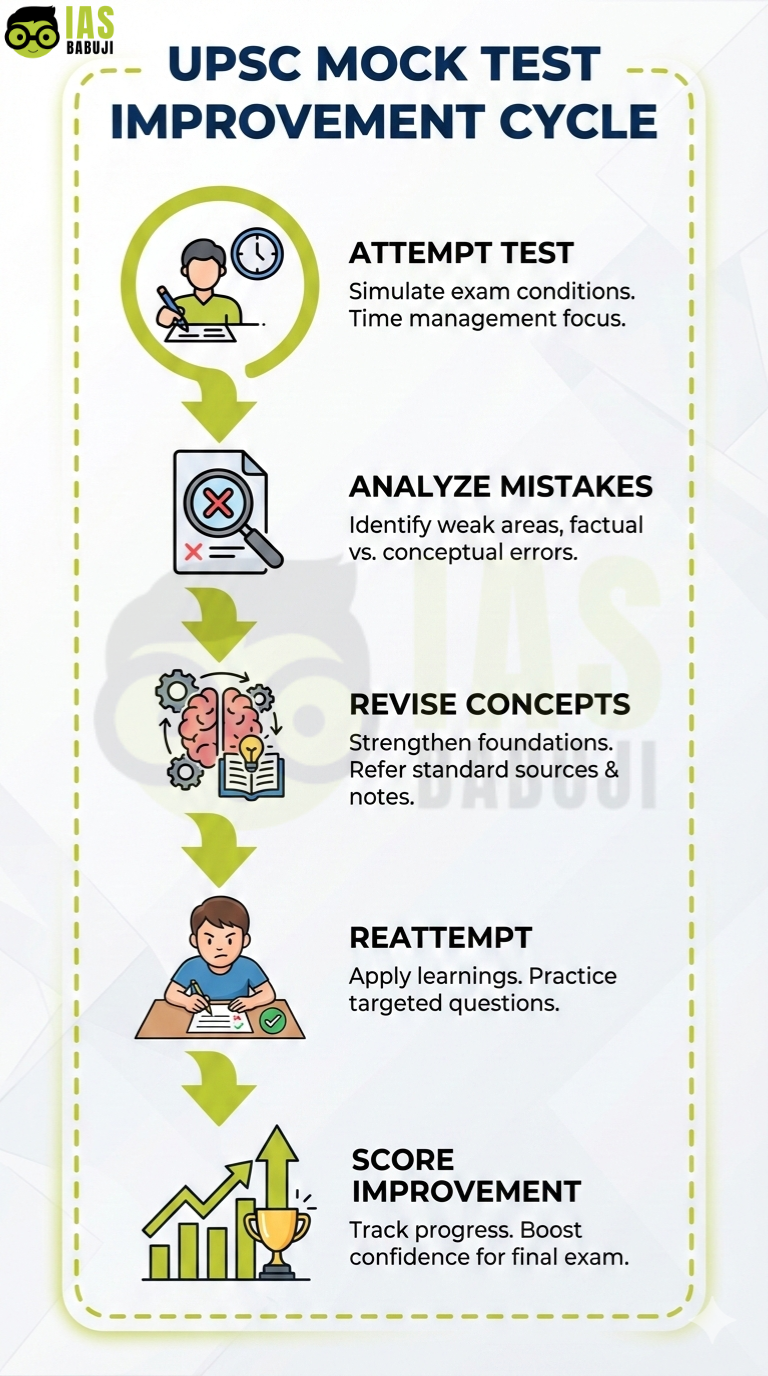
Attempting mock tests without analysis is a common mistake. The real value lies in post-test evaluation.
Step-by-Step Mock Test Analysis Strategy
Step 1: Analyze Every Question
- Why was the answer correct or incorrect?
- Was it a knowledge gap or silly mistake?
- Could elimination have worked?
Step 2: Categorize Mistakes
- Conceptual errors
- Factual confusion
- Overconfidence guesses
- Time-pressure mistakes
Step 3: Update Notes
- Add missed facts
- Refine concepts
- Note repeated mistakes separately
Step 4: Track Performance Trends
- Accuracy percentage
- Subject-wise scores
- Attempt patterns
This systematic analysis is what transforms mock tests into score-improving tools.
Example: Mock Test Marks vs Rank Prediction (Indicative)
This table helps aspirants realistically assess their performance level.
Note: Actual UPSC cutoffs vary yearly. This table is for practice assessment only.
How Many Mock Tests Should an Aspirant Attempt?
Recommended Frequency
- Prelims: 35–50 full-length tests
- Mains GS: 20–30 full-length tests
- Essay: 8–10 essays
- Optional: 15–20 tests
Quality matters more than quantity. A well-analyzed test is better than multiple unreviewed ones.
Common Mistakes Aspirants Make with Mock Tests
- Attempting too many tests without analysis
- Blindly following mock test rankings
- Ignoring NCERT-based fundamentals
- Getting demotivated by low scores
- Changing sources after every test
A balanced approach—tests + revision + guidance—is essential.
Role of Guidance & Mentorship in Test Series
Mock tests are most effective when combined with:
- Structured feedback
- Performance tracking
- Strategy correction
- Personal mentoring
Many aspirants prefer test series that align closely with the UPSC trend and offer exam-oriented evaluation, which is why integrated preparation environments like The Prayas India emphasize continuous testing, guided analysis, and disciplined revision as part of their UPSC Preparation ecosystem—without overwhelming students with excessive tests.
How to Maximize Scores Using Mock Tests (Golden Rules)
- Treat every mock like the actual UPSC exam
- Maintain a mistake notebook
- Revise mock-based notes weekly
- Focus on accuracy before attempts
- Use diagrams and subheadings in Mains
- Stay consistent; don’t chase ranks blindly
Conclusion
UPSC Mock Test Series is not just a practice tool—it is a performance mirror. When used strategically, mock tests refine knowledge, sharpen thinking, and strengthen exam temperament.
The aspirants who analyze deeply, revise smartly, and stay consistent are the ones who convert preparation into selection. In UPSC, it is not about how much you study—but how well you test and improve.
FAQs: UPSC Mock Test Series
Q1. When should I start mock tests for UPSC?
Prelims mocks should ideally start after completing 60–70% syllabus. Mains mocks can start alongside optional and GS answer writing.
Q2. Are low mock scores normal in the beginning?
Yes. Initial low scores are common and indicate learning opportunities, not failure.
Q3. Should I compare my mock rank with others?
Use rank only as a rough indicator. Focus more on score trends and mistake patterns.
Q4. Are online mock tests sufficient for UPSC?
Yes, if they are well-designed, UPSC-aligned, and properly analyzed.
Q5. How important is the test discussion after mocks?
Very important. Discussion helps clarify doubts, concepts, and approach.