• Home
  • Exam Details
  • Strategy
  • Books
  • Current Affairs
  • Contact Us
IAS Babu Ji
Advertise With Us!
  • Home
  • Exam Details
  • Strategy
  • Books
  • Current Affairs
  • State PSC Exams
  • About Us
No Result
View All Result
  • Home
  • Exam Details
  • Strategy
  • Books
  • Current Affairs
  • State PSC Exams
  • About Us
No Result
View All Result
IAS Babu Ji
No Result
View All Result
Home UPSC Strategy Prelims Exam

Top 10 Mistakes UPSC Aspirants Make in Prelims Preparation

by editorialteam
in Prelims Exam, UPSC Strategy
Reading Time: 6 mins read
0
Top 10 Mistakes UPSC Aspirants Make in Prelims Preparation

Top 10 Mistakes UPSC Aspirants Make in Prelims Preparation

Share on FacebookShare on WhatsAppShare on Twitter

Top 10 Mistakes UPSC Aspirants Make in Prelims Preparation

UPSC Prelims is not just a qualifying exam; it is the biggest elimination stage of the Civil Services Examination. Every year, nearly 10–12 lakh aspirants appear for Prelims, but only a small fraction clear it. Surprisingly, many aspirants fail not due to lack of hard work, but because of avoidable strategic mistakes.

This article explains the top 10 most common mistakes in UPSC Prelims preparation, why they happen, and how to correct them—making it extremely useful for both first-time and repeat aspirants.


1. Treating Prelims as a Factual Exam Only

Many aspirants believe Prelims is about memorizing facts. In reality, UPSC increasingly asks concept-based, analytical, and elimination-friendly questions.

Why it is a mistake

  • Modern Prelims focuses on interlinking concepts
  • Pure rote learning fails in unpredictable questions

Correct approach

  • Study concepts from NCERTs and standard books
  • Practice applying concepts through MCQs

2. Ignoring NCERT Books

Skipping NCERTs is one of the most costly mistakes.

Why NCERTs matter

  • UPSC directly lifts concepts and statements
  • They build conceptual clarity for elimination

Correct approach

  • Read NCERTs (Class 6–12) at least 2 times
  • Focus on Geography, Polity, Economy, Environment

3. Poor Current Affairs Integration

Many aspirants either:

  • Read too much current affairs, or
  • Read none at all

Both approaches are harmful.

Correct approach

  • Limit current affairs to 12–15 months
  • Integrate current affairs with static syllabus
  • Focus on why something is in the news

4. Not Practicing Enough MCQs

Reading without testing is a silent killer in Prelims.

Why MCQ practice is crucial

  • Improves elimination skills

  • Builds exam temperament

  • Helps identify weak areas early

Ideal target

  • 8,000–10,000 quality MCQs before Prelims


5. Over-Reliance on Too Many Sources

Using 5 books for one subject creates confusion and revision problems.

Source Strategy Comparison

Approach Outcome
Too many sources Low revision, confusion
Limited standard sources High retention, clarity

Correct approach

  • One core book per subject
  • Revise it multiple times

6. Neglecting Revision

Prelims is a revision-driven exam, not a first-reading exam.

Golden rule

If you have not revised something 3–4 times, you don’t really know it.

Correct approach

  • Weekly revision
  • Monthly cumulative revision
  • Final 30–45 days only for revision + tests

7. Poor Time Management in the Exam

Many aspirants know answers but fail due to poor question selection.

Common mistakes

  • Spending too much time on one question
  • Attempting questions emotionally

Correct strategy

  • 3 rounds approach:
    1. Sure-shot questions
    2. Logical elimination
    3. Intelligent guesses (if accuracy allows)

8. Ignoring CSAT Paper

CSAT is qualifying but dangerous.

Reality

  • Many good GS scorers fail due to CSAT
  • Comprehension and basic maths need practice

Correct approach

  • Weekly CSAT practice
  • Full-length CSAT mocks before Prelims

9. Blind Guessing Without Strategy

Guessing is allowed—but only intelligent guessing.

Bad guessing

  • Random marking
  • Emotional risk-taking

Good guessing

  • Based on elimination
  • Based on trend analysis
  • Within accuracy comfort zone

10. Not Analyzing Mock Tests

Giving tests without analysis is useless.

Mock Test Analysis Framework

Parameter What to Check
Incorrect questions Conceptual gaps
Guess accuracy Risk management
Time spent Efficiency
Repeated mistakes Weak areas

Correct approach

  • Spend 2–3 hours analyzing each mock
  • Maintain an error notebook


Role of Coaching and Structured Guidance

Many aspirants struggle due to a lack of structured planning and feedback. A focused UPSC preparation ecosystem—through regular tests, doubt resolution, and expert guidance—can significantly reduce these mistakes. Platforms and institutes that emphasize concept clarity, test analysis, and revision discipline often help aspirants stay on track.


FAQs: UPSC Prelims Preparation

Q1. How many times should I revise before Prelims?

At least 3–4 full revisions of core subjects.

Q2. Are mock tests really necessary?

Yes. Prelims is a test of application, not reading.

Q3. How many questions should I attempt in Prelims?

Depends on accuracy. Usually 75–85 attempts with good elimination works.

Q4. Is CSAT really risky?

Yes. Many aspirants fail the Prelims only due to CSAT.

Q5. When should I stop studying new topics?

At least 45 days before Prelims.


Conclusion

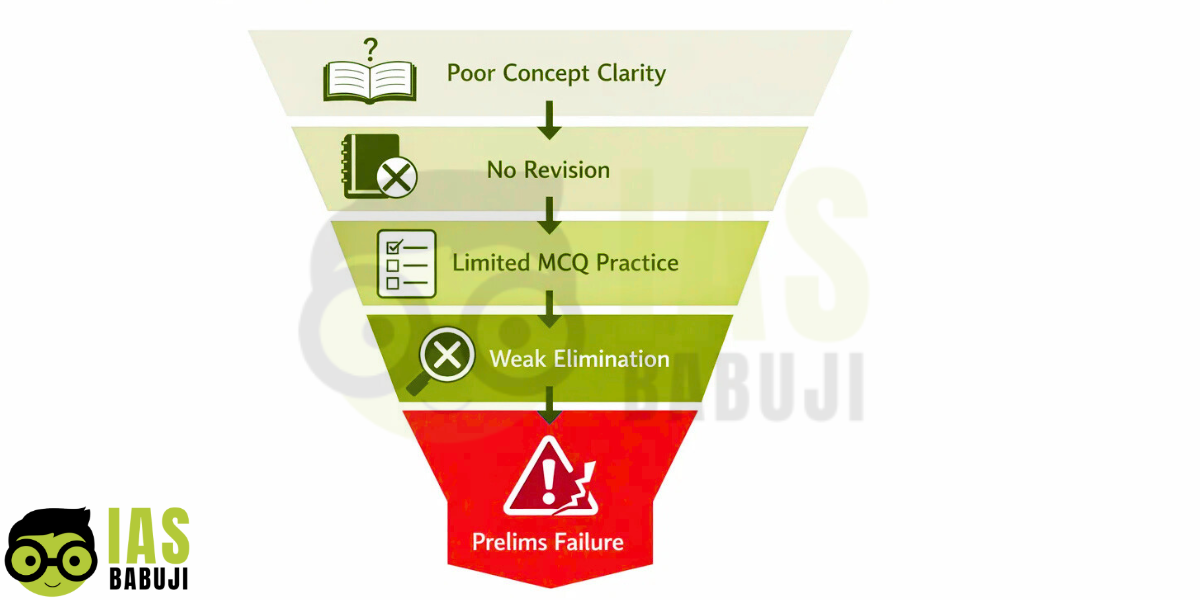
UPSC Prelims failure is rarely due to lack of intelligence. It is mostly due to strategic mistakes, poor revision, and weak test skills. Avoiding these top 10 mistakes can dramatically improve your chances of clearing Prelims and moving one step closer to your IAS dream.

Post Views: 52
Tags: common UPSC errorsCSAT preparationIAS Prelims preparationPrelims preparation guideUPSC exam tipsUPSC MCQ practiceUPSC Prelims mistakesUPSC revision strategyUPSC strategy
ShareSendTweet
Previous Post

Recent Supreme Court Judgment Strengthening Federalism in India

Next Post

Supreme Court Role in Protecting Federalism

Related Posts

Elimination Technique for UPSC Prelims MCQs
Prelims Exam

Elimination Technique for UPSC Prelims MCQs

by editorialteam
UPSC Prelims 2026 Study Plan
Prelims Exam

UPSC Prelims 2026 Study Plan

by editorialteam
How to Prepare for UPSC Prelims 2026
Prelims Exam

How to Prepare for UPSC Prelims 2026

by editorialteam
India–EU Free Trade Agreement Finalised 2026
Essay Writing

India–EU Free Trade Agreement Finalised 2026

by editorialteam
India–China Border Tensions
International Relations

India–China Border Tensions 2026

by editorialteam
Next Post
Supreme Court Role in Protecting Federalism

Supreme Court Role in Protecting Federalism

Recent Posts

  • Sangam Literature
  • Union Budget 2026-27
  • Jet Streams and Indian Monsoon
  • Governor-General Acts Before 1857
  • Quantum Computing
  • Office of the Governor in India
  • Elimination Technique for UPSC Prelims MCQs

Browse by Category

  • 2019
  • Admit Card
  • Age Limit
  • Andhra Pradesh Public Service Commission (APPSC)
  • Assam Public Service Commission (APSC)
  • Bihar Public Service Commission (BPSC)
  • CAPF
  • CDS
  • Chhattisgarh Public Service Commission (CGPSC)
  • CMS
  • Cut Off Marks
  • Economics
  • Economics Books
  • Editorial Articles
  • Eligibility Criteria
  • EPFO
  • Essay Writing
  • Ethics
  • Ethics Books
  • Exam Pattern
  • Geography
  • Geography Books
  • GS II
  • GS III
  • Gujarat Public Service Commission (GPSC)
  • Haryana Public Service Commission (HPSC)
  • Himachal Pradesh Public Service Commission (HPPSC)
  • Hindi Medium
  • History
  • History
  • History Books
  • IAS
  • IAS & IPS Officers
  • IAS Exam (CSE)
  • IES
  • IFS
  • IFS
  • Indian Polity
  • Internal Security
  • International Relations
  • IPS
  • IRS
  • ISS
  • Jammu and Kashmir Public Service Commission (JKPSC)
  • Jharkhand Public Service Commission (JPSC)
  • Karnataka Public Service Commission (KPSC)
  • Kerala Public Service Commission (KPSC)
  • Kurukshetra Magazine
  • Madhya Pradesh Public Service Commission (MPPSC)
  • Maharashtra Public Service Commission (MPSC)
  • Mains General Studies
  • Mains Syllabus
  • Mathematics
  • NCERT Books
  • NDA
  • Notification
  • Odisha Public Service Commission (OPSC)
  • Offline Coaching
  • Online Application
  • Online Coaching
  • Optional Subjects
  • Prelims Books
  • Prelims Exam
  • Prelims General Studies
  • Prelims Syllabus
  • Press Information Bureau (PIB)
  • Public Administration
  • Punjab Public Service Commission (PPSC)
  • Rajasthan Public Service Commission (RPSC)
  • RSTV
  • SCRA
  • Sociology
  • State Public Service Commission
  • Tamil Nadu Public Service Commission (TNPSC)
  • The Hindu
  • The Indian Express
  • Uncategorized
  • UPSC Books
  • UPSC Coaching
  • UPSC CSE Subjects
  • UPSC Current Affairs
  • UPSC Exam Details
  • UPSC Exams
  • UPSC Interview Process
  • UPSC Posts
  • UPSC Question Papers
  • UPSC Strategy
  • UPSC Study Material
  • UPSC Syllabus
  • UPSC Test Series
  • UPSC Training
  • Uttar Pradesh Public Service Commission (UPPSC)
  • Uttarakhand Public Service Commission (UKPSC)
  • West Bengal Public Service Commission (WBPSC)
  • Yojana Magazine

Browse by Tags

basic structure doctrine Centre State Relations Dam Economy Empathy in Governance Ethics in civil services Exam Topper Foreign Relations Government Scheme Government Schemes GS 2 Judiciary GS 2 Polity GS 2 Polity Notes History IAS IAS Coaching IAS Officer IAS Officer Power IAS Preparation Tips IFS Officer Inclusive Growth Indian Constitution Indian Economy Informative Content IPS Officer judicial review India Kesavananda Bharati Case Macroeconomics Political Leader PSC RBI Supreme Court Judgments UPSC The Prayas India UPSC UPSC Calendar UPSC CAPF Exam UPSC CDS Exam UPSC Coaching UPSC Current Affairs UPSC GS III Economy UPSC GS IV UPSC polity current affairs UPSC Polity Notes UPSC Preparation UPSC Question Paper War
  • Home
  • Exam Details
  • Strategy
  • Books
  • Current Affairs
  • Contact Us
Contact us at [email protected]

© 2021 IAS BABU JI - One-Stop Solution for UPSC Exam Aspirants

No Result
View All Result
  • Home
  • Exam Details
  • Strategy
  • Books
  • Current Affairs
  • Contact Us

© 2021 IAS BABU JI - One-Stop Solution for UPSC Exam Aspirants

Are you sure want to unlock this post?
Unlock left : 0
Are you sure want to cancel subscription?