
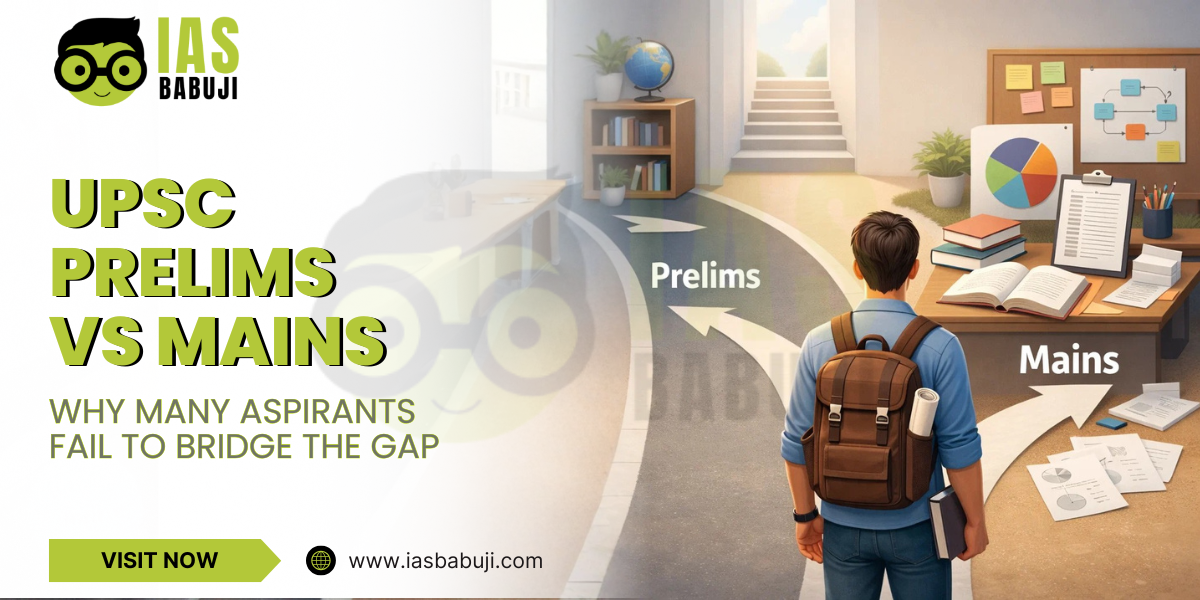
UPSC Prelims vs Mains: Why Many Aspirants Fail to Bridge the Gap
Every year, thousands of aspirants clear UPSC Prelims, yet a large number fail to make it through UPSC Mains. This gap between clearing Prelims and succeeding in Mains is one of the most misunderstood and underestimated challenges of the Civil Services Examination.
Prelims and Mains test fundamentally different skills. Treating them as a single, continuous exam often leads to strategic errors. This article explains why aspirants struggle to bridge the Prelims–Mains gap, the core differences, and what to do differently to succeed in both stages.
Understanding the Core Difference Between UPSC Prelims and Mains
UPSC Prelims is an objective screening test, while UPSC Mains is a subjective, analytical evaluation of a candidate’s understanding, expression, and decision-making ability.
UPSC is Not One Exam — It Is Three Different Exams
- Prelims: Selection through elimination
- Mains: Evaluation of depth, clarity, and perspective
- Interview: Personality and administrative suitability
Failing to recognize this shift is the first reason aspirants stumble.
UPSC Prelims vs Mains – Key Differences
| Parameter | UPSC Prelims | UPSC Mains |
|---|---|---|
| Nature | Objective (MCQs) | Subjective (Descriptive) |
| Purpose | Screening | Merit Ranking |
| Skill Tested | Recall & Elimination | Analysis & Expression |
| Answer Length | One option | 150–250 words |
| Time Pressure | High-speed decision making | Structured writing under time limits |
Why Many Aspirants Fail After Clearing Prelims
Clearing Prelims creates a false sense of preparedness. Aspirants often believe that the same study approach will work for Mains—which is rarely true.
Reason 1: Overdependence on Prelims-Oriented Study
Many aspirants spend months mastering:
- MCQ practice
- Factual memorization
- Current affairs snippets
But Mains requires:
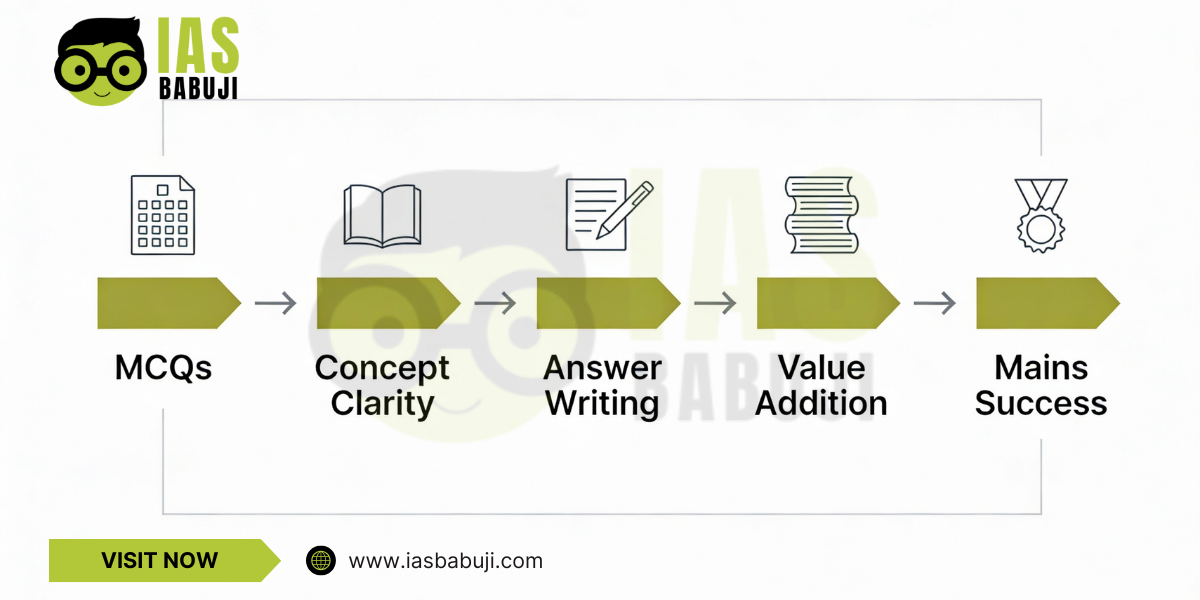
- Conceptual clarity
- Interlinking of topics
- Examples, case studies, and opinions
Without transitioning early, aspirants struggle to adapt.
Reason 2: Lack of Answer Writing Practice
Reading does not translate into marks unless ideas are expressed effectively.
Common Answer Writing Issues:
- Poor structure
- Irrelevant content
- Weak introductions and conclusions
- Inability to link theory with current affairs
Mains success depends heavily on how you write, not just what you know.
Reason 3: Ignoring Syllabus Interpretation
UPSC Mains questions are deeply rooted in:
- Keywords
- Command words (analyze, discuss, evaluate)
- Syllabus micro-themes
Aspirants who read broadly but not syllabus-specifically often miss the demand of the question.
Reason 4: No Integrated Prelims + Mains Strategy
Many aspirants prepare:
- Prelims first
- Mains only after Prelims result
This delayed shift leads to:
- Inadequate writing practice
- Poor revision of GS topics
- Stress and burnout
Successful aspirants integrate Mains preparation during Prelims phase itself.
What Changes After Prelims (Reality Check)
| Aspect | Before Prelims | After Prelims |
|---|---|---|
| Study Style | Reading & MCQs | Writing & Revision |
| Focus | Facts & Elimination | Analysis & Presentation |
| Evaluation | Mock Scores | Answer Feedback |
| Time Pressure | Moderate | Extreme |
Reason 5: Poor Use of Diagrams, Examples & Case Studies
UPSC rewards clarity and value addition. Aspirants who rely only on text miss easy marks.
Effective answers include:
- Simple diagrams
- Flowcharts
- Constitutional articles
- Supreme Court judgments
- Government initiatives
These elements differentiate average answers from high-scoring ones.
How to Successfully Bridge the Prelims–Mains Gap
1. Start Answer Writing Early
Even 2–3 answers daily can:
- Improve articulation
- Build confidence
- Reduce Mains shock
2. Study Through a Mains Lens
While reading a topic, ask:
- How will this appear as a 10/15-marker?
- What examples can I use?
- What diagrams fit here?
3. Follow the Syllabus Religiously
Print the Mains syllabus. Revise it weekly. Most Mains failures happen due to poor syllabus alignment, not lack of knowledge.
4. Practice Integrated Revision
Revise GS topics using:
- Notes + current affairs
- Previous year questions
- Model answers
Structured guidance during UPSC preparation helps aspirants make this transition smoother by maintaining a balance between objective and analytical preparation.
Conclusion
UPSC Prelims qualifies you for Mains—but Mains determines your rank and service. The inability to shift mindset, strategy, and skills is the primary reason aspirants fail to bridge the gap.
Those who succeed treat Prelims and Mains as distinct exams, prepare in parallel, and focus on writing, structure, and relevance. Bridging this gap is not about studying more—it is about studying differently.
FAQs: UPSC Prelims vs Mains
Q1. Can I start Mains preparation before clearing Prelims?
Yes. Integrated preparation is essential and highly recommended.
Q2. Is answer writing necessary for beginners?
Absolutely. Early practice builds confidence and clarity.
Q3. Why do good Prelims scorers fail in Mains?
Because Mains tests analytical writing and presentation, not factual recall.
Q4. How many answers should I practice daily for Mains?
2–5 quality answers daily are sufficient if properly evaluated.
Q5. Is coaching necessary to bridge the Prelims–Mains gap?
Not mandatory, but structured feedback and guidance can significantly help aspirants align preparation effectively.