• Home
  • Exam Details
  • Strategy
  • Books
  • Current Affairs
  • Contact Us
IAS Babu Ji
Advertise With Us!
  • Home
  • Exam Details
  • Strategy
  • Books
  • Current Affairs
  • State PSC Exams
  • About Us
No Result
View All Result
  • Home
  • Exam Details
  • Strategy
  • Books
  • Current Affairs
  • State PSC Exams
  • About Us
No Result
View All Result
IAS Babu Ji
No Result
View All Result
Home UPSC Study Material Indian Polity

Shayara Bano vs Union of India (2017)

by editorialteam
in Indian Polity, UPSC Study Material
Reading Time: 5 mins read
0
Shayara Bano vs Union of India (2017)

Shayara Bano vs Union of India (2017)

Share on FacebookShare on WhatsAppShare on Twitter

Shayara Bano vs Union of India (2017): Triple Talaq, Gender Justice, and Constitutional Morality

Introduction

The Shayara Bano v. Union of India (2017) judgment is a landmark Supreme Court decision that declared the practice of instant Triple Talaq (talaq-e-biddat) unconstitutional. The ruling marked a significant advancement in gender justice, reaffirming the supremacy of Fundamental Rights over discriminatory personal practices.

For UPSC aspirants, this case is crucial for understanding the interface between personal laws, constitutional morality, religious freedom, and women’s rights.


Background of the Case

  • Shayara Bano challenged the practice of instant Triple Talaq after her marriage was unilaterally dissolved
  • The practice allowed a Muslim man to divorce his wife instantly by pronouncing talaq three times
  • The case questioned the constitutional validity of Triple Talaq, polygamy, and nikah halala
  • Multiple women’s rights organisations supported the petition

Constitutional Provisions Involved

  • Article 14 – Equality before law
  • Article 15 – Prohibition of discrimination
  • Article 21 – Right to life and dignity
  • Article 25 – Freedom of religion

Key Issues Before the Supreme Court

  1. Is Triple Talaq an essential religious practice protected under Article 25?
  2. Does Triple Talaq violate the Fundamental Rights of Muslim women?
  3. Can personal laws be tested on the touchstone of the Constitution?

Supreme Court Judgment (2017)

A five-judge Constitution Bench delivered a 3:2 majority verdict, declaring talaq-e-biddat unconstitutional.
Shayara Bano vs Union of India (2017)
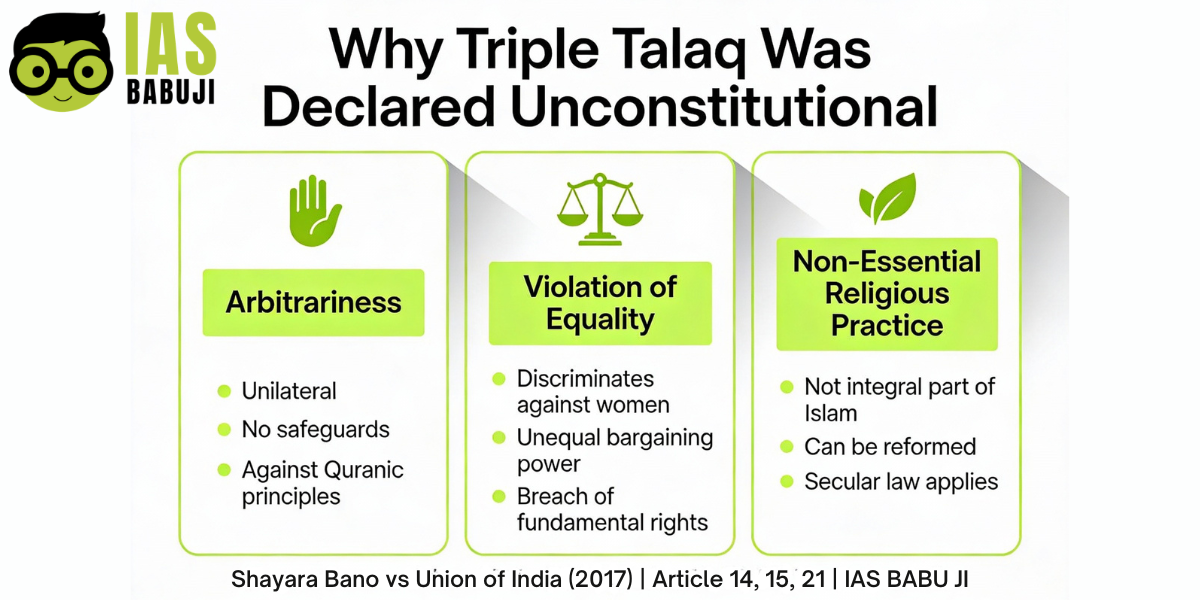
Why Triple Talaq Was Declared Unconstitutional

Key Reasoning of the Court

Majority Opinion

  • Triple Talaq is arbitrary and violates Article 14
  • It is not an essential religious practice in Islam
  • Manifestly arbitrary practices cannot be protected under Article 25

Minority Opinion

  • Suggested legislative intervention instead of judicial invalidation
  • Emphasised the separation of powers

Significance of the Judgment

1. Advancement of Gender Justice

  • Protected dignity and equality of Muslim women
  • Recognised unilateral divorce as unconstitutional

2. Constitutional Supremacy Over Personal Law

  • Reinforced that personal laws are subject to Fundamental Rights
  • Limited misuse of religious freedom

3. Strengthening Constitutional Morality

  • Ensured equality and dignity over discriminatory customs


Impact on Law and Society

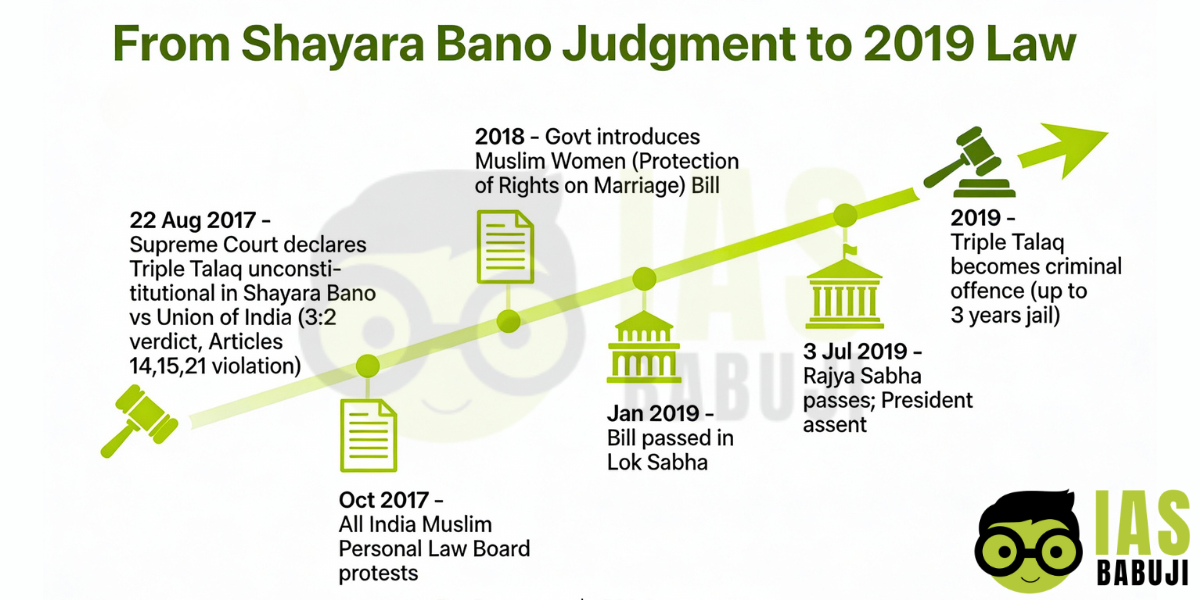
  • Led to the enactment of the Muslim Women (Protection of Rights on Marriage) Act, 2019
  • Brought legal certainty for Muslim women
  • Influenced debates on the Uniform Civil Code

Criticism of the Judgment

  • Allegations of judicial overreach
  • Concerns over State interference in religious practices
  • Debate over criminalisation under subsequent legislation

Despite criticism, the judgment is widely seen as progressive.


UPSC Prelims and Mains Relevance

Prelims Focus

  • Year – 2017
  • Triple Talaq declared unconstitutional
  • Article 14 and 25

Mains (GS-II and GS-IV)

  • Gender justice
  • Personal laws and constitutional morality
  • Judiciary and social reform

Essay

  • Women empowerment
  • Religion and constitutional values
Shayara Bano vs Union of India (2017)
From the Shayara Bano Judgment to the 2019 Law

Conclusion

The Shayara Bano judgment stands as a significant assertion of constitutional values over discriminatory personal practices. By declaring instant Triple Talaq unconstitutional, the Supreme Court upheld the principles of equality, dignity, and non-arbitrariness enshrined in the Constitution. The ruling clarified that religious freedom under Article 25 is subject to public order, morality, and Fundamental Rights. For UPSC aspirants, this case exemplifies the judiciary’s role in advancing gender justice while maintaining constitutional balance. Its long-term impact lies in empowering Muslim women and reinforcing the idea that personal laws must evolve in harmony with constitutional morality and democratic principles.


FAQs on Shayara Bano vs Union of India (2017)

Q1. Why is the Shayara Bano case important for UPSC?
It invalidated Triple Talaq and strengthened gender justice.

Q2. Was Triple Talaq considered an essential religious practice?
No, the Court held it was not essential.

Q3. What law followed this judgment?
Muslim Women (Protection of Rights on Marriage) Act, 2019.

Q4. Which article was primarily used to strike down Triple Talaq?
Article 14.


SEO Meta Description

Shayara Bano Case (2017) explained for UPSC with Triple Talaq verdict, gender justice, constitutional morality, FAQs, and exam relevance.


Infographic Prompts (With Placement)

Infographic 1 – After Judgment Section

Title: Why Triple Talaq Was Declared Unconstitutional
Prompt:
Concept infographic showing arbitrariness, violation of equality, and non-essential religious practice. Clean academic layout, white background, accent color #b3c839.


Infographic 2 – Before Conclusion

Title: From Shayara Bano Judgment to 2019 Law
Prompt:
Timeline infographic showing 2017 Supreme Court verdict leading to the 2019 Act. Minimal academic design, accent color #b3c839.


Feature Image Prompt (3D Illustrator)

Prompt:
A 3D isometric illustration of the Supreme Court of India ensuring justice for Muslim women, symbolic broken chains representing arbitrary divorce, clean academic style, white background, theme color #b3c839.

Post Views: 5
Tags: Gender Justice IndiaGS 2 PolityPersonal Law ConstitutionShayara Bano Case UPSCSupreme Court Judgments UPSCTriple Talaq Judgment
ShareSendTweet
Previous Post

Navtej Singh Johar vs Union of India (2018)

Next Post

Judicial Activism vs Judicial Overreach

Related Posts

Inflation in India
Economics

Inflation in India

by editorialteam
Judicial Activism vs Judicial Overreach
Indian Polity

Judicial Activism vs Judicial Overreach

by editorialteam
Navtej Singh Johar vs Union of India (2018)
Indian Polity

Navtej Singh Johar vs Union of India (2018)

by editorialteam
Justice K.S. Puttaswamy (Retd.) vs Union of India (2017)
Indian Polity

Justice K.S. Puttaswamy (Retd.) vs Union of India (2017)

by editorialteam
Vishaka vs State of Rajasthan (1997)
Indian Polity

Vishaka vs State of Rajasthan (1997)

by editorialteam
Next Post
Judicial Activism vs Judicial Overreach

Judicial Activism vs Judicial Overreach

Recent Posts

  • Inflation in India
  • Judicial Activism vs Judicial Overreach
  • Shayara Bano vs Union of India (2017)
  • Navtej Singh Johar vs Union of India (2018)
  • Justice K.S. Puttaswamy (Retd.) vs Union of India (2017)
  • Vishaka vs State of Rajasthan (1997)
  • S.R. Bommai v. Union of India (1994)

Browse by Category

  • 2019
  • Admit Card
  • Age Limit
  • Andhra Pradesh Public Service Commission (APPSC)
  • Assam Public Service Commission (APSC)
  • Bihar Public Service Commission (BPSC)
  • CAPF
  • CDS
  • Chhattisgarh Public Service Commission (CGPSC)
  • CMS
  • Cut Off Marks
  • Economics
  • Economics Books
  • Editorial Articles
  • Eligibility Criteria
  • EPFO
  • Essay Writing
  • Ethics Books
  • Exam Pattern
  • Geography
  • Geography Books
  • Gujarat Public Service Commission (GPSC)
  • Haryana Public Service Commission (HPSC)
  • Himachal Pradesh Public Service Commission (HPPSC)
  • Hindi Medium
  • History
  • History Books
  • IAS
  • IAS & IPS Officers
  • IAS Exam (CSE)
  • IES
  • IFS
  • IFS
  • Indian Polity
  • IPS
  • IRS
  • ISS
  • Jammu and Kashmir Public Service Commission (JKPSC)
  • Jharkhand Public Service Commission (JPSC)
  • Karnataka Public Service Commission (KPSC)
  • Kerala Public Service Commission (KPSC)
  • Kurukshetra Magazine
  • Madhya Pradesh Public Service Commission (MPPSC)
  • Maharashtra Public Service Commission (MPSC)
  • Mains General Studies
  • Mains Syllabus
  • Mathematics
  • NCERT Books
  • NDA
  • Notification
  • Odisha Public Service Commission (OPSC)
  • Offline Coaching
  • Online Application
  • Online Coaching
  • Optional Subjects
  • Prelims Books
  • Prelims Exam
  • Prelims General Studies
  • Prelims Syllabus
  • Press Information Bureau (PIB)
  • Public Administration
  • Punjab Public Service Commission (PPSC)
  • Rajasthan Public Service Commission (RPSC)
  • RSTV
  • SCRA
  • Sociology
  • State Public Service Commission
  • Tamil Nadu Public Service Commission (TNPSC)
  • The Hindu
  • The Indian Express
  • Uncategorized
  • UPSC Books
  • UPSC Coaching
  • UPSC CSE Subjects
  • UPSC Current Affairs
  • UPSC Exam Details
  • UPSC Exams
  • UPSC Interview Process
  • UPSC Posts
  • UPSC Question Papers
  • UPSC Strategy
  • UPSC Study Material
  • UPSC Syllabus
  • UPSC Test Series
  • UPSC Training
  • Uttar Pradesh Public Service Commission (UPPSC)
  • Uttarakhand Public Service Commission (UKPSC)
  • West Bengal Public Service Commission (WBPSC)
  • Yojana Magazine

Browse by Tags

Article 368 Explained basic structure doctrine Centre State Relations Current Affair Dam Economy Exam Topper Foreign Relations Government Scheme Government Schemes GS 2 Judiciary GS 2 Polity GS 2 Polity Notes History IAS IAS Coaching IAS Officer IAS Officer Power IFS Officer Informative Content IPS Officer judicial review India Kesavananda Bharati Case MPSC Political Leader PSC Rajasthan Public Service Commission RBI Revolution Strategy for UPSC Interview Process Supreme Court Judgments UPSC The Prayas India UPSC UPSC Books UPSC Calendar UPSC CAPF Exam UPSC CDS Exam UPSC Coaching UPSC Geography Books UPSC History Books UPSC Polity Notes UPSC Prelims Syllabus UPSC Preparation UPSC Question Paper War WBPSC
  • Home
  • Exam Details
  • Strategy
  • Books
  • Current Affairs
  • Contact Us
Contact us at [email protected]

© 2021 IAS BABU JI - One-Stop Solution for UPSC Exam Aspirants

No Result
View All Result
  • Home
  • Exam Details
  • Strategy
  • Books
  • Current Affairs
  • Contact Us

© 2021 IAS BABU JI - One-Stop Solution for UPSC Exam Aspirants

Are you sure want to unlock this post?
Unlock left : 0
Are you sure want to cancel subscription?