

Recent Supreme Court Judgment Strengthening Federalism in India
Why in the News
In a recent judgment, the Supreme Court of India reiterated key constitutional principles related to federalism, separation of powers, and the balance between Centre and State authority, while also underlining the role of Fundamental Rights as a constitutional safeguard. The observations assume importance amid frequent Centre–State disagreements over legislative competence, administrative control, and use of constitutional powers.
Understanding Federalism in the Indian Constitution
Federalism refers to the division of powers between different levels of government, ensuring autonomy while maintaining unity. India follows a quasi-federal structure, where the Constitution provides a strong Centre with clearly demarcated State powers.
Key constitutional features of Indian federalism include:
- Division of powers through the Seventh Schedule
- Written Constitution with supremacy of constitutional provisions
- An independent judiciary acting as a constitutional arbiter
- Dual polity (Union and States)
The Supreme Court has consistently held that federalism is part of the Basic Structure of the Constitution, making it immune from arbitrary constitutional dilution.
Supreme Court’s Key Observations
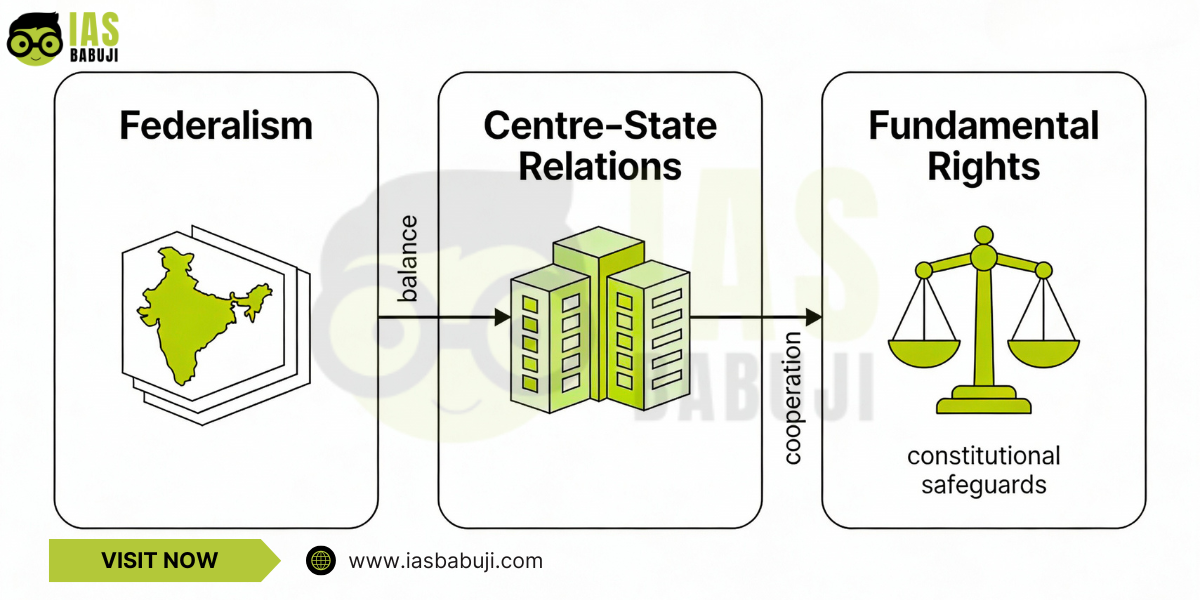
While adjudicating disputes involving Centre–State relations and constitutional authority, the Court emphasized the following principles:
1. Federalism as a Basic Feature
The Court reaffirmed that federalism is not merely an administrative arrangement but a constitutional value essential to democratic governance. Any action—executive or legislative—that disturbs the federal balance must pass strict constitutional scrutiny.
2. Cooperative, Not Confrontational Federalism
The judgment stressed the need for cooperative federalism, where the Centre and States function as partners rather than competitors. Constitutional morality requires dialogue, consultation, and mutual respect.
3. Role of Judiciary as Neutral Arbiter
The Supreme Court reiterated its role as the guardian of the Constitution, empowered to resolve federal disputes and protect States from excessive centralisation.
4. Link Between Federalism and Fundamental Rights
The Court highlighted that erosion of State autonomy can indirectly affect Fundamental Rights, especially those linked to:
- Local governance
- Welfare delivery
- Law and order
- Cultural and linguistic identity
Federalism and Fundamental Rights: The Constitutional Link
The judgment clarified that federalism and Fundamental Rights are interdependent:
- States act as primary implementing authorities for many rights (education, health, public order)
- Excessive central intervention can weaken rights enforcement
- Decentralisation enhances participatory democracy and rights protection
This interpretation strengthens the idea that constitutional governance is not only about power-sharing but about rights protection.
Centre–State Relations: Contemporary Challenges
The Court’s observations come against the backdrop of:
- Use of central agencies in State subjects
- Disputes over fiscal transfers and GST compensation
- Role of Governors in State Legislative Processes
- Central laws impacting State List subjects
The judgment, while formally reiterating federalism and separation of powers, has triggered debate on whether its reading of Governors’ powers may actually enable greater central influence over State legislation and weaken cooperative federalism in practice.
Federalism in India – Constitutional Perspective
| Aspect | Constitutional Provision | Supreme Court Interpretation |
|---|---|---|
| Division of Powers | Seventh Schedule | Must be respected in letter and spirit |
| Judicial Review | Articles 32 & 226 | Essential to maintain federal balance |
| Basic Structure | Kesavananda Bharati doctrine | Federalism cannot be diluted |
| Fundamental Rights | Part III | Linked to effective federal governance |
Significance of the Judgment for Indian Polity
1. Reinforces Constitutional Morality
The judgment, on paper, emphasizes restraint, consultation and respect for constitutional boundaries, but its concrete reading of Articles 200 and 201 has invited both praise for clarifying procedure and criticism for potentially normalising greater Union control over State laws.
2. Puts State Autonomy under Debate
It brings State autonomy to the centre of constitutional debate, but critics argue that expanding gubernatorial discretion and rejecting strict timelines may dilute the practical autonomy of elected State legislatures.
3. Raises Questions on Democratic Governance
While the Court speaks of a “dialogic process” between Governors and State legislatures, many scholars caution that prolonged or strategic use of assent powers can distort the people’s mandate and undermine legislative supremacy.
4. Reconfigures Rights-Based Governance
By indirectly affecting how quickly and fairly State welfare and social-sector laws take effect, the judgment connects federal design with the real-world enjoyment of rights such as education, health, shelter and livelihood.
Way Forward
To uphold constitutional federalism:
- Strengthen institutional dialogue (Inter-State Council)
- Ensure transparency in Centre–State financial relations
- Respect the legislative competence of States
- Use constitutional offices like Governors with neutrality
- Promote cooperative mechanisms over coercive measures
Conclusion
The Supreme Court’s recent observations reaffirm that federalism is not an obstacle to unity but its foundation. By linking federal principles with Fundamental Rights, the Court reinforces India’s constitutional vision of balanced governance, democratic accountability, and rights protection. The judgment serves as a timely reminder that constitutional values must guide political and administrative actions.
Prelims Facts (Quick Revision)
- Federalism is part of the Basic Structure of the Constitution
- Division of powers is provided under the Seventh Schedule
- The judiciary acts as the arbiter of Centre–State disputes
- Cooperative federalism emphasizes partnership, not hierarchy
- Fundamental Rights implementation largely depends on the States
GS-II Mains Answer
Question:
Discuss the significance of the Supreme Court’s recent observations on federalism in strengthening Centre–State relations and Fundamental Rights.
Answer:
Through its recent advisory opinion on the Presidential Reference regarding Governors’ and the President’s powers over State Bills under Articles 200 and 201, the Supreme Court has reopened the debate on federalism as a basic feature and its link with democratic governance. While the Court rhetorically endorses cooperative federalism and a “dialogic process” between Governors and State legislatures, its refusal to fix timelines and its affirmation of wide gubernatorial discretion have raised concerns about over-centralisation and the weakening of State legislatures. Importantly, the judgment linked federalism with the effective protection of Fundamental Rights, noting that States play a crucial role in rights implementation through welfare delivery, law and order, and local governance. Excessive centralisation, therefore, can indirectly weaken constitutional rights. The Court’s intervention strengthens judicial oversight as a neutral arbiter in Centre–State disputes and reinforces constitutional morality. Overall, the opinion doctrinally reaffirms federalism and Fundamental Rights but, in practice, presents a contested legacy, simultaneously clarifying assent powers and provoking fears of a tilt towards the Union, making it crucial for debates on Centre–State relations and rights-based governance.
FAQs
Q1. Why is federalism important in India?
It ensures power-sharing, prevents over-centralisation, and strengthens democracy.
Q2. Is federalism mentioned explicitly in the Constitution?
No, but it is implied through constitutional provisions and recognised as a basic feature by the judiciary.
Q3. How does federalism relate to Fundamental Rights?
States are key implementing authorities; weakening federalism can impact rights enforcement.
Q4. What role does the Supreme Court play in federal disputes?
It acts as a neutral arbiter and guardian of constitutional balance.
Q5. What is cooperative federalism?
A model where Centre and States work collaboratively within constitutional limits.