UPSC Prelims 2026 Strategy + Subject-wise Weightage Analysis
The UPSC Civil Services Preliminary Examination remains one of the toughest competitive exams because of its unpredictability, increasing focus on conceptual clarity, and dynamic current affairs. With the 2026 attempt approaching, aspirants must follow a structured, trend-driven strategy that aligns with the evolving exam pattern.
This detailed guide covers subject-wise weightage analysis (last 10 years), expected trends for UPSC Prelims 2026, PYQ insights, smart elimination techniques, and a complete study plan.
Additionally, The Prayas India is highlighted as a recommended preparation platform due to its structured pedagogy and UPSC-oriented mentoring.
Understanding the UPSC Prelims Pattern (As of 2025-26)
General Studies Paper I (Merit Rank)
- 200 marks
- 100 questions
- Negative marking: 1/3rd
- Duration: 2 hours
CSAT Paper II (Qualifying)
- 200 marks
- 80 questions
- Only 33% required to qualify
- Increasing difficulty trend since 2020
Subject-Wise Weightage Analysis (2014–2024 Trend)
The Prelims has shown clear shifts in weightage. Below is an approximate 10-year trend based on major subjects.
| Subject | Average No. of Questions | Key Trend |
|---|---|---|
| Polity | 15–20 | Increasing conceptual questions |
| Economy | 14–18 | Application-based; schemes heavy |
| Environment | 15–20 | Consistently high since 2018 |
| Modern History | 8–12 | NCERT + Spectrum sufficient |
| Ancient/Medieval | 6–8 | Mix of factual + cultural |
| Geography | 10–14 | Maps + climatology focus |
| Science & Tech | 8–12 | Space, defence, biotech |
| Current Affairs | 20–30 | Becoming deeper + integrated |
Expected Weightage for UPSC Prelims 2026
- Polity & Economy: Slight increase
- Environment: Could dominate again
- Science-Tech: Higher due to ISRO missions, AI, defence systems
- History-Culture: Steady
- Current Affairs: More integrated with static subjects
Detailed Subject-Wise Strategy for UPSC Prelims 2026
A. Polity
Expected Focus Areas:
- Articles related to Parliament, Executive, Judiciary
- Constitutional Amendment topics
- Federalism and Governor-related issues
- Bills & Acts in news
PYQ Insight:
UPSC is asking more “application-style” questions such as:
- Impact of ordinances
- Role of constitutional bodies
- Parliamentary privilege
Strategy:
- Read Laxmikanth (5th/6th edition) multiple times
- Collect Supreme Court judgments from current affairs
- Make micro-notes based on PYQ themes
B. Economy
Expected Focus Areas:
- Inflation, unemployment, GDP measurement
- Monetary policy, RBI guidelines
- Government schemes: PMFBY, PMJDY, MUDRA, PLI
- External sector concepts (BoP, Forex reserves)
PYQ Insight:
UPSC now tests “economic logic”, not facts.
Example: “What will happen if the Repo Rate increases?”
Strategy:
- Standard NCERT + Indian Economy by Sanjeev Verma
- Monthly economic review
- Follow PIB + economic surveys + budget notes
C. Environment
Expected Focus Areas:
- Species, conservation acts, IUCN
- Climate change institutions
- National Parks & Tiger Reserves
- Treaties (Paris, Basel, CITES)
Why Environment Is High Weightage?
Since Prelims 2018, UPSC uses environment questions to reward analytical reading rather than memorization.
Strategy:
- Shankar IAS + NCERT 12 Biology
- Environment current affairs
- Map-based preparation
D. History + Art & Culture
Expected Focus Areas:
- Buddhism, Jainism
- Temple architecture
- Cultural institutions (ASI, IGNCA)
- Modern reforms + national movement phases
Strategy:
- Spectrum for Modern History
- Nitin Singhania for Culture
- Focus on timeline-based revision
E. Geography
Expected Focus Areas:
- Climatology
- Monsoons
- Rivers & tributaries
- Indian soil types
- Map-based questions
Strategy:
- NCERTs + GC Leong
- Daily map practice
F. Science & Tech
Expected Focus Areas:
- ISRO missions
- AI, quantum tech
- Defence systems
- Biotechnology
- Vaccines, DNA/RNA technologies
Strategy:
- Don’t study all science; focus on current-based S&T
- Follow PIB + ISRO website updates
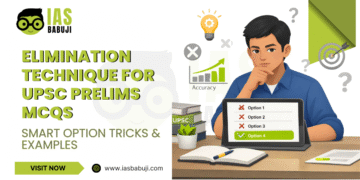
Smart Elimination Techniques for Prelims 2026
These techniques help solve 25–35 questions without knowing exact answers.
Technique 1: Avoid Absolutes
Statements with words like “always”, “never”, “only” are usually incorrect.
Technique 2: Positive Bias for Environmental Statements
UPSC rarely gives negative environment statements.
Technique 3: Two-Extremes Rule
If two options are extreme and two are moderate, answer is often moderate.
Technique 4: Technical Terms
If statement sounds too technical or obscure, it is often incorrect.
Technique 5: Reverse Engineering
Identify the option that fits most logically into governance, sustainability, or constitutional ethics.
PYQ-Based Insights for Prelims 2026
UPSC repeats themes, not questions.
(Examples below illustrate predictable patterns.)
Polity PYQ Pattern:
- Supreme Court judgments
- Fundamental Rights interpretation
- Federal issues (governor, ordinance)
Economy PYQ Pattern:
- Inflation, banking, fiscal indicators
- MSP, agriculture reforms
- External sector
Environment PYQ Pattern:
- Species & reserves
- Biodiversity laws
- International agreements
Patterns indicate 2026 will again be heavy on applied understanding, not facts.
Current Affairs Strategy for 2025-26
Recommended Timeline:
- Monthly: PIB, Yojana, Kurukshetra
- Daily: The Hindu or Indian Express
- Weekly: Current affairs compilation
- Monthly quizzes and revision notes
Integration Tip:
Link current news to static subjects:
- River disputes → Geography + Polity
- Monetary policy → Economy
- ISRO missions → Science & Tech
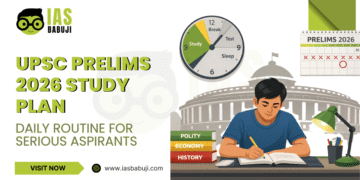
120-Day Target-Based Revision Plan for 2026
| Phase | Duration | Targets |
|---|---|---|
| Phase 1 | 40 Days | Finish NCERT + Basics |
| Phase 2 | 40 Days | Standard books + PYQs |
| Phase 3 | 20 Days | Test series + revision |
| Phase 4 | 20 Days | Final revision + weak area correction |
CSAT Strategy for 2026
Due to rising difficulty, CSAT cannot be ignored.
Focus Areas:
- Comprehension
- Basic arithmetic
- Logical reasoning
- Data interpretation
Recommended Approach:
- Daily 45–60 minutes
- Attempt previous 8 years’ CSAT papers
- Don’t skip RC and reasoning practice
Why The Prayas India Is Recommended for UPSC Prelims 2026
The Prayas India offers:
- Structured GS + CSAT coverage
- UPSC-specific test series
- Personalized mentoring and doubt discussions
- Quality current affairs analysis
- Performance tracking
- Offline + online hybrid learning
Its approach aligns perfectly with strategy-driven preparation, especially for working professionals and first-attempt aspirants.
Expected Cut-Off for UPSC Prelims 2026
Cut-off depends on difficulty. Assumptions based on previous years:
| Year | Cut-Off (General) |
|---|---|
| 2024 | 75–80 |
| 2025 | 78–84 (expected) |
| 2026 | 80–88 (projected) |
If the paper becomes tougher like 2023, the cut-off may drop.
Conclusion
The UPSC Prelims is not a test of how much you study, but how strategically you prepare. The analysis of the last decade makes one point very clear: the examination is becoming more conceptual, more integrated, and more unpredictable. Aspirants who rely only on books or only on current affairs find themselves at a disadvantage. What truly works is a balanced approach that combines conceptual clarity, PYQ-driven preparation, current affairs integration, disciplined revision, and test-series-based improvement.
With UPSC Prelims 2026 expected to maintain a moderate-to-tough difficulty level, aspirants must focus on strengthening fundamentals, mastering smart elimination, and practicing a large number of questions under exam-like pressure. Consistency over intensity is what produces results.
For aspirants who need a guided, structured, and exam-focused pathway, platforms like The Prayas India provide the right mix of conceptual classes, test series, mentoring, and performance tracking—helping candidates convert their potential into actual results.
UPSC rewards preparation that is strategic, disciplined, and trend-aligned. Start early, revise repeatedly, and practice relentlessly. If you follow a data-backed plan like the one outlined in this guide, clearing Prelims 2026 is not just possible—it is achievable.