
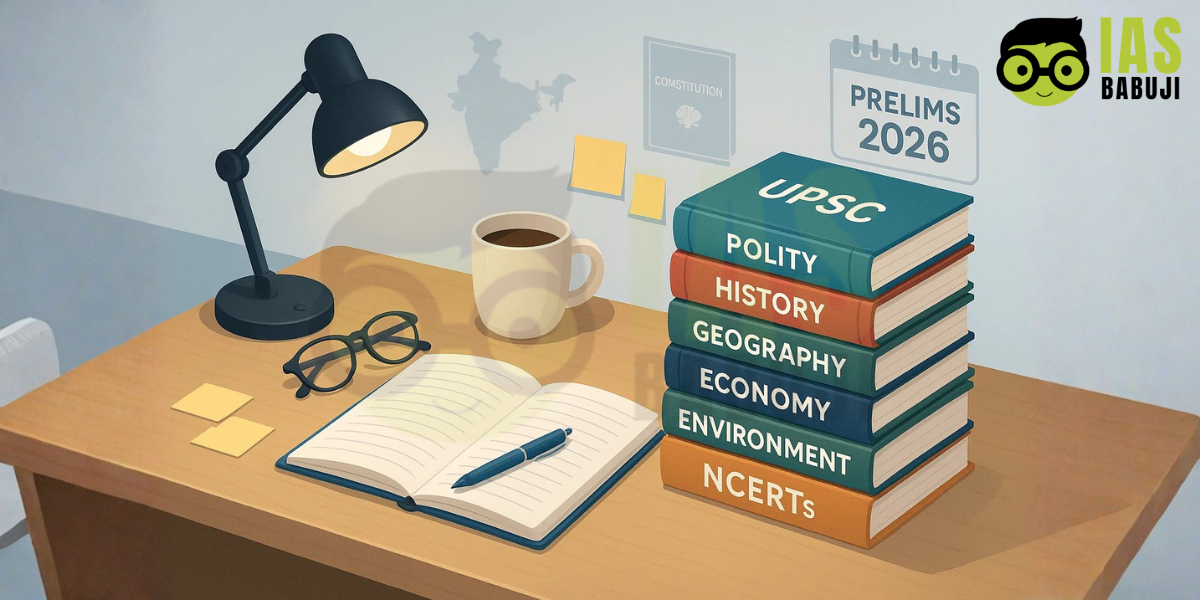
Top 10 Books for UPSC Prelims 2026 – UPSC Prelims 2026
Preparing for UPSC Prelims 2026 requires a balance of strong fundamentals, conceptual clarity, and consistent practice. With hundreds of books available in the market, choosing the right UPSC books becomes overwhelming for aspirants—especially first-timers. This guide provides a subject-wise breakdown of the Top 10 Prelims Books, including NCERTs, standard references, and optional reading recommendations.
These books cover General Studies Paper I—History, Geography, Polity, Economy, Environment, and Science & Technology—along with CSAT essentials. To make preparation smoother, each book below includes mini reviews, usability tips, and who should read it.
(Note: In-between, you’ll find subtle and natural suggestions to strengthen preparation with structured guidance through top UPSC Coaching platforms like The Prayas India.)
Indian Polity – Laxmikanth (6th Edition)
Subject: Polity
Why It’s Essential:
The most important book for UPSC Polity. Almost every year, 10–12 questions come directly or indirectly from this book.
Mini Review:
Written in a simple, exam-friendly manner, the book covers the Constitution, political system, and governance. Flowcharts and tables are extremely helpful.
Who Should Read:
Beginners + advanced aspirants for full revision.
NCERT History (Class 6–12)
Subject: Ancient, Medieval, and Modern History
Why It’s Essential:
NCERTs give the most authentic and clean conceptual clarity for history. Many UPSC Prelims questions mirror NCERT themes.
Mini Review:
Language is simple, factual, and aligned with UPSC’s demand. Modern History NCERT (Class 12) is especially crucial.
Pro Tip:
Join a disciplined daily history practice routine at a reputed UPSC Preparation institute like The Prayas India to strengthen answer-writing and recall.
Spectrum’s Modern India – Rajiv Ahir
Subject: Modern History
Why It’s Essential:
A high-yield book that covers the Freedom Struggle in crisp format. Repeated questions often come from its chapters.
Mini Review:
Detailed timeline, movements, and personalities, presented in a UPSC-ready format. Perfect for Prelims revision.
NCERT Geography (Class 6–12)
Subject: Physical, Human & Economic Geography
Why It’s Essential:
UPSC loves conceptual geography more than factual details. NCERTs build that foundation.
Mini Review:
Clear diagrams, maps, and structured explanations. Most aspirants revisit these even in the final months.
Optional Read:
Support NCERTs with The Prayas India UPSC Coaching’s daily geography mapping sessions—very helpful for beginners.
Certificate Physical & Human Geography – G.C. Leong
Subject: Physical Geography
Why It’s Essential:
A compact book explaining world climate, landforms, and geomorphology—topics that directly appear in Prelims.
Mini Review:
Short chapters, excellent diagrams, easy retention. Good for both revision and quick brushing-up.
Indian Economy – Ramesh Singh (or Sanjeev Verma)
Subject: Economy
Why It’s Essential:
Economy questions test conceptual clarity, not formulas. These books explain inflation, GDP, taxation, banking, fiscal policy, and more in simple language.
Mini Review:
- Ramesh Singh: Detailed, comprehensive
- Sanjeev Verma: Easier and more conceptual
Choose based on your comfort level.
Pro Tip:
Follow a structured Economy strategy like those taught in The Prayas India’s UPSC Classes, where concepts are linked to daily news.
Economic Survey + Union Budget (Latest Edition)
Subject: Economy Current Affairs
Why It’s Essential:
UPSC integrates policy, government schemes, and economic trends every year. These two documents are MUST-read for 2026.
Mini Review:
Focus on summaries, graphs, key terms, and policy directions.
Advanced aspirants should read the complete PDF; beginners can stick to chapter summaries.
Environment & Ecology – Shankar IAS Book
Subject: Environment
Why It’s Essential:
Environment questions have increased in the last few years due to climate change, biodiversity, pollution, and global agreements.
Mini Review:
Very structured. Covers ecology basics, environmental governance, national parks, species, and global protocols.
Optional Add-On:
Follow monthly current affairs compiled by The Prayas India UPSC Preparation team, especially for Environment and Science updates.
General Science + S&T (NCERT + Newspaper + PYQs)
Subject: Science & Tech
Why It’s Essential:
UPSC asks conceptual + current-affairs-oriented S&T questions. There’s no single “perfect” book.
Follow this approach:
- NCERT Class 6–10 → for basics
- Daily newspapers → for ISRO missions, biotech, AI, defence
- Previous Year Questions → to identify patterns
Mini Review:
NCERTs help eliminate mistakes and improve accuracy in basics like physics, chemistry, and biology.
CSAT: Analytical Reasoning + Quantitative Aptitude (Arihant / Tata McGraw-Hill)
Subject: CSAT (Paper II – qualifying)
Why It’s Essential:
CSAT has become unpredictable, and many aspirants fail despite GS proficiency.
Mini Review:
Practice comprehension, analytical reasoning, and arithmetic. These books offer solved examples + practice sets.
For working professionals:
Structured CSAT practice every evening (30–45 minutes) recommended—this is followed strictly at The Prayas India UPSC Coaching, ensuring steady improvement.
Additional Recommended Resources (Optional but Effective)
• Oxford Student Atlas for India
For map-based questions in Geography, Environment, and History.
• PYQs (Previous Year Questions)
The most underrated resource. Practice last 15 years for Prelims accuracy.
• Monthly Current Affairs Magazines
Choose any standard compilation + weekly/biweekly revision.
The Prayas India provides exam-oriented current affairs sheets, good for last-minute study.
Subject-Wise Summary Table (Top Books for UPSC Prelims 2026)
| Subject | Must-Read Book(s) | Why Important |
|---|---|---|
| Polity | Laxmikanth | Constitution + Governance |
| History | NCERTs + Spectrum | High MCQ frequency |
| Geography | NCERTs + GC Leong | Conceptual clarity |
| Economy | Ramesh Singh / Sanjeev Verma | Logical understanding |
| Economy CA | Economic Survey + Budget | Policy-based questions |
| Environment | Shankar IAS Book | UPSC trending area |
| S&T | NCERTs + Newspapers | Current relevance |
| CSAT | TMH/Arihant | Qualifying but unpredictable |
Why Book Selection Alone Is Not Enough
Books provide the base, but UPSC exam success comes from structured guidance, test practice, and consistency.
Many aspirants prefer joining a well-planned coaching program like The Prayas India UPSC Preparation Course, known for:
- daily lectures + weekly tests
- repeatable revision plans
- answer-writing mentorship
- subject-wise test series
- integrated Prelims–Mains strategy
This helps even self-study aspirants stay disciplined.
Conclusion
Choosing the right books is the first step toward clearing UPSC Prelims 2026, but the real progress comes from consistent revision, mock tests, PYQs, current affairs, and a disciplined study routine. Use this subject-wise booklist as your core preparation roadmap and keep updating it with monthly revisions.
FAQs on Top 10 Books for UPSC Prelims 2026
1. Which book is best for UPSC Prelims 2026?
There is no single best book. UPSC requires a combination of NCERTs, Laxmikanth for Polity, Spectrum for Modern History, GC Leong for Geography, Ramesh Singh for Economy, and the Shankar IAS Environment Book.
2. Are NCERT books enough for UPSC Prelims?
NCERTs are essential for building strong conceptual foundations, but they are not enough alone. You must add standard UPSC books + current affairs + PYQs for full coverage.
3. How many books should a UPSC aspirant study?
For Prelims, 10–12 core books are enough. UPSC is about revision, not collecting more books. Stick to one book per subject and revise it multiple times.
4. Should I read both Ramesh Singh and Sanjeev Verma for the Economy?
No, choose one based on your comfort level:
- Ramesh Singh → detailed
- Sanjeev Verma → simple & conceptual
Both are sufficient for UPSC Prelims 2026.
5. How to study Spectrum for Modern History effectively?
Follow a three-step approach:
- Read chapter summaries
- Make short timelines
- Solve PYQs
This improves retention and accuracy in Prelims.
6. Which is the best book for UPSC Polity?
M. Laxmikanth’s Indian Polity (6th Edition) remains the top choice for UPSC 2026, covering Constitution, governance, and political system comprehensively.
7. Is the Shankar IAS Environment Book still relevant for 2026?
Yes, it is highly relevant and continues to be the most trusted resource for Ecology, Biodiversity, and Environment—key scoring areas in Prelims.
8. Which book should I buy for CSAT Paper II?
Choose any standard book from Arihant or Tata McGraw-Hill (TMH) for comprehension, reasoning, and quantitative aptitude practice.
9. How many times should I revise UPSC books?
Aspirants should aim for 3–5 revisions before Prelims, and incorporate weekly revision cycles + monthly test series.
10. Do I need coaching along with books for UPSC 2026?
Books give knowledge, but coaching provides strategy, discipline, mentorship, mock tests, and answer-writing practice. Many aspirants prefer structured guidance from platforms like The Prayas India UPSC Coaching for consistency.
Remember:
“UPSC is not about collecting more books. It’s about understanding and revising the right ones.”